Thank you for visiting SNEWPapers!
Sign up free
Kentucky Gazette
Lexington, Fayette County, Kentucky
What is this article about?
In 1775, Massachusetts patriots met in Bellingham church amid rising tensions. A sheriff delivered a royal election precept, ignored as revolution ignited. Decades later, repairs uncovered the sealed letter, a relic of pre-Revolution loyalty, now reflecting on liberty's triumph and forgotten heroes.
Clipping
OCR Quality
Full Text
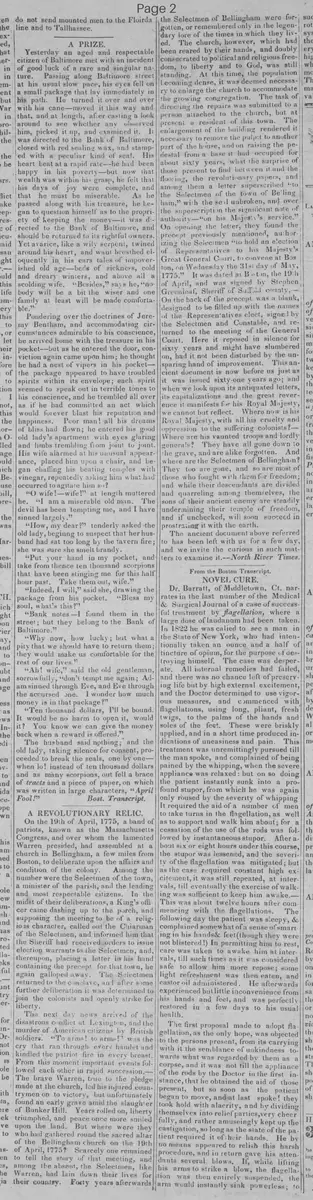
On the 19th of April, 1775, a band of patriots, known as the Massachusetts Congress, and over whom the lamented Warren presided, had assembled at a church in Bellingham, a few miles from Boston, to deliberate upon the affairs and condition of the colony. Among the number were the Selectmen of the town, a minister of the parish, and the leading and most respectable citizens. In the midst of their deliberations, a King's officer came dashing up to the porch, and supposing the meeting to be of a religious character, called out the Chairman of the Selectmen, and informed him that the Sheriff had received orders to issue election warrants to the Selectmen, and thereupon, placing a letter in his hand containing the precept for that town, he again galloped away. The Selectmen returned to the conclave, and after some further deliberation it was determined to join the colonists and openly strike for liberty.
The next day news arrived of the disastrous conflict at Lexington, and the murder of American citizens by British soldiers. "To arms! to arms!" was the cry that ran through every hamlet and kindled the patriot fire in every breast. From this moment important events followed each other in rapid succession.—The brave Warren, true to the pledge made at the church, led his injured countrymen on to victory, but unfortunately found an early grave amid the slaughter of Bunker Hill. Years rolled on, liberty triumphed, and peace once more smiled upon the land. But where were they who had gathered round the sacred altar of the Bellingham church on the 19th of April, 1775? Scarcely one remained to tell the story of that meeting, and among the absent, the Selectmen, like Warren, had lain down their lives for their country. Forty years afterwards the Selectmen of Bellingham were forgotten, or remembered only in the legendary lore of the times in which they lived. The church, however, which had been reared by their hands, and doubly consecrated to political and religious freedom, to liberty and to God, was still standing. At this time, the population becoming dense, it was deemed necessary to enlarge the church to accommodate the growing congregation. The task of directing the repairs was submitted to a person attached to the church, but at present a resident of this town. The enlargement of the building rendered it necessary to remove the pulpit to another part of the house, and on raising the pedestal from a base it had occupied for about sixty years, what the surprise of those present to find between it and the flooring, the revolutionary papers, and among them a letter superscribed "to the Selectmen of the town of Bellingham," with the seal unbroken, and over the superscription the significant note of authority—"on his Majesty's service."
On opening the letter, they found the precept previously mentioned, authorizing the Selectmen "to hold an election of Representatives to his Majesty's Great General Court, to convene at Boston, on Wednesday the 31st day of May, 1775." It was dated at Boston, the 19th of April, and was signed by Stephen Greenleaf, Sheriff of Suffolk county.—On the back of the precept was a blank, designed to be filled up with the names of the Representatives elect, signed by the Selectmen and Constable, and returned to the meeting of the General Court. Here it reposed in silence for sixty years and might have slumbered on, had it not been disturbed by the unsparing hand of improvement. This ancient document is now before us just as it was issued sixty-one years ago; and when we look upon its antiquated letters, its capitalizations and the great reverence it manifests for his Royal Majesty, we cannot but reflect. Where now is his Royal Majesty, with all his cruelty and oppression to the suffering colonists?—Where are his vaunted troops and lordly generals? They have all gone down to the grave, and are alike forgotten. And where are the Selectmen of Bellingham? They too are gone, and so are most of those who fought with them for freedom: and while their descendants are divided and quarreling among themselves, the sons of their ancient enemy are steadily undermining their temple of freedom, and if unchecked, will soon succeed in prostrating it with the earth.
The ancient document above referred to has been left with us for a few days, and we invite the curious in such matters to examine it.--North River Times.
What sub-type of article is it?
What themes does it cover?
What keywords are associated?
What entities or persons were involved?
Where did it happen?
Story Details
Key Persons
Location
Bellingham Church, Near Boston
Event Date
1775 04 19
Story Details
Patriots including Warren met in Bellingham church on April 19, 1775; received ignored royal election precept from sheriff. Sparked by Lexington, they joined revolution; Warren died at Bunker Hill. Sixty years later, church repairs uncovered the sealed letter relic, symbolizing shift from monarchy to liberty.