Thank you for visiting SNEWPapers!
Sign up free
Editorial
July 19, 1849
Indiana State Sentinel
Indianapolis, Marion County, Indiana
What is this article about?
This editorial from the New York Mirror critiques the Whig party's lack of direction and clear principles under President Taylor's administration. It laments the absence of a defined policy platform, deems old issues like the national bank obsolete, notes caution on the tariff and free soil doctrine, and satirically describes various Whig newspapers' indecisiveness.
Clipping
OCR Quality
95%
Excellent
Full Text
From the New York Mirror.
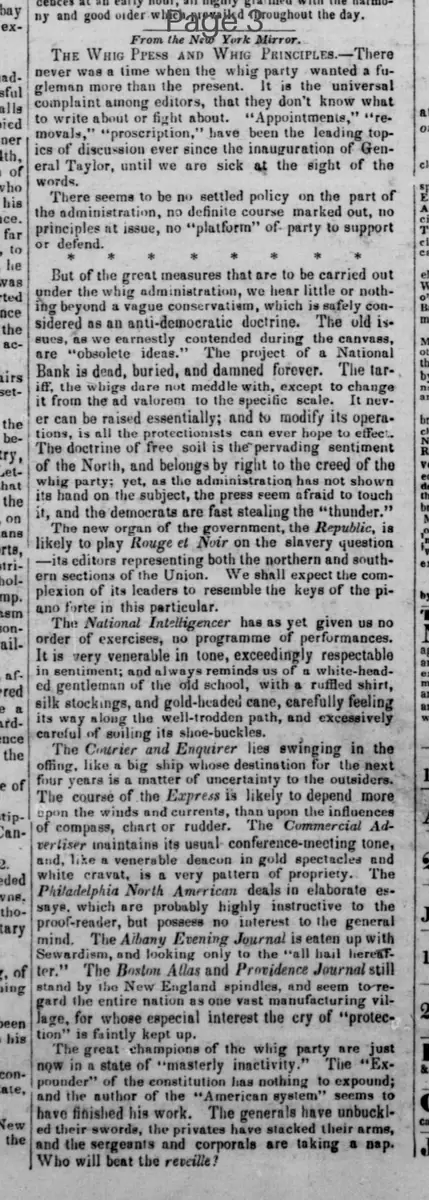
The Whig Press And Whig Principles. There never was a time when the whig party wanted a fugleman more than the present. It is the universal complaint among editors, that they don't know what to write about or fight about. "Appointments," "removals," "proscription," have been the leading topics of discussion ever since the inauguration of General Taylor, until we are sick at the sight of the words.
There seems to be no settled policy on the part of the administration, no definite course marked out, no principles at issue, no "platform" of party to support or defend.
But of the great measures that are to be carried out under the whig administration, we hear little or nothing beyond a vague conservatism, which is safely considered as an anti-democratic doctrine. The old issues, as we earnestly contended during the canvass, are "obsolete ideas." The project of a National Bank is dead, buried, and damned forever. The tariff, the whigs dare not meddle with, except to change it from the ad valorem to the specific scale. It never can be raised essentially; and to modify its operations, is all the protectionists can ever hope to effect.
The doctrine of free soil is the pervading sentiment of the North, and belongs by right to the creed of the whig party: yet, as the administration has not shown its hand on the subject, the press seem afraid to touch it, and the democrats are fast stealing the "thunder."
The new organ of the government, the Republic, is likely to play Rouge et Noir on the slavery question—its editors representing both the northern and southern sections of the Union. We shall expect the complexion of its leaders to resemble the keys of the piano forte in this particular.
The National Intelligencer has as yet given us no order of exercises, no programme of performances. It is very venerable in tone, exceedingly respectable in sentiment; and always reminds us of a white-headed gentleman of the old school, with a ruffled shirt, silk stockings, and gold-headed cane, carefully feeling its way along the well-trodden path, and excessively careful of soiling its shoe-buckles.
The Courier and Enquirer lies swinging in the offing, like a big ship whose destination for the next four years is a matter of uncertainty to the outsiders.
The course of the Express is likely to depend more upon the winds and currents, than upon the influences of compass, chart or rudder. The Commercial Advertiser maintains its usual conference-meeting tone, and, like a venerable deacon in gold spectacles and white cravat, is a very pattern of propriety. The Philadelphia North American deals in elaborate essays, which are probably highly instructive to the proof-reader, but possess no interest to the general mind. The Albany Evening Journal is eaten up with Sewardism, and looking only to the "all hail hereafter." The Boston Atlas and Providence Journal still stand by the New England spindles, and seem to regard the entire nation as one vast manufacturing village, for whose especial interest the cry of "protection" is faintly kept up.
The great champions of the whig party are just now in a state of "masterly inactivity." The "Expounder" of the constitution has nothing to expound; and the author of the "American system" seems to have finished his work. The generals have unbuckled their swords, the privates have stacked their arms, and the sergeants and corporals are taking a nap.
Who will beat the reveille?
The Whig Press And Whig Principles. There never was a time when the whig party wanted a fugleman more than the present. It is the universal complaint among editors, that they don't know what to write about or fight about. "Appointments," "removals," "proscription," have been the leading topics of discussion ever since the inauguration of General Taylor, until we are sick at the sight of the words.
There seems to be no settled policy on the part of the administration, no definite course marked out, no principles at issue, no "platform" of party to support or defend.
But of the great measures that are to be carried out under the whig administration, we hear little or nothing beyond a vague conservatism, which is safely considered as an anti-democratic doctrine. The old issues, as we earnestly contended during the canvass, are "obsolete ideas." The project of a National Bank is dead, buried, and damned forever. The tariff, the whigs dare not meddle with, except to change it from the ad valorem to the specific scale. It never can be raised essentially; and to modify its operations, is all the protectionists can ever hope to effect.
The doctrine of free soil is the pervading sentiment of the North, and belongs by right to the creed of the whig party: yet, as the administration has not shown its hand on the subject, the press seem afraid to touch it, and the democrats are fast stealing the "thunder."
The new organ of the government, the Republic, is likely to play Rouge et Noir on the slavery question—its editors representing both the northern and southern sections of the Union. We shall expect the complexion of its leaders to resemble the keys of the piano forte in this particular.
The National Intelligencer has as yet given us no order of exercises, no programme of performances. It is very venerable in tone, exceedingly respectable in sentiment; and always reminds us of a white-headed gentleman of the old school, with a ruffled shirt, silk stockings, and gold-headed cane, carefully feeling its way along the well-trodden path, and excessively careful of soiling its shoe-buckles.
The Courier and Enquirer lies swinging in the offing, like a big ship whose destination for the next four years is a matter of uncertainty to the outsiders.
The course of the Express is likely to depend more upon the winds and currents, than upon the influences of compass, chart or rudder. The Commercial Advertiser maintains its usual conference-meeting tone, and, like a venerable deacon in gold spectacles and white cravat, is a very pattern of propriety. The Philadelphia North American deals in elaborate essays, which are probably highly instructive to the proof-reader, but possess no interest to the general mind. The Albany Evening Journal is eaten up with Sewardism, and looking only to the "all hail hereafter." The Boston Atlas and Providence Journal still stand by the New England spindles, and seem to regard the entire nation as one vast manufacturing village, for whose especial interest the cry of "protection" is faintly kept up.
The great champions of the whig party are just now in a state of "masterly inactivity." The "Expounder" of the constitution has nothing to expound; and the author of the "American system" seems to have finished his work. The generals have unbuckled their swords, the privates have stacked their arms, and the sergeants and corporals are taking a nap.
Who will beat the reveille?
What sub-type of article is it?
Partisan Politics
Economic Policy
Slavery Abolition
What keywords are associated?
Whig Party
Political Principles
Free Soil
National Bank
Tariff
Slavery Question
Whig Press
Taylor Administration
What entities or persons were involved?
Whig Party
General Taylor
National Intelligencer
Republic
Courier And Enquirer
Express
Commercial Advertiser
Philadelphia North American
Albany Evening Journal
Boston Atlas
Providence Journal
Editorial Details
Primary Topic
Critique Of Whig Party's Lack Of Principles And Policy Direction
Stance / Tone
Satirical Criticism Of Whig Indecisiveness
Key Figures
Whig Party
General Taylor
National Intelligencer
Republic
Courier And Enquirer
Express
Commercial Advertiser
Philadelphia North American
Albany Evening Journal
Boston Atlas
Providence Journal
Key Arguments
Whig Editors Lack Topics Beyond Appointments And Removals
No Settled Policy Or Party Platform Under Taylor Administration
Old Issues Like National Bank Are Obsolete
Tariff Changes Limited To Scale Modification, Cannot Be Raised
Free Soil Doctrine Belongs To Whigs But Administration Avoids It, Allowing Democrats To Claim It
Republic Plays Both Sides On Slavery Question
Whig Newspapers Exhibit Indecisiveness And Inactivity
Great Whig Leaders In State Of Masterly Inactivity