Thank you for visiting SNEWPapers!
Sign up free
Editorial
April 4, 1828
Winchester Virginia Republican
Winchester, Virginia
What is this article about?
A satirical letter using the Jack and the Beanstalk fable to critique Jacksonism as growing from a dunghill of slander and predicting its imminent downfall, signed Timothy Buckskin from Hampshire County, March 1828.
Clipping
OCR Quality
95%
Excellent
Full Text
The following is rather rank; but it conveys an excellent moral.
FOR THE REPUBLICAN.
Hampshire county, March 13, 1828.
Sir: I dare say you have heard the story of Jack and the bean stalk. If ever you had a grandmother sir, you must certainly have heard it—for it was one of the standing dishes of all old women who delighted in terrifying children with stories of giants and monsters. Well I remember, though many a year has slipt over my head since that time, when half a-dozen or so of us younkers took our seats round a winter's evening fire, in order to be terrified by the tales of old Granny Leerie. Granny was a devil incarnate both in features and disposition, which helped not a little to set off her stories, which were generally of the horrible and awful. Often, when the dying fire shed a dim glare upon the walls—and ceiling, have I listened to her, as she sat sybil like upon her three legged stool, and the fire from the bowl of her pipe about an inch and a half long, and as black as jet, gleamed athwart her haggard visage, till my whole soul was harrowed up within me.
Although she hated every body, and delighted in terrifying us urchins, yet she would sometimes relax into something of the pleasing, and after having got us right upon the confines of the infernal world, would break off suddenly like the Sultana in the Arabian Nights Entertainments, and give us something else, such as Jack and the bean stalk. Jack got a bean from his mother, which like a good husbandman he planted in the dunghill. Now of all the soil in this world for planting beans in, a dunghill is the best. Sir John Sinclair himself could not recommend a better. Consequently Jack's bean did not stay long below. Next morning rising early, as all farmers who wish to thrive ought to do, Jack paid a visit to the farm, and found his bean had shot up a stalk a foot high. Next morning it was as tall as himself, the third morning it was as high as his mother's house, and so it went on growing and growing until it lost its head in the clouds. Jack was enterprising; so nothing daunted, he boldly mounted this gigantic vegetable in order to follow the head. Well, he climbed, and better climbed, until he came to a strong castle—so that by this time he must have got into the moon or some such outlandish place,—but, whether he found this said castle to be inhabited by a giant, and thereby caught a Tartar, I really can not tell, as I am under the necessity of adopting the measure, so much reprobated by my lord Chesterfield, of stopping short in the middle of my narrative by saying I have forgotten the rest.
And now for the moral of the thing; for he is but a poor writer and but as poor a reader who cannot draw a moral from the first part of a story as well as the last. In our young days sir, we did not much mind the moral of a story; mischief was the word, and it would be well for the world if men laid aside their mischief with their boyish clothes. But such is not the case. The generality of mankind appear to think that the assumption of the toga, the first suit of clothes cut man-fashion, and the sproutings of down upon their chins, are so many warrants to do as much mischief as they possibly can. But I have lost sight of my text, sir. Who would have supposed that the grand mothers of those tale telling days could have foreseen the rise of Jacksonism to disturb the quiet of this fair land in these latter times? Yet so it is. This same story of Jack and his bean is an exact type of Jacksonism. Jacksonism, sir, has been planted in a dung hill composed of slander, falsehood, ignorance, prejudice, contempt both of the laws of God and man; and the abominable compost, moistened with brandy and human blood, smells most foully,—worse than a dead horse in a summer day. In such a soil has Gen. Jackson buried the fame acquired by his splendid achievement at New-Orleans, and it has produced a stalk forsooth by which he is attempting to climb to the presidency. When he gets to the top, and by this time I think he has got as far as he can go, he will then find a castle inhabited by a strong man whom it will be necessary to bind before he gets possession of the house. Thank God, there is as yet plenty of sterling republicanism in the country, a sufficiency of good sense and patriotic feeling to keep us all quite easy on that account. No, sir we have nothing to fear. The winter of age has already laid its cold hand upon Jacksonism, and is in process of clearing the political atmosphere but too long contaminated by the effluvia of rank vegetables and noisome dunghills, and we are about to enjoy purer air and see our sun rise brighter in the horizon and shed a cheerier light over our country. Yes, to Gen. Jackson this winter has arrived. Its blasts are upon him, and its snows are about to bury him and his fame for ever. The bean stalk by which he thought to climb to the highest honors the nation can confer is fast withering, and, poor man! disappointed in his hopes he is soon to lay his head upon the pillow in that narrow house, where the wicked cease from troubling, and where the spirits of the murdered are waiting to sing his lullaby, while such will be the horror of his name that henceforth every enemy to his country and every disturber of the government will be branded with the epithet of Jacksonist.
For the present, sir, fare you well.
TIMOTHY BUCKSKIN.
Hampshire county, March, 1828.
FOR THE REPUBLICAN.
Hampshire county, March 13, 1828.
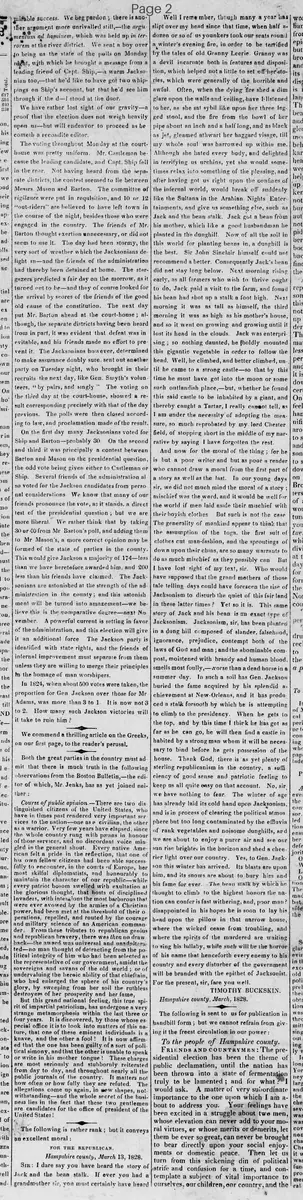
Sir: I dare say you have heard the story of Jack and the bean stalk. If ever you had a grandmother sir, you must certainly have heard it—for it was one of the standing dishes of all old women who delighted in terrifying children with stories of giants and monsters. Well I remember, though many a year has slipt over my head since that time, when half a-dozen or so of us younkers took our seats round a winter's evening fire, in order to be terrified by the tales of old Granny Leerie. Granny was a devil incarnate both in features and disposition, which helped not a little to set off her stories, which were generally of the horrible and awful. Often, when the dying fire shed a dim glare upon the walls—and ceiling, have I listened to her, as she sat sybil like upon her three legged stool, and the fire from the bowl of her pipe about an inch and a half long, and as black as jet, gleamed athwart her haggard visage, till my whole soul was harrowed up within me.
Although she hated every body, and delighted in terrifying us urchins, yet she would sometimes relax into something of the pleasing, and after having got us right upon the confines of the infernal world, would break off suddenly like the Sultana in the Arabian Nights Entertainments, and give us something else, such as Jack and the bean stalk. Jack got a bean from his mother, which like a good husbandman he planted in the dunghill. Now of all the soil in this world for planting beans in, a dunghill is the best. Sir John Sinclair himself could not recommend a better. Consequently Jack's bean did not stay long below. Next morning rising early, as all farmers who wish to thrive ought to do, Jack paid a visit to the farm, and found his bean had shot up a stalk a foot high. Next morning it was as tall as himself, the third morning it was as high as his mother's house, and so it went on growing and growing until it lost its head in the clouds. Jack was enterprising; so nothing daunted, he boldly mounted this gigantic vegetable in order to follow the head. Well, he climbed, and better climbed, until he came to a strong castle—so that by this time he must have got into the moon or some such outlandish place,—but, whether he found this said castle to be inhabited by a giant, and thereby caught a Tartar, I really can not tell, as I am under the necessity of adopting the measure, so much reprobated by my lord Chesterfield, of stopping short in the middle of my narrative by saying I have forgotten the rest.
And now for the moral of the thing; for he is but a poor writer and but as poor a reader who cannot draw a moral from the first part of a story as well as the last. In our young days sir, we did not much mind the moral of a story; mischief was the word, and it would be well for the world if men laid aside their mischief with their boyish clothes. But such is not the case. The generality of mankind appear to think that the assumption of the toga, the first suit of clothes cut man-fashion, and the sproutings of down upon their chins, are so many warrants to do as much mischief as they possibly can. But I have lost sight of my text, sir. Who would have supposed that the grand mothers of those tale telling days could have foreseen the rise of Jacksonism to disturb the quiet of this fair land in these latter times? Yet so it is. This same story of Jack and his bean is an exact type of Jacksonism. Jacksonism, sir, has been planted in a dung hill composed of slander, falsehood, ignorance, prejudice, contempt both of the laws of God and man; and the abominable compost, moistened with brandy and human blood, smells most foully,—worse than a dead horse in a summer day. In such a soil has Gen. Jackson buried the fame acquired by his splendid achievement at New-Orleans, and it has produced a stalk forsooth by which he is attempting to climb to the presidency. When he gets to the top, and by this time I think he has got as far as he can go, he will then find a castle inhabited by a strong man whom it will be necessary to bind before he gets possession of the house. Thank God, there is as yet plenty of sterling republicanism in the country, a sufficiency of good sense and patriotic feeling to keep us all quite easy on that account. No, sir we have nothing to fear. The winter of age has already laid its cold hand upon Jacksonism, and is in process of clearing the political atmosphere but too long contaminated by the effluvia of rank vegetables and noisome dunghills, and we are about to enjoy purer air and see our sun rise brighter in the horizon and shed a cheerier light over our country. Yes, to Gen. Jackson this winter has arrived. Its blasts are upon him, and its snows are about to bury him and his fame for ever. The bean stalk by which he thought to climb to the highest honors the nation can confer is fast withering, and, poor man! disappointed in his hopes he is soon to lay his head upon the pillow in that narrow house, where the wicked cease from troubling, and where the spirits of the murdered are waiting to sing his lullaby, while such will be the horror of his name that henceforth every enemy to his country and every disturber of the government will be branded with the epithet of Jacksonist.
For the present, sir, fare you well.
TIMOTHY BUCKSKIN.
Hampshire county, March, 1828.
What sub-type of article is it?
Satire
Partisan Politics
What keywords are associated?
Jacksonism
Andrew Jackson
Beanstalk
Satire
Presidency
Republicanism
New Orleans
What entities or persons were involved?
Gen. Jackson
Jacksonism
Editorial Details
Primary Topic
Satirical Critique Of Jacksonism Using Jack And The Beanstalk Metaphor
Stance / Tone
Strongly Anti Jackson, Predictive Of Downfall
Key Figures
Gen. Jackson
Jacksonism
Key Arguments
Jacksonism Planted In Dunghill Of Slander, Falsehood, Ignorance, Prejudice, And Contempt For Laws
Beanstalk Represents Jackson's Attempt To Climb To Presidency From Base Origins
Predicts Failure Due To Sterling Republicanism And Patriotic Feeling In The Country
Winter Of Age Will Bury Jacksonism And Its Fame Forever