Thank you for visiting SNEWPapers!
Sign up free
Story
September 28, 1945
Clinch Valley News
Tazewell, Jeffersonville, Tazewell County, Virginia
What is this article about?
Ashton W. Sinclair reviews pasture experiments in Tazewell County, Virginia, on farms of Frank Harman, Ben Buchanan, Albert Peery, and Ed Hopkins, demonstrating benefits of phosphate, lime, and other treatments for improving grass, reducing weeds, and enhancing cattle grazing.
Clipping
OCR Quality
98%
Excellent
Full Text
(By Ashton W. Sinclair, Assistant County Agent)
Pasture Treatment
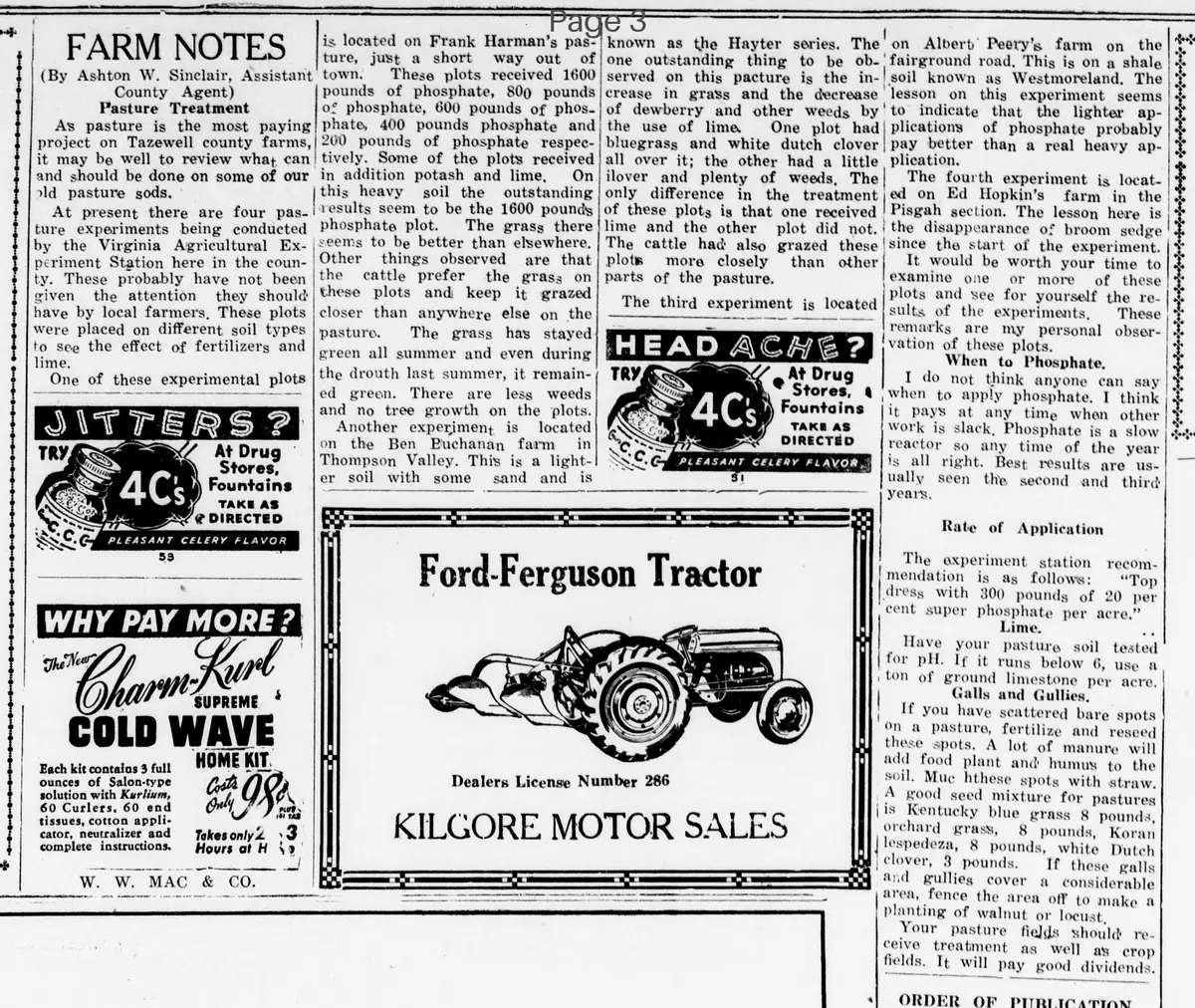
As pasture is the most paying project on Tazewell county farms, it may be well to review what can and should be done on some of our old pasture sods.
At present there are four pasture experiments being conducted by the Virginia Agricultural Experiment Station here in the county. These probably have not been given the attention they should have by local farmers. These plots were placed on different soil types to see the effect of fertilizers and lime.
One of these experimental plots is located on Frank Harman's pasture, just a short way out of town. These plots received 1600 pounds of phosphate, 800 pounds of phosphate, 600 pounds of phosphate, 400 pounds phosphate and 200 pounds of phosphate respectively. Some of the plots received in addition potash and lime.
On this heavy soil the outstanding results seem to be the 1600 pounds phosphate plot. The grass there seems to be better than elsewhere. Other things observed are that the cattle prefer the grass on these plots and keep it grazed closer than anywhere else on the pasture. The grass has stayed green all summer and even during the drouth last summer, it remained green. There are less weeds and no tree growth on the plots.
Another experiment is located on the Ben Buchanan farm in Thompson Valley. This is a lighter soil with some sand and is known as the Hayter series. The one outstanding thing to be observed on this pasture is the increase in grass and the decrease of dewberry and other weeds by the use of lime. One plot had bluegrass and white dutch clover all over it: the other had a little clover and plenty of weeds. The only difference in the treatment of these plots is that one received lime and the other plot did not. The cattle had also grazed these plots more closely than other parts of the pasture.
The third experiment is located on Albert Peery's farm on the fairground road. This is on a shale soil known as Westmoreland. The lesson on this experiment seems to indicate that the lighter applications of phosphate probably pay better than a real heavy application.
The fourth experiment is located on Ed Hopkin's farm in the Pisgah section. The lesson here is the disappearance of broom sedge since the start of the experiment.
It would be worth your time to examine one or more of these plots and see for yourself the results of the experiments. These remarks are my personal observation of these plots.
When to Phosphate,
I do not think anyone can say when to apply phosphate. I think it pays at any time when other work is slack. Phosphate is a slow reactor so any time of the year is all right. Best results are usually seen the second and third years.
Rate of Application
The experiment station recommendation is as follows:
"Top dress with 300 pounds of 20 per cent super phosphate per acre."
Lime.
Have your pasture soil tested for pH. If it runs below 6, use a ton of ground limestone per acre.
Galls and Gullies.
If you have scattered bare spots on a pasture, fertilize and reseed these spots. A lot of manure will add food plant and humus to the soil. Mulch these spots with straw.
A good seed mixture for pastures is Kentucky blue grass 8 pounds, orchard grass, 8 pounds, Korean lespedeza, 8 pounds, white Dutch clover, 3 pounds. If these galls and gullies cover a considerable area, fence the area off to make a planting of walnut or locust.
Your pasture fields should receive treatment as well as crop fields. It will pay good dividends.
Pasture Treatment
As pasture is the most paying project on Tazewell county farms, it may be well to review what can and should be done on some of our old pasture sods.
At present there are four pasture experiments being conducted by the Virginia Agricultural Experiment Station here in the county. These probably have not been given the attention they should have by local farmers. These plots were placed on different soil types to see the effect of fertilizers and lime.
One of these experimental plots is located on Frank Harman's pasture, just a short way out of town. These plots received 1600 pounds of phosphate, 800 pounds of phosphate, 600 pounds of phosphate, 400 pounds phosphate and 200 pounds of phosphate respectively. Some of the plots received in addition potash and lime.
On this heavy soil the outstanding results seem to be the 1600 pounds phosphate plot. The grass there seems to be better than elsewhere. Other things observed are that the cattle prefer the grass on these plots and keep it grazed closer than anywhere else on the pasture. The grass has stayed green all summer and even during the drouth last summer, it remained green. There are less weeds and no tree growth on the plots.
Another experiment is located on the Ben Buchanan farm in Thompson Valley. This is a lighter soil with some sand and is known as the Hayter series. The one outstanding thing to be observed on this pasture is the increase in grass and the decrease of dewberry and other weeds by the use of lime. One plot had bluegrass and white dutch clover all over it: the other had a little clover and plenty of weeds. The only difference in the treatment of these plots is that one received lime and the other plot did not. The cattle had also grazed these plots more closely than other parts of the pasture.
The third experiment is located on Albert Peery's farm on the fairground road. This is on a shale soil known as Westmoreland. The lesson on this experiment seems to indicate that the lighter applications of phosphate probably pay better than a real heavy application.
The fourth experiment is located on Ed Hopkin's farm in the Pisgah section. The lesson here is the disappearance of broom sedge since the start of the experiment.
It would be worth your time to examine one or more of these plots and see for yourself the results of the experiments. These remarks are my personal observation of these plots.
When to Phosphate,
I do not think anyone can say when to apply phosphate. I think it pays at any time when other work is slack. Phosphate is a slow reactor so any time of the year is all right. Best results are usually seen the second and third years.
Rate of Application
The experiment station recommendation is as follows:
"Top dress with 300 pounds of 20 per cent super phosphate per acre."
Lime.
Have your pasture soil tested for pH. If it runs below 6, use a ton of ground limestone per acre.
Galls and Gullies.
If you have scattered bare spots on a pasture, fertilize and reseed these spots. A lot of manure will add food plant and humus to the soil. Mulch these spots with straw.
A good seed mixture for pastures is Kentucky blue grass 8 pounds, orchard grass, 8 pounds, Korean lespedeza, 8 pounds, white Dutch clover, 3 pounds. If these galls and gullies cover a considerable area, fence the area off to make a planting of walnut or locust.
Your pasture fields should receive treatment as well as crop fields. It will pay good dividends.
What sub-type of article is it?
Agricultural Report
Experiment Summary
What keywords are associated?
Pasture Treatment
Phosphate Experiments
Lime Effects
Tazewell Farms
Soil Fertility
Weed Control
Cattle Grazing
What entities or persons were involved?
Ashton W. Sinclair
Frank Harman
Ben Buchanan
Albert Peery
Ed Hopkin's
Where did it happen?
Tazewell County, Virginia
Story Details
Key Persons
Ashton W. Sinclair
Frank Harman
Ben Buchanan
Albert Peery
Ed Hopkin's
Location
Tazewell County, Virginia
Story Details
Description of four pasture experiments testing fertilizers and lime on different soils, showing improved grass growth, weed reduction, and cattle preference; advice on application timing, rates, liming, and reseeding bare spots.