Thank you for visiting SNEWPapers!
Sign up free
Story
October 25, 1895
Arizona Republican
Phoenix, Maricopa County, Arizona
What is this article about?
I.W. Cook recounts his enjoyable trip to Arizona's Salt River Valley, highlighting the fertile land, alfalfa crops, livestock, warm hospitality in Tempe and Mesa City with feasts and fruit displays, and early-maturing orange orchards near Phoenix.
Clipping
OCR Quality
98%
Excellent
Full Text
HE LIKED THE ALFALFA.
An Eastern Editor's Arizona Trip.
What Constitutes Entertainment in the West.
Salt River Valley Especially Appreciated in Its Level Land and Fat Stock.
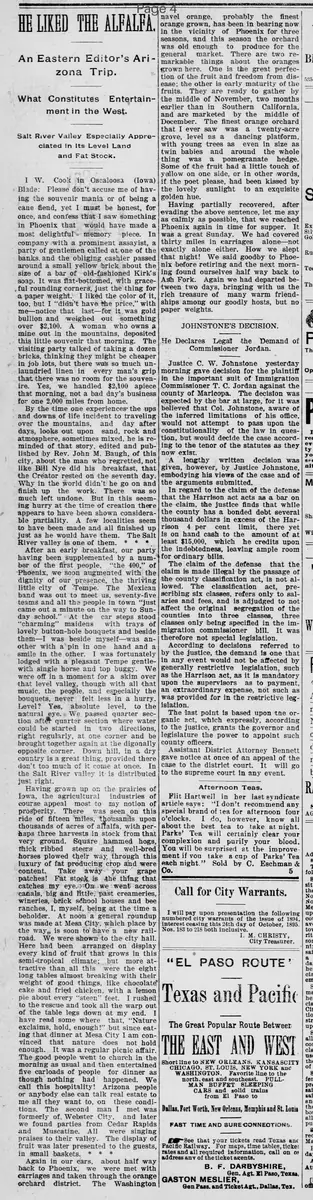
I. W. Cook in Oskaloosa (Iowa) Blade: Please don't accuse me of having the souvenir mania or of being a cane fiend, yet I must be honest, for once, and confess that I saw something in Phoenix that would have made a most delightful memory piece. In company with a prominent assayist, a party of gentlemen called at one of the banks, and the obliging cashier passed around a small yellow brick about the size of a bar of old-fashioned Kirk's soap. It was flat-bottomed, with graceful rounding corners, just the thing for a paper weight. I liked the color of it, too, but I "didn't have the price," with me—notice that last—for it was gold bullion and weighed out something over $2,100. A woman who owns a mine out in the mountains, deposited this little souvenir that morning. The visiting party talked of taking a dozen bricks, thinking they might be cheaper in job lots, but there was so much unlaundried linen in every man's grip that there was no room for the souvenir. Yes, we handled $2,100 apiece that morning, not a bad day's business for one 2,000 miles from home.
By the time one experiences the ups and downs of life incident to traveling over the mountains, and day after days, looks out upon sand, rock and atmosphere, sometimes mixed, he is reminded of that story, edited and published by Rev. John M. Baugh, of this city, about the man who regretted, not like Bill Nye did his breakfast, that the Creator rested on the seventh day. Why in the world didn't he go on and finish up the work. There was so much left undone. But in this seeming hurry at the time of creation there appears to have been shown considerable partiality. A few localities seem to have been made and all finished up just as he would have them. The Salt River valley is one of them. * *
After an early breakfast, our party having been supplemented by a number of the first people, "the 400," of Phoenix, we soon augmented with the dignity of our presence, the thriving little city of Tempe. The Mexican band was out to meet us, seventy-five teams and all the people in town "just came out a minute on the way to Sunday school." At the car steps stood "charming" maidens with trays of lovely button-hole bouquets and beside them—I was beside myself—was another with a pin in one hand and a smile in the other. I was fortunately lodged with a pleasant Tempe gentleman with single horse and top buggy. We were off in a moment for a skim over that level valley, though with all that music, the people, and especially the bouquets, never felt less in a hurry.
Level? Yes, absolute level, to the natural eye. We passed quarter section after quarter section where water could be started in two directions, right regularly, at one corner and be brought together again at the diagonally opposite corner. Down hill, in a dry country is a great thing, provided there don't too much of it come at once. In the Salt River valley it is distributed just right.
Having grown up on the prairies of Iowa, the agricultural industries of course appeal most to my notion of prosperity. There was seen on this ride of fifteen miles, thousands upon thousands of acres of alfalfa, with perhaps three harvests in stock from that very ground. Square hammed hogs, thick ribbed steers and well-bred horses plowed their way through this luxury of fat producing crop and were content. Take away your grape patches! Fat stock is the thing that catches my eye. On we went across canals, big and little, past creameries, wineries, brick school houses and bee ranches, I, myself, being at the time a beholder. At noon a general roundup was made at Mesa City, which place by the way, is soon to have a new railroad. We were shown to the city hall. Here had been arranged on display every kind of fruit that grows in this semi-tropical climate; but more attractive than all this were the eight long tables almost breaking with their weight of good things, like chocolate cake and fried chicken, with a lemon pie about every "steen" feet. I rushed to the rescue and took all the warp out of the table legs down at my end. I have read somewhere that, "Nature exclaims, hold, enough!" but since eating that dinner at Mesa City I am convinced that nature does not hold enough. It was a regular picnic affair. The good people went to church in the morning as usual and then entertained five carloads of people for dinner as though nothing had happened. We call this hospitality! Arizona people or anybody else can talk real estate to me all they want to, on these conditions. The second man I met was formerly of Webster City, and later we found parties from Cedar Rapids and Muscatine. All were singing praises to their valley. The display of fruit was later presented to the guests, in small baskets.
Again in our cars, about half way back to Phoenix, we were met with carriages and taken through the orange orchard district. The Washington navel orange, probably the finest orange grown, has been in bearing now in the vicinity of Phoenix for three seasons, and this season the orchard was old enough to produce for the general market. There are two remarkable things about the oranges grown here. One is the great perfection of the fruit and freedom from disease; the other is early maturity of the fruits. They are ready to gather by the middle of November, two months earlier than in Southern California, and are marketed by the middle of December. The finest orange orchard that I ever saw was a twenty-acre grove, level as a dancing platform, with young trees as even in size as twin babies and around the whole thing was a pomegranate hedge. Some of the fruit had a little touch of yellow on one side, or in other words, if the poet please, had been kissed by the lovely sunlight to an exquisite golden hue.
Having partially recovered, after evading the above sentence, let me say as calmly as possible, that we reached Phoenix again in time for supper. It was a great Sunday. We had covered thirty miles in carriages alone—not exactly alone either. How we slept that night! We said goodby to Phoenix before retiring and the next morning found ourselves half way back to Ash Fork. Again we had departed between two days, bringing with us the rich treasure of many warm friendships among our goodly hosts, but no paper weights.
An Eastern Editor's Arizona Trip.
What Constitutes Entertainment in the West.
Salt River Valley Especially Appreciated in Its Level Land and Fat Stock.
I. W. Cook in Oskaloosa (Iowa) Blade: Please don't accuse me of having the souvenir mania or of being a cane fiend, yet I must be honest, for once, and confess that I saw something in Phoenix that would have made a most delightful memory piece. In company with a prominent assayist, a party of gentlemen called at one of the banks, and the obliging cashier passed around a small yellow brick about the size of a bar of old-fashioned Kirk's soap. It was flat-bottomed, with graceful rounding corners, just the thing for a paper weight. I liked the color of it, too, but I "didn't have the price," with me—notice that last—for it was gold bullion and weighed out something over $2,100. A woman who owns a mine out in the mountains, deposited this little souvenir that morning. The visiting party talked of taking a dozen bricks, thinking they might be cheaper in job lots, but there was so much unlaundried linen in every man's grip that there was no room for the souvenir. Yes, we handled $2,100 apiece that morning, not a bad day's business for one 2,000 miles from home.
By the time one experiences the ups and downs of life incident to traveling over the mountains, and day after days, looks out upon sand, rock and atmosphere, sometimes mixed, he is reminded of that story, edited and published by Rev. John M. Baugh, of this city, about the man who regretted, not like Bill Nye did his breakfast, that the Creator rested on the seventh day. Why in the world didn't he go on and finish up the work. There was so much left undone. But in this seeming hurry at the time of creation there appears to have been shown considerable partiality. A few localities seem to have been made and all finished up just as he would have them. The Salt River valley is one of them. * *
After an early breakfast, our party having been supplemented by a number of the first people, "the 400," of Phoenix, we soon augmented with the dignity of our presence, the thriving little city of Tempe. The Mexican band was out to meet us, seventy-five teams and all the people in town "just came out a minute on the way to Sunday school." At the car steps stood "charming" maidens with trays of lovely button-hole bouquets and beside them—I was beside myself—was another with a pin in one hand and a smile in the other. I was fortunately lodged with a pleasant Tempe gentleman with single horse and top buggy. We were off in a moment for a skim over that level valley, though with all that music, the people, and especially the bouquets, never felt less in a hurry.
Level? Yes, absolute level, to the natural eye. We passed quarter section after quarter section where water could be started in two directions, right regularly, at one corner and be brought together again at the diagonally opposite corner. Down hill, in a dry country is a great thing, provided there don't too much of it come at once. In the Salt River valley it is distributed just right.
Having grown up on the prairies of Iowa, the agricultural industries of course appeal most to my notion of prosperity. There was seen on this ride of fifteen miles, thousands upon thousands of acres of alfalfa, with perhaps three harvests in stock from that very ground. Square hammed hogs, thick ribbed steers and well-bred horses plowed their way through this luxury of fat producing crop and were content. Take away your grape patches! Fat stock is the thing that catches my eye. On we went across canals, big and little, past creameries, wineries, brick school houses and bee ranches, I, myself, being at the time a beholder. At noon a general roundup was made at Mesa City, which place by the way, is soon to have a new railroad. We were shown to the city hall. Here had been arranged on display every kind of fruit that grows in this semi-tropical climate; but more attractive than all this were the eight long tables almost breaking with their weight of good things, like chocolate cake and fried chicken, with a lemon pie about every "steen" feet. I rushed to the rescue and took all the warp out of the table legs down at my end. I have read somewhere that, "Nature exclaims, hold, enough!" but since eating that dinner at Mesa City I am convinced that nature does not hold enough. It was a regular picnic affair. The good people went to church in the morning as usual and then entertained five carloads of people for dinner as though nothing had happened. We call this hospitality! Arizona people or anybody else can talk real estate to me all they want to, on these conditions. The second man I met was formerly of Webster City, and later we found parties from Cedar Rapids and Muscatine. All were singing praises to their valley. The display of fruit was later presented to the guests, in small baskets.
Again in our cars, about half way back to Phoenix, we were met with carriages and taken through the orange orchard district. The Washington navel orange, probably the finest orange grown, has been in bearing now in the vicinity of Phoenix for three seasons, and this season the orchard was old enough to produce for the general market. There are two remarkable things about the oranges grown here. One is the great perfection of the fruit and freedom from disease; the other is early maturity of the fruits. They are ready to gather by the middle of November, two months earlier than in Southern California, and are marketed by the middle of December. The finest orange orchard that I ever saw was a twenty-acre grove, level as a dancing platform, with young trees as even in size as twin babies and around the whole thing was a pomegranate hedge. Some of the fruit had a little touch of yellow on one side, or in other words, if the poet please, had been kissed by the lovely sunlight to an exquisite golden hue.
Having partially recovered, after evading the above sentence, let me say as calmly as possible, that we reached Phoenix again in time for supper. It was a great Sunday. We had covered thirty miles in carriages alone—not exactly alone either. How we slept that night! We said goodby to Phoenix before retiring and the next morning found ourselves half way back to Ash Fork. Again we had departed between two days, bringing with us the rich treasure of many warm friendships among our goodly hosts, but no paper weights.
What sub-type of article is it?
Journey
Curiosity
What themes does it cover?
Exploration
Triumph
What keywords are associated?
Arizona Trip
Salt River Valley
Alfalfa
Hospitality
Orange Orchards
Tempe
Mesa City
What entities or persons were involved?
I. W. Cook
Rev. John M. Baugh
Where did it happen?
Salt River Valley, Arizona; Phoenix; Tempe; Mesa City
Story Details
Key Persons
I. W. Cook
Rev. John M. Baugh
Location
Salt River Valley, Arizona; Phoenix; Tempe; Mesa City
Story Details
An Eastern editor describes his trip to Arizona's Salt River Valley, appreciating the level land, alfalfa fields, fat stock, hospitality in Tempe and Mesa City, fruit displays, and orange orchards, contrasting it with the unfinished creation elsewhere.