Thank you for visiting SNEWPapers!
Sign up free
The National Intelligencer And Washington Advertiser
Washington, District Of Columbia
What is this article about?
On April 19, in the U.S. House of Representatives, debate on a Senate bill authorizing the President to suspend the embargo under uncertain conditions. Mr. Randolph proposes an amendment linking suspension to revocation of French decrees and British orders. Mr. Quincy opposes limitations, advocating broad executive discretion for public good to mitigate embargo's hardships.
Merged-components note: Merged continuation of the congressional debate on the embargo bill across pages 1 and 2, as the text flows directly from one to the other and ends with an indication of continuation.
Clippings
1 of 2
OCR Quality
Full Text
HOUSE OF REPRESENTATIVES.
TUESDAY, APRIL 19.
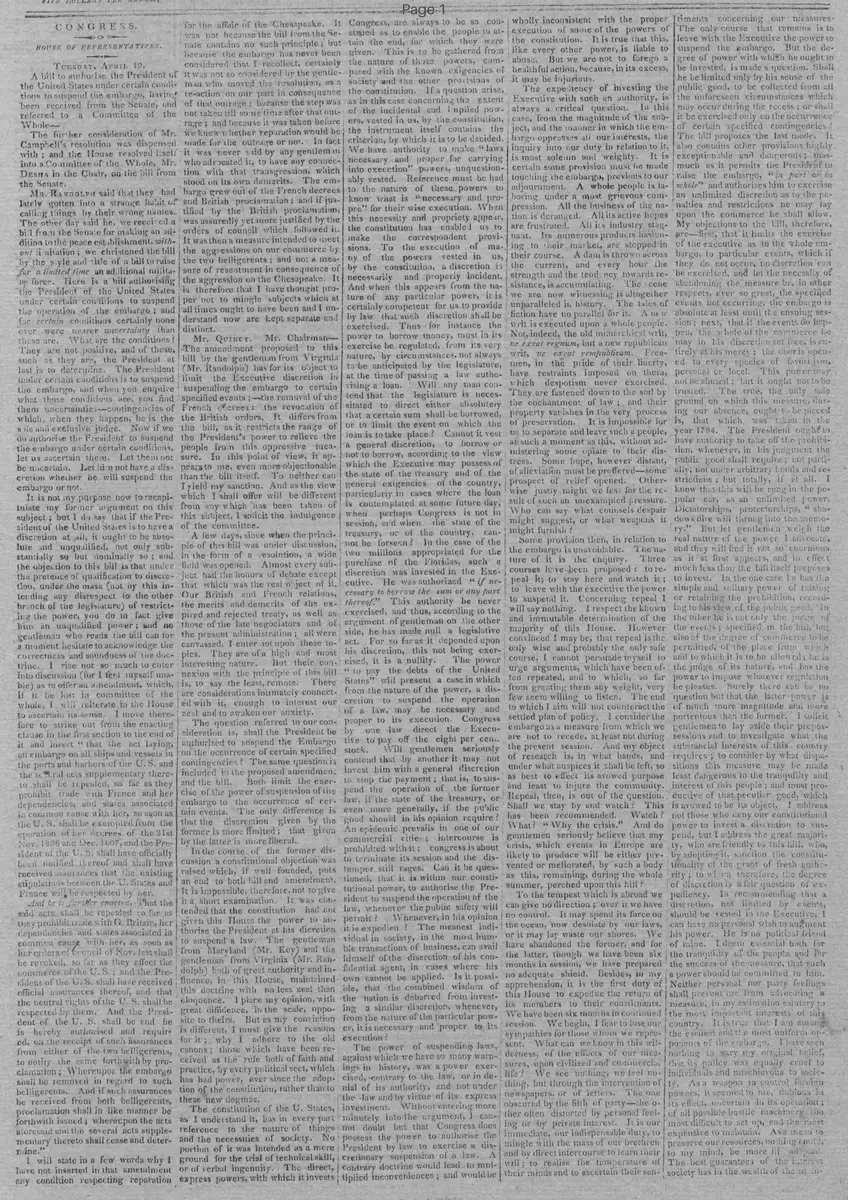
A bill to authorise the President of the United States under certain conditions to suspend the embargo, having been received from the Senate, and referred to a Committee of the Whole—
The further consideration of Mr. Campbell's resolution was dispensed with; and the House resolved itself into a Committee of the Whole, Mr. Desna in the Chair, on the bill from the Senate.
Mr. Randolph said that they had lately gotten into a strange habit of calling things by their wrong names. The other day, said he, we received a bill from the Senate for making an addition to the peace establishment, without limitation; we christened the bill by the style and title of a bill to raise for a limited time an additional military force. Here is a bill authorising the President of the United States under certain conditions to suspend the operation of the embargo; and for certain conditions certainly none ever were nearer uncertainty than these are. What are the conditions? They are not positive, and of these, such as they are, the President at last is to determine. The President under certain conditions is to suspend the embargo, and when you enquire what those conditions are, you find them uncertainties—contingencies of which, when they happen, he is the sole and exclusive judge. Now if we do authorise the President to suspend the embargo under certain conditions, let us ascertain them. Let them not be uncertain. Let him not have a discretion whether he will suspend the embargo or not.
It is not my purpose now to recapitulate my former argument on this subject; but I do say that if the President of the United States is to have a discretion at all, it ought to be absolute and unqualified, not only substantially so but nominally so; and the objection to this bill is that under the pretence of qualification to discretion, under the mask (not by this intending any disrespect to the other branch of the legislature) of restricting the power, you do in act give him an unqualified power; and no gentleman who reads the bill can for a moment hesitate to acknowledge the correctness and soundness of the doctrine. I rise not so much to enter into discussion (for I feel myself unable) as to offer an amendment, which, if it be lost in committee of the whole, I will reiterate in the House to ascertain its sense. I move therefore to strike out from the enacting clause in the first section to the end of it and insert "that the act laying an embargo on all ships and vessels in the ports and harbors of the U. S. and the several acts supplementary thereto shall be repealed, so far as they prohibit trade with France and her dependencies, and states associated in common cause with her, so soon as the U. S. shall be exempted from the operation of her decrees of the 21st Nov. 1806 and Dec. 1807, and the President of the U. S. shall have officially been notified thereof and shall have received assurances that the existing stipulations between the U. States and France will be respected by her.
And be it further enacted, That the said acts shall be repealed so far as they prohibit trade with G. Britain, her dependencies and states associated in common cause with her, as soon as her orders of council of Nov. last shall be revoked, so far as they affect the commerce of the U.S.; and the President of the U. S. shall have received official assurances thereof, and that the neutral rights of the U. S. shall be respected by them. And the President of the U. S. shall be and he is hereby authorised and required, on the receipt of such assurances from either of the two belligerents, to notify the same forthwith by proclamation; Whereupon the embargo shall be removed in regard to such belligerents. And if such assurances be received from both belligerents, proclamation shall in like manner be forthwith issued; whereupon the acts aforesaid and the several acts supplementary thereto shall cease and determine."
I will state in a few words why I have not inserted in that amendment any condition respecting reparation for the affair of the Chesapeake. It was not because the bill from the Senate contains no such principle; but because the embargo has never been considered that I recollect, certainly it was not so considered by the gentleman who moved the resolution, as a re-action on our part in consequence of that outrage; because the step was not taken till some time after that outrage; and because it was taken before we knew whether reparation would be made for the outrage or not. In fact it was never said by any gentleman who advocated it, to have any connection with that transgression, which stood on its own demerits. The embargo grew out of the French decrees and British proclamation; and if justified by the British proclamation, was assuredly yet more justified by the orders of council which followed it. It was then a measure intended to meet the aggressions on our commerce by the two belligerents; and not a measure of resentment in consequence of the aggression on the Chesapeake. It is therefore that I have thought proper not to mingle subjects which at all times ought to have been and I understand now are kept separate and distinct.
Mr. Quincy. Mr. Chairman—
The amendment proposed to this bill by the gentleman from Virginia (Mr. Randolph) has for its object to limit the Executive discretion in suspending the embargo to certain specified events;—the removal of the French decrees: the revocation of the British orders, It differs from the bill, as it restricts the range of the President's power to relieve the people from this oppressive measure. In this point of view, it appears to me, even more objectionable than the bill itself. To neither can I yield my sanction. And as the view which I shall offer will be different from any which has been taken of this subject, I solicit the indulgence of the committee.
A few days since when the principle of this bill was under discussion, in the form of a resolution, a wide field was opened. Almost every subject had the honors of debate except that which was the real object of it. Our British and French relations, the merits and demerits of the expired and rejected treaty, as well as those of the late negociators and of the present administration; all were canvassed. I enter not upon these topics. They are of a high and most interesting nature. But their connection with the principle of this bill is, to say the least, remote. There are considerations intimately connected with it, enough to interest our zeal and to awaken our anxiety.
The question referred to our consideration is, shall the President be authorised to suspend the Embargo on the occurrence of certain specified contingencies? The same question is included in the proposed amendment; and the bill. Both limit the exercise of the power of suspension of the embargo to the occurrence of certain events. The only difference is that the discretion given by the former is more limited; that given by the latter is more liberal.
In the course of the former discussion a constitutional objection was raised which, if well founded, puts an end to both bill and amendment. It is impossible, therefore, not to give it a short examination. It was contended that the constitution had not given this House the power to authorise the President at his discretion to suspend a law. The gentleman from Maryland (Mr. Key) and the gentleman from Virginia (Mr. Randolph) both of great authority and influence, in this House, maintained this doctrine with no less zeal than eloquence. I place my opinion, with great diffidence, in the scale, opposite to theirs. But as my conviction is different, I must give the reasons for it; why I adhere to the old canons; those which have been received as the rule both of faith and practice, by every political sect, which has had power, ever since the adoption of the constitution, rather than to these new dogmas.
The constitution of the U. States, as I understand it, has in every part reference to the nature of things and the necessities of society. No portion of it was intended as a mere ground for the trial of technical skill, or of verbal ingenuity. The direct, express powers, with which it invests Congress, are always to be so construed as to enable the people to attain the end, for which they were given. This is to be gathered from the nature of those powers, compared with the known exigencies of society and the other provisions of the constitution. If a question arise, as in this case concerning the extent of the incidental and implied powers, vested in us, by the constitution, the instrument itself contains the criterion, by which it is to be decided. We have authority to make "laws necessary and proper for carrying into execution" powers, unquestionably vested. Reference must be had to the nature of these powers to know what is "necessary and proper" for their wise execution. When this necessity and propriety appear, the constitution has enabled us to make the correspondent provisions. To the execution of many of the powers vested in us, by the constitution, a discretion is necessarily and properly incident. And when this appears from the nature of any particular power, it is certainly competent for us to provide by law that such discretion shall be exercised. Thus for instance the power to borrow money, must in its exercise be regulated, from its very nature, by circumstances, not always to be anticipated by the legislature, at the time of passing a law authorising a loan. Will any man contend that the legislature is necessitated to direct either absolutely that a certain sum shall be borrowed, or to limit the event on which the loan is to take place? Cannot it vest a general discretion, to borrow or not to borrow, according to the view which the Executive may possess of the state of the treasury and of the general exigencies of the country, particularly in cases where the loan is contemplated at some future day, when perhaps Congress is not in session, and when the state of the treasury, or of the country, cannot be foreseen? In the case of the two millions appropriated for the purchase of the Floridas, such a discretion was invested in the Executive. He was authorized "if necessary to borrow the sum or any part thereof." This authority he never exercised, and thus, according to the argument of gentleman on the other side, he has made null a legislative act. For so far as it depended upon his discretion, this not being exercised, it is a nullity. The power "to pay the debts of the United States" will present a case in which from the nature of the power, a discretion to suspend the operation of a law, may be necessary and proper to its execution. Congress by one law direct the Executive to pay off the eight per cent. stock. Will gentlemen seriously contend that by another it may not invest him with a general discretion to stop the payment; that is, to suspend the operation of the former law, if the state of the treasury, or even more generally, if the public good should in his opinion require? An epidemic prevails in one of our commercial cities; intercourse is prohibited with it; congress is about to terminate its session and the distemper still rages. Can it be questioned, that it is within our constitutional power, to authorise the President to suspend the operation of the law, whenever the public safety will permit? Whenever, in his opinion it is expedient? The meanest individual in society, in the most humble transactions of business, can avail himself of the discretion of his confidential agent, in cases where his own cannot be applied. Is it possible, that the combined wisdom of the nation is debarred from investing a similar discretion, whenever, from the nature of the particular power, it is necessary and proper to its execution?
The power of suspending laws, against which we have so many warnings in history, was a power exercised, contrary to the law, or in denial of its authority, and not under the law and by virtue of its express investment. Without entering more minutely into the argument, I cannot doubt but that Congress does possess the power to authorise the President by law to exercise a discretionary suspension of a law. A contrary doctrine would lead to multiplied inconveniences; and would be wholly inconsistent with the proper execution of some of the powers of the constitution. It is true that this, like every other power, is liable to abuse. But we are not to forego a healthful action, because, in its excess, it may be injurious.
The expediency of investing the Executive with such an authority, is always a critical question. In this case, from the magnitude of the subject, and the manner in which the embargo oppresses all our interests, the inquiry into our duty in relation to it, is most solemn and weighty. It is certain some provision must be made touching the embargo, previous to our adjournment. A whole people is laboring under a most grievous compression. All the business of the nation is deranged. All its active hopes are frustrated. All its industry stagnant. Its numerous products hastening to their market, are stopped in their course. A dam is thrown across the current, and every hour the strength and the tendency towards resistance, is accumulating. The scene we are now witnessing is altogether unparalleled in history. The tales of fiction have no parallel for it. A new writ is executed upon a whole people. Not, indeed, the old monarchical writ, ne exeat regnum, but a new republican writ, ne exeat rempublicam. Freemen, in the pride of their liberty, have restraints imposed on them, which despotism never exercised. They are fastened down to the soil by the enchantment of law: and their property vanishes in the very process of preservation. It is impossible for us to separate and leave such a people, at such a moment as this, without administering some opiate to their distress. Some hope, however distant, of alleviation must be proffered—some prospect of relief opened. Otherwise justly might we fear for the result of such an unexampled pressure. Who can say what counsels despair might suggest, or what weapons it might furnish?
Some provision then, in relation to the embargo is unavoidable. The nature of it is the enquiry. Three courses have been proposed: to repeal it; to stay here and watch it; to leave with the executive the power to suspend it. Concerning repeal I will say nothing. I respect the known and immutable determination of the majority of this House. However convinced I may be, that repeal is the only wise and probably the only safe course, I cannot persuade myself to urge arguments, which have been often repeated, and to which, so far from granting them any weight, very few seem willing to listen. The end to which I aim will not counteract the settled plan of policy. I consider the embargo as a measure from which we are not to recede, at least not during the present session. And my object of research is, in what hands, and under what auspices it shall be left, so as best to effect its avowed purpose and least to injure the community. Repeal, then, is out of the question. Shall we stay by and watch? This has been recommended. Watch? What? "Why the crisis." And do gentlemen seriously believe that any crisis, which events in Europe are likely to produce will be either prevented or meliorated, by such a body as this, remaining, during the whole summer, perched upon this hill? To the tempest which is abroad we can give no direction; over it we have no control. It may spend its force on the ocean, now desolate by our laws, or it may lay waste our shores. We have abandoned the former, and for the latter, though we have been six months in session, we have prepared no adequate shield. Besides, in my apprehension, it is the first duty of this House to expedite the return of its members to their constituents. We have been six months in continued session. We begin, I fear to lose our sympathies for those whom we represent. What can we know in this wilderness, of the effects of our measures, upon civilized and commercial life? We see nothing, we feel nothing, but through the intervention of newspapers, or of letters. The one obscured by the filth of party—the other often distorted by personal feeling or by private interest. It is our immediate, our indispensable duty, to mingle with the mass of our brethren and by direct intercourse to learn their will; to realise the temperature of their minds and to ascertain their sentiments concerning our measures.
The only course that remains is to leave with the Executive the power to suspend the embargo. But the degree of power with which he ought to be invested, is made a question. Shall he be limited only by his sense of the public good, to be collected from all the unforeseen circumstances which may occur during the recess; or shall it be exercised only on the occurrence of certain specified contingencies? The bill proposes the last mode. It also contains other provisions highly exceptionable and dangerous; inasmuch as it permits the President to raise the embargo, "in part or in whole" and authorises him to exercise an unlimited discretion as to the penalties and restrictions he may lay upon the commerce he shall allow. My objections to the bill, therefore, are—first, that it limits the exercise of the executive as to the whole embargo, to particular events, which if they do not occur, no discretion can be exercised, and let the necessity of abandoning the measure be, in other respects, ever so great, the specified events not occurring, the embargo is absolute at least until the ensuing session; next, that if the events do happen, the whole of the commerce he may in his discretion set free, is entirely at his mercy; the doors is opened to every species of favoritism, personal or local. This power may not be abused; but it ought not to be trusted. The true, the only safe ground on which this measure, during our absence, ought to be placed is, that which was taken in the year 1794. The President ought to have authority to take off the prohibition, whenever, in his judgment the public good shall require; not partially, not under arbitrary bonds and restrictions; but totally, if at all. I know that this will be rung in the popular ear, as an unlimited power. Dictatorships, protectorships, "shadows dire will throng into the memory." But let gentlemen weigh the real nature of the power I advocate, and they will find it not so enormous as it at first appears, and in effect much less than the bill itself proposes to invest. In the one case he has the simple and solitary power of raising or retaining the prohibition, according to his view of the public good. In the other he is not only the judge of the events; specified in the bill, but also of the degree of commerce to be permitted, of the place from which and to which it is to be allowed; he is the judge of its nature, and has the power to impose whatever regulation he pleases. Surely there can be no question but that the latter power is of much more magnitude and more portentous than the former. I solicit gentlemen to lay aside their prepossessions and to investigate what the substantial interests of this country requires; to consider by what dispositions this measure may be made least dangerous to the tranquility and interest of this people; and most productive of that peculiar good, which is avowed to be its object. I address not those who deny our constitutional power to invest a discretion to suspend, but I address the great majority, who are friendly to this bill, who, by adopting it, sanction the constitutionality of the grant of fresh authority; to whom therefore, the degree of discretion is a fair question of expediency. In recommending that a discretion, not limited by events, should be vested in the Executive, I can have no personal wish to augment his power. He is no political friend of mine. I deem essential both for the tranquility of the people and for the success of the measure, that such a power should be committed to him. Neither personal nor party feelings shall prevent me from advocating a measure, in my estimation salutary to the most important interests of this country. It is true that I am among the earliest and the most uniform opponents of the embargo, I have seen nothing to vary my original belief, that its policy was equally cruel to individuals and mischievous to society. As a weapon to control foreign powers, it seemed to me, dubious in its effect, uncertain in its operation; of all possible hostile machinery the most difficult to set up, and the most expensive to maintain. As a mean to preserve our resources, nothing could, to my mind, be more ill advised. The best guarantees of the interest society has in the wealth of the individuals composing it
The numbers which compose it, are the industry, intelligence and enterprise of the individual proprietors, strengthened as they always are by knowledge of business and quickened by that which gives the keenest edge to human ingenuity—self interest. When all the property of a multitude is at hazard, the simplest and the surest way of securing the greatest portion, is not to limit individual exertion, but to stimulate it; not to conceal the nature of the exposure, but, by giving a full knowledge of the state of things, to leave the wit of every proprietor free, to work out the salvation of his property, according to the opportunities he may discern. Notwithstanding the decrees of the belligerents, there appeared to me a field wide enough to occupy and reward mercantile enterprise. If we left commerce at liberty, we might, according to the fable, lose some of her golden eggs, but if we crushed commerce, the parent which produced them, and with her, our future hopes perished. Without entering into the particular details, whence these conclusions resulted, it is enough that they were such as satisfied my mind as to the duty of opposition to the system, in its incipient state, and in all the restrictions which have grown out of it. But the system is adopted. May it be successful! It is not to diminish, but to increase the chance of that success, I urge that a discretion, unlimited by events, should be vested in the Executive. I shall rejoice if this great miracle be worked. I shall congratulate my country, if the experiment shall prove, that the old world can be controlled by the fear of being excluded from the commerce of the new. Happy shall I be, if on the other side of this dark valley of the shadow of death, through which our commercial hopes are passing, shall be found regions of future safety and felicity.
Among all the propositions offered to this House, no man has suggested, that we ought to rise and leave this embargo until our return, pressing upon the people, without some power of suspension vested in the executive. Why this uniformity of opinion? The reason is obvious: the greatness of the comparison. If the people were let six months without hope, no man could anticipate the consequences. All agree that such an experiment would be unwise and dangerous. Now precisely the same reasons which induce the majority not to go away without making some provision for its removal, on which to feed popular expectation, is conclusive in my mind, that the discretion proposed to be invested, should not be limited by contingencies.
The embargo power, which now holds in its palsying gripe all the hopes of this nation, is distinguished by two characteristics of material importance, in deciding what control shall be left over it during our recess. I allude to its greatness and its novelty. As to its greatness, nothing is like it. Every class of men feels it. Every interest in the nation is affected by it. The merchant, the farmer, the planter, the mechanic, the laboring poor; all, all are sinking under its weight. But there is this peculiar in it; that there is no equality in its nature. It is not like taxation, which raises revenue according to the average of wealth; burthening the rich and letting the poor go free. But it presses upon the particular classes of society, in an inverse ratio to the capacity of each to bear it. From those who have much it takes, indeed, something. But from those who have little, it takes all. For what hope is left to the industrious poor, when enterprise, activity and capital are proscribed their legitimate exercise?
This power resembles the mild influences of an intelligent mind, balancing the interests and conditions of men, and so conducting a complicated machine as to make inevitable pressure bear upon its strongest parts. But it is like one of the blind visitations of nature; a tornado or a whirlwind. It sweeps away the weak: It only strips the strong. The humble plant, uprooted, is overwhelmed by the tempest. The oak escapes with the loss of nothing except its annual honors.
It is true the sheriff does not enter any man's house to collect a tax from his property. But want knocks at his door and poverty thrusts his face into the window. And what relief can the rich extend? They sit upon their heaps and feel them mouldering into ruins under them. The regulations of society forbid what was once property, to be so any longer. For property depends on circulation; on exchange; on ideal value. The power of property is all relative. It depends not merely upon opinion here, but upon opinion in other countries. If it be cut off from its destined market, much of it is worth nothing, and all of it is worth infinitely less than when circulation is unobstructed. This embargo power is therefore of all powers the most enormous; in the manner in which it affects the hopes and interests of a nation. But its magnitude is not more remarkable than its novelty. An experiment, such as is now making, was never before—I will not say tried—it never before entered into the human imagination. There is nothing like it in the narrations of history or in the tales of fiction. All the habits of a mighty nation are at once counteracted. All their property depreciated. All their external connexions violated. Five millions of people are encaged. They cannot go beyond the limits of that once free country; now they are not even permitted to thrust their own property through the grates. I am not now questioning its policy, its wisdom, or its practicability. I am merely stating the fact. And I ask if such a power as this, thus great thus novel, thus interfering with all the great passions and interests of a whole people, ought to be left for six months, in operation without any power of control, except upon the occurrence of certain specified and arbitrary contingencies? Who can foretel when the Spirit of endurance will cease? Who, when the strength of nature shall outgrow the strength of your bonds? Or if they do, who can give a pledge that the patience of the people will not first be exhausted? I make a supposition Mr. Chairman—you are a great physician; you take a hearty, hale man, in the very pride of health; his young blood all active in his veins, and you outstretch him on a bed, you stop up all his natural orifices, you hermetically seal down his pores; so that nothing shall escape outwards, and that all his functions and all his humors shall be turned inward upon his system. While your patient is laboring, in the very crisis of this course of treatment, you, his physician, take a journey into a far country, and you say to his attendant, "I have a great experiment here in process, and a new one. It is all for the good of the young man, so do not fail to adhere to it. These are my directions, and the power with which invest you. No attention is to be paid to any internal symptom which may occur. Let the patient be convulsed as much as he will, you are to remove none of my bandages. But, in case something external should happen; if the sky should fall, and larks should begin to appear, if three birds of Paradise should fly into the window, the great purpose of all these suffering is answered. Then, and then only, have you my authority to administer relief."
The conduct of such a physician, in such a case, would not be more extraordinary than that of this House, in the present, should it adjourn and limit the discretion of the Executive, to certain specified events, arbitrarily anticipated; leaving him destitute of the power to grant relief should internal symptoms indicate that nothing else would prevent convulsions. If the events you specify do not happen, then the embargo is absolutely fixed until our return. Is there one among us that has such an enlarged view of the nature and necessities of this people as to warrant that such a system can continue six months longer? It is a presumption, which no known facts substantiate, and which the strength and the universality of the passions such a pressure will set at work in the community, render, to say the least, of very dubious credit. My argument, in this part, has this prudential truth for its basis. If a great power is put in motion affecting great interests, the power which is left to manage it should be adequate to its control. If the power be not only great in its nature, but novel in its mode of operation, the superintending power should be permitted to exercise a wise discretion. For if you limit him by contingencies, the experiment may fail, or its results be unexpected. In either case, nothing but shame, or ruin, would be our portion.
But I ask the House to view this subject in relation to the success of this measure, which the majority have justly so much at heart. Which position of invested power, is the most auspicious to a happy issue? As soon as this House has risen, what think you will be the first question every man in this nation will put to his neighbor? Will it not be— "What has Congress done with the embargo?" Suppose the reply should be— "They have made no provision. This corroding cancer is to be left absolutely on the vitals six months longer." Is there a man who doubts but that such a reply would sink the heart of every owner of property, and of every laborer in the community? No man can hesitate. The magnitude of the evil, the certain prospect of so terrible a calamity thus long protracted, would itself tend to counteract the continuance of the measure by the discontent and despair it could not fail to produce in the great body of the people. But suppose in reply to such a question, it should be said — "The removal of the embargo depend upon events. France must retrace her steps. England must apologize and atone for her insolence. Two of the proudest and most powerful nations on the globe must truckle for our favor, or we shall persist in maintaining our dignified retirement." What then would be the consequence? Would every reflecting man in the nation set himself at work to calculate the probability of the occurrence of these events? If they were little likely to happen, the distress and discontent would be scarcely less than in the case of absolute certainty or six months perpetuation of it. For if the events do not happen, the embargo is absolute. Such a state of popular mind all agree is little favorable either to perseverance in the measure, or to its ultimate success. But suppose that the people should find a discretionary power was invested in the Executive, to act as in his judgment according to circumstances, the public good should require. Would not such a state of things have a direct tendency to allay fear, to tranquillize discontent, and encourage endurance of suffering? Should experience prove, that it is absolutely insupportable, there is a constitutional way of relief. The way of escape is not wholly closed. The knowledge of this fact would be alone a support to the people. They would endure it longer. They would endure it better. We should be secure of a more cordial co-operation in the measure, as the people would see they were not wholly hopeless, in case the experiment was oppressive. Surely nothing can be more favorable to its success than producing such a state of public sentiment.
But it is objected that a power like this, is too great to be invested in the Executive. In my opinion, as I have urged, it has less than that which you are about to confer. But what is this great discretion, so dangerous and alarming? It is simply a power to remove a prohibition, when the public good, in his judgment, requires. It is merely a power to do good; without the possibility of doing harm. If the specified events do not happen, then it is absolutely a six months embargo. Worse than this it cannot be, should he have the discretion, and fail to exercise it. But, suppose the events do not happen, and the state of the country require, that the embargo should be raised; then discretion becomes only an instrument of good; a means of escape from ruin. There is only one apprehension, which is in opposition to this reasoning; and that is, that the Executive might raise the embargo before a fair experiment of its efficacy. Can there be, possibly, any just ground for such a fear? Is not the Executive, in a manner pledged for its success? Is it not eminently his measure? It is not too much to say that he is, and that he ought to be the last man in the nation who can be convinced of its inefficacy.
But there is another objection. It would expose the President to frequent solicitation for its removal. The preparing such solicitation would be a work of time, and while pending by keeping hope alive, would tend to tranquilize the people. Should such solicitations spring from party spirit, would not its rival party counteract and defeat their efforts? But suppose the real sufferings, previous to the next session, should break down party distinction; suppose that men of all political sects should unite in judgment concerning the wisdom of abandoning the measure, are we prepared to say, that in such a state of things, it shall not be removed.
But I confess there are other reasons which have great weight in my mind, against this limitation of Executive discretion by events. First, it is altogether doubtful whether the contingencies will happen; and if they do, and thereupon the embargo should be raised, there is no possible security can be given that, as soon as our property is again upon the sea, the obnoxious policy will not be renewed. The ear of commissioned piracy, when it is combined with a pre-determination not to protect commerce against it, furnishes quite as sound a reason for a perpetual, as for a temporary abandonment of the ocean. But a more powerful argument, in my mind, against this specification of events, on the occurrence of which alone, the embargo shall be raised, is that, reasoning according to the known principles of human conduct, it seems full as likely to prevent as to promote that change of European policy at which we aim. I think it is clearly to be seen, from the nature of the British decrees, which, in a manner carry their own antidote with them, and by their operation defeat their own object, that a change of measures will be produced from the evils inevitably resulting, independent of any act of ours, not to neutrals merely, but to the English themselves. From the perpetually shifting administration of that government, resulting partly from its nature and partly from the characters of the men now the rivals for power in it, there can be but little doubt that a change will soon be wrought, and a wiser course towards neutrals be pursued. The ready way to prevent such a change is to unite the pride of the whole nation in opposition to our pretensions. Let us once declare to the world, that before our embargo policy be abandoned, the French orders and the British decrees must be revoked, and we league whatever honorable spirit exist in both those nations against us. Not to do that, under a threat, which we could do either from a sense of justice or from a sense of interest, is a common and a necessary principle of national, as well as personal dignity. No nation will easily be brought to acknowledge that it is so dependent upon another, that by its withholding intercourse an abandonment has been necessarily effected of a settled plan of policy. The admission sinks the nation making it, from the rank of an equal to that of a dependant. Again, by proclaiming to the world the terms on which our Executive may raise the embargo, we compromise our own honor. This weapon has two edges. It not merely pledges us to raise it, when those events occur, but what is worse it pledges us to keep it on, until they happen. We solemnly avow our purpose: can we recede from it afterwards but with disgrace? It is infinitely wiser to leave the reasons for the embargo in that obscure and mystical light, which has yet characterized the whole course of its existence. Let us not commit ourselves as to its object. Let it continue to be as it has yet been, sometimes intended to save our seamen, and sometimes to save our property. Now to constrain France, and now to take vengeance on Great-Britain. At one time let its end be to protect commerce; at another to encourage manufacturers. To day let it be an attempt to preserve our neutrality. To morrow a trial, "who shall do one another most harm." Thus we leave ground enough to retreat upon, "in the undefined field of contingencies."
But there is another most weighty objection to this restriction of Executive discretion by events. Such a course places the whole commerce of the United States at the mercy of foreign nations. The language of this policy is— "rescind your decrees and your orders, or we will, in our wrath, abandon the ocean." Now suppose that Great Britain, governed by a spirit of mercantile calculation, should reply— "Is this your mode of vengeance? Take the whole benefit of it. It is the very thing we wish. You are our only rivals. By driving you out of the market, we gain more than we lose by your retirement." Are gentlemen prepared to prove that such will not be her interest; or are they quite certain, if it be no, that she may not mistake her interest, under the influence of some stronger passion? What then will be our situation? Why, the melancholy alternative will alone be left us of abandoning forever the highway of nations; or retracting with shame, a policy to which we had pledged ourselves without sufficient caution. I do indeed believe that the commerce of the United States is important enough to France and Great Britain, to incline both those nations to grant us for its continuance many and great commercial privileges. But that it is so consequential to either, as that for its enjoyment, the one could be tempted to forego a policy, which has for its object to crush the only obstacle in its way to universal empire, or the other induced to abandon a system, adopted as the only means for the preservation of its national existence, now in peril, on all sides, I confess I am very far from believing.
We are but a young nation. The U. States are scarcely yet hardened into the bone of manhood. The whole period of our national existence has been nothing else than a continued series of prosperity. The miseries of the revolutionary war were but as the pangs of parturition. The experience of that period was of a nature not to be very useful after our nation had acquired an individual form and a manly constitutional stamina. It is to be feared we have grown giddy with good fortune; attributing the greatness of our prosperity to our own wisdom, rather than to a course of events, and a guidance over which we had no influence. It is to be feared that we are now entering that school of adversity, the first blessing of which, is to chastise an over-weaning conceit of ourselves. A nation mistakes its relative consequence, when it thinks its countenance, or its intercourse, or its existence, all-important to the rest of the world. There is scarcely any people, and none of any weight in the society of nations, which does not possess within its own sphere, all that is essential to its existence. An individual who should retire from conversation with the world for the purpose of taking vengeance on it for some real or imaginary wrong, would soon find himself grievously mistaken. Notwithstanding the delusions of self flattery, he would certainly be taught that the world was moving along just as well, after his dignified retirement, as it did while he intermeddled with its concerns. The case of a nation which should make a similar trial of its consequence to other nations, would not be very different from that of such an individual. The intercourse of human life has its basis in a natural reciprocity, which always exists, although the vanity of nations, as well as of individuals, will often suggest to inflated fancies, that they give, more than they gain in the interchange of friendship, of civilities or of business. I conjure gentlemen not to commit the nation upon the objects of this embargo measure, but by leaving a wise discretion, during our absence, with the Executive, neither to admit nor deny by the terms of our law that its object was to coerce foreign nations. Such a state of things is safest for our own honor and the wisest to secure success for this system of policy.
(DEBATE TO BE CONTINUED.)
What sub-type of article is it?
What themes does it cover?
What keywords are associated?
What entities or persons were involved?
Where did it happen?
Story Details
Key Persons
Location
House Of Representatives
Event Date
Tuesday, April 19
Story Details
Debate on Senate bill authorizing President to suspend embargo under conditions. Randolph amends to tie suspension to France revoking 1806/1807 decrees and Britain revoking November orders, excluding Chesapeake reparation. Quincy defends constitutional power for executive discretion, argues for unlimited suspension based on public good to ease embargo's oppressive effects, critiques limitations as risky for national interests.