Thank you for visiting SNEWPapers!
Sign up free
Martinsburg Gazette
Martinsburg, Berkeley County, West Virginia
What is this article about?
The Baltimore Gazette summarizes the Postmaster General's 1833 report on U.S. mail transportation, highlighting increases in mileage (to 26.8 million miles annually), post offices (10,127), postage revenue ($909,119 rise), reduced costs per mile, accounting issues leading to underreported expenses, and a $195,203 deficit by July 1, 1833, with planned retrenchments.
Clipping
OCR Quality
Full Text
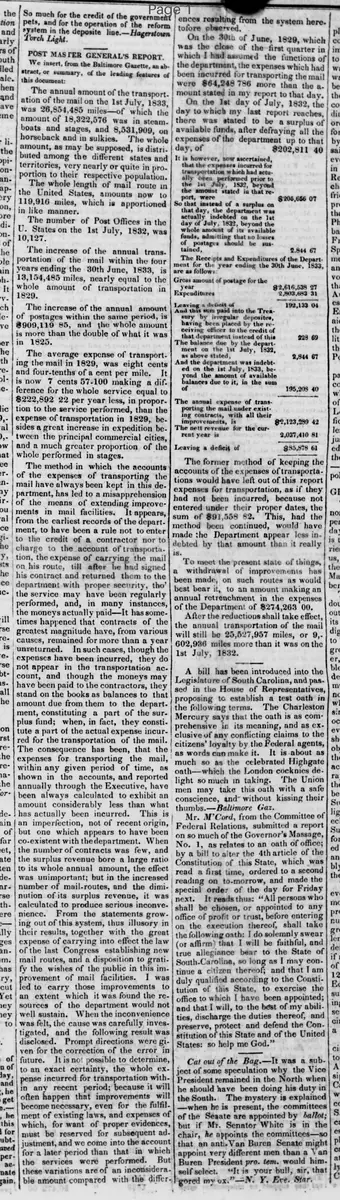
We insert, from the Baltimore Gazette, an abstract, or summary, of the leading features of this document:
The annual amount of the transportation of the mail on the 1st July, 1833, was 26,854,485 miles—of which the amount of 18,322,576 was in steamboats and stages, and 8,531,909, on horseback and in sulkies. The whole amount, as may be supposed, is distributed among the different states and territories, very nearly or quite in proportion to their respective population.
The whole length of mail route in the United States, amounts now to 119,916 miles, which is apportioned in like manner.
The number of Post Offices in the U. States on the 1st July, 1832, was 10,127.
The increase of the annual transportation of the mail within the four years ending the 30th June, 1833, is 13,154,485 miles, nearly equal to the whole amount of transportation in 1829.
The increase of the annual amount of postages within the same period, is $909,119 85, and the whole amount is more than the double of what it was in 1825.
The average expense of transporting the mail in 1829, was eight cents and four-tenths of a cent per mile. It is now 7 cents 57/100 making a difference for the whole service equal to $222,892 22 per year less, in proportion to the service performed, than the expense of transportation in 1829, besides a great increase in expedition between the principal commercial cities, and a much greater proportion of the whole performed in stages.
The method in which the accounts of the expenses of transporting the mail have always been kept in this department, has led to a misapprehension of the means of extending improvements in mail facilities. It appears, from the earliest records of the department, to have been a rule not to enter to the credit of a contractor nor to charge to the account of transportation, the expense of carrying the mail on his route, till after he had signed his contract and returned them to the department with proper security, tho the service may have been regularly performed, and, in many instances, the moneys actually paid—It has sometimes happened that contracts of the greatest magnitude have, from various causes, remained for more than a year unreturned. In such cases, though the expenses have been incurred, they do not appear in the transportation account, and though the moneys may have been paid to the contractors, they stand on the books as balances to that amount due from them to the department, constituting a part of the surplus fund; when, in fact, they constitute a part of the actual expense incurred for the transportation of the mail. The consequence has been, that the expenses for transporting the mail, within any given period of time, as shown in the accounts, and reported annually through the Executive, have been always calculated to exhibit an amount considerably less than what has actually been incurred. This is an imperfection, not of recent origin, but one which appears to have been co-existent with the department. When the number of contracts was few, and the surplus revenue bore a large ratio to its whole annual amount, the effect was unimportant; but in the increased number of mail-routes, and the diminution of its surplus revenue, it was calculated to produce serious inconvenience. From the statements growing out of this system, thus illusory in their results, together with the great expense of carrying into effect the law of the last Congress establishing new mail routes, and a disposition to gratify the wishes of the public in this improvement of mail facilities. I was led to carry those improvements to an extent which it was found the resources of the department would not well sustain. When the inconvenience was felt, the cause was carefully investigated, and the following result was disclosed. Prompt directions were given for the correction of the error in future. It is not possible to determine, to an exact certainty, the whole expense incurred for transportation within any recent period; because it will often happen that improvements will become necessary, even for the fulfilment of existing laws, and expenses of which, for want of proper evidences, must be reserved for subsequent adjustment, and we come into the account for a later period than that in which the services were performed. But these variations are of an inconsiderable amount compared with the differences resulting from the system heretofore observed.
On the 30th of June, 1829, which was the close of the first quarter in which I had assumed the functions of the department, the expenses which had been incurred for transporting the mail were $64,248 78 6 more than the amount stated in my report to that day.
On the 1st day of July, 1832, the day to which my last report reaches, there was stated to be a surplus of available funds, after defraying all the expenses of the department up to that day, of $202,811 40
It is however, now ascertained, that the expenses incurred for transportation which had actually been performed prior to the 1st July, 1832, beyond the amount stated in that report, were $205,656 07
So that instead of a surplus on that day, the department was actually indebted on the 1st day of July, 1832, beyond the whole amount of its available funds. admitting that no losses of postages should be sustained, $2,844 67
The Receipts and Expenditures of the Department for the year ending the 30th June, 1833, are as follows:
Gross amount of postage for the year $2,616,539 27
Expenditures $2,424,406 26
Leaving a deficit of $192,133 01
And this surplus paid into the Treasury by irregular deposites having been placed by the receiving officer to the credit of that department instead of this $923 69
The balance due by the department on the 1st July, 1832, as above stated. $2,844 67
And the department was indebted on the 1st July, 1833, beyond the amount of available balances due to it, in the sum of $195,203 40
The annual expense of transporting the mail under existing contracts, with all their improvements, is $2,123,299 42
The nett revenue for the current year is $2,037,410 81
Leaving a deficit of $85,888 61
The former method of keeping the accounts of the expenses of transportations would have left out of this report expenses or transportation, as if they had not been incurred, because not entered under their proper dates, the sum of $91,558 82. This, had the method been continued, would've made the Department appear less indebted by that amount than it really is.
To meet the present state of things, a withdrawal of improvements has been made, on such routes as would best bear it, to an amount making an annual retrenchment in the expenses of the Department of $274,263 00.
After the reductions shall take effect, the annual transportation of the mail will still be 25,527,957 miles, or 9,602,936 miles more than it was on the 1st July, 1832.
What sub-type of article is it?
What keywords are associated?
Where did it happen?
Domestic News Details
Primary Location
United States
Event Date
Year Ending The 30th June, 1833
Outcome
deficit of $195,203.40 by july 1, 1833; annual retrenchment of $274,263 in expenses; transportation reduced but still increased overall.
Event Details
Summary from Baltimore Gazette of Postmaster General's report detailing mail transportation statistics, increases in mileage and postages, accounting errors leading to underreported expenses, financial deficits, and planned reductions in services.