Thank you for visiting SNEWPapers!
Sign up free
Frostburg Mining Journal
Frostburg, Allegany County, Maryland
What is this article about?
Article discusses the proposed Maryland and Delaware ship canal from Chesapeake Bay to Lewes, 51 miles long, 200 ft wide, 25 ft deep, free of tolls, to save 225 miles for vessels to northern European ports. Recommends $37M appropriation. Benefits coal trade via extension of Chesapeake and Ohio canal, endorsed by John W. Garrett.
Clipping
OCR Quality
Full Text
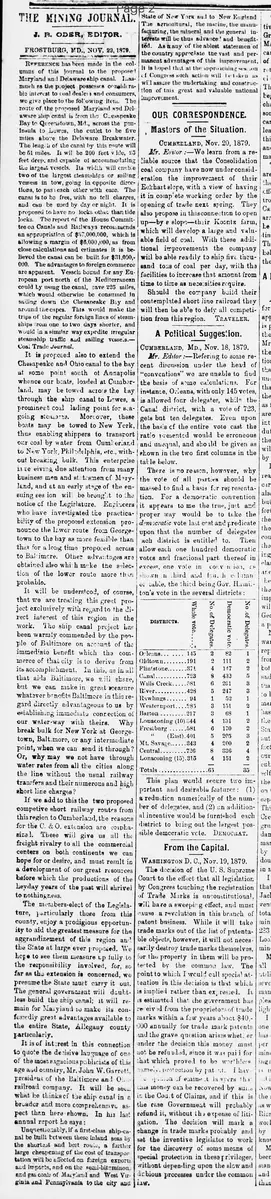
The route of the proposed Maryland and Delaware ship canal is from the Chesapeake Bay to Queenstown, Md., across the peninsula to Lewes, the outlet to be five miles above the Delaware Breakwater. The length of the canal by this route will be 51 miles. It will be 200 feet wide, 25 feet deep, and capable of accommodating the largest vessels. Its width will enable two of the largest steamships or sailing vessels in tow, going in opposite directions, to pass each other with ease. The canal is to be free, with no toll charges, and can be used by day or night. It is proposed to have no locks other than tide locks.
The report of the House Committee on Canals and Railways recommends an appropriation of $37,000,000, which is allowing a margin of $6,000,000, as from close calculations and estimates it is believed the canal can be built for $31,000,000. The advantages to foreign commerce are apparent. Vessels bound for any European port north of the Mediterranean could by using the canal, save 225 miles, which would otherwise be consumed in sailing down the Chesapeake Bay and around the capes. This would make the trips of the regular foreign lines of steamships from one to two days shorter, and would in a similar way expedite irregular steamship traffic and sailing vessels.
Coal Trade Journal
It is proposed also to extend the Chesapeake and Ohio canal to the bay at some point south of Annapolis whence our boats, loaded at Cumberland, may be towed across the bay through the ship canal to Lewes, a prominent coal lading point for sea-going steamers. Moreover, these boats may be towed to New York, thus enabling shippers to transport our coal by water from Cumberland to New York, Philadelphia, etc., without breaking bulk. This enterprise is receiving due attention from many business men and statesmen of Maryland, and at an early stage of the ensuing session will be brought to the notice of the Legislature. Engineers who have investigated the practicability of the proposed extension pronounce the lower route from Georgetown to the bay as more feasible than that for a long time proposed across to Baltimore. Other advantages are obtained also which make the selection of the lower route more than probable.
It will be understood, of course, that we are treating this great project exclusively with regard to the direct interest of this region in the work. The ship canal project has been warmly commended by the people of Baltimore on account of the immediate benefit which the commerce of that city is to derive from its accomplishment. In this, as in all that aids Baltimore, we will share, but we can make in great measure whatever benefits Baltimore in this regard directly advantageous to us by establishing immediate connection of our water-way with theirs. Why break bulk for New York at Georgetown, Baltimore, or any intermediate point, when we can send it through? Or, why may we not have through water rates from all the cities along the line without the usual railway transfers and their numerous and high short line charges?
If we add to this the two proposed competitive short railway routes from this region to Cumberland, the reasons for the C. & O. extension are emphasized. These will give us all the freight rivalry to all the commercial centers on both continents we can hope for or desire, and must result in a development of our great resources before which the productions of the heyday years of the past will shrivel to nothingness.
The members-elect of the Legislature, particularly those from this county, enjoy a prodigious opportunity to aid the greatest measure for the aggrandizement of this region and the State at large ever proposed. We hope to see them measure up fully to the responsibility involved, for, so far as the extension is concerned, we presume the State must carry it out. The general government will doubtless build the ship canal; it will remain for Maryland to make its confessedly great advantages available to the entire State, Allegany county particularly.
It is of interest in this connection to quote the decisive language of one of the most sagacious publicists of this age and country, Mr. John W. Garrett, president of the Baltimore and Ohio railroad company. It will be seen what he thinks of the ship canal in a broader and more comprehensive aspect than here shown. In his last annual report he says:
Unquestionably, if a first-class ship-canal be built between these inland seas by the shortest and best route, a farther large cheapening of the cost of transportation will be effected on foreign exports and imports, and on the semi-bituminous and gas coals of Maryland and West Virginia and Pennsylvania to the city and State of New York and to New England. The agricultural, the marine, the manufacturing, the mineral and the general interests will be thus advanced and benefited. As many of the ablest statesmen of the country appreciate the vast and permanent advantages of this improvement, it is hoped that at the approaching session of Congress such action will be taken as will assure the undertaking and construction of this great and valuable national improvement.
What sub-type of article is it?
What themes does it cover?
What keywords are associated?
What entities or persons were involved?
Where did it happen?
Story Details
Key Persons
Location
Maryland And Delaware Peninsula, From Chesapeake Bay To Lewes
Story Details
Proposed ship canal route from Chesapeake Bay to Lewes, 51 miles, 200 ft wide, 25 ft deep, free tolls, no locks except tide locks, estimated cost $31M with $37M appropriation recommended. Benefits include 225-mile savings for vessels to northern European ports, expedited coal trade via extension of Chesapeake and Ohio canal from Cumberland to New York without breaking bulk. Endorsed for commerce and endorsed by John W. Garrett.