Thank you for visiting SNEWPapers!
Sign up free
Editorial
December 30, 1785
Fowle's New Hampshire Gazette And General Advertiser
Portsmouth, Rockingham County, New Hampshire
What is this article about?
Editorial from Portsmouth, Dec. 30, relays a prominent American figure's (likely Washington) opinion that U.S. salvation hinges on complying with the peace treaty by allowing non-traitorous absconders to return, explaining Britain's hold on frontier posts. Satirically laments the departure of 'Mr. Public Spirit' due to ingratitude and the rise of 'Mr. Self-Interest.'
Clipping
OCR Quality
95%
Excellent
Full Text
Portsmouth, December 30.
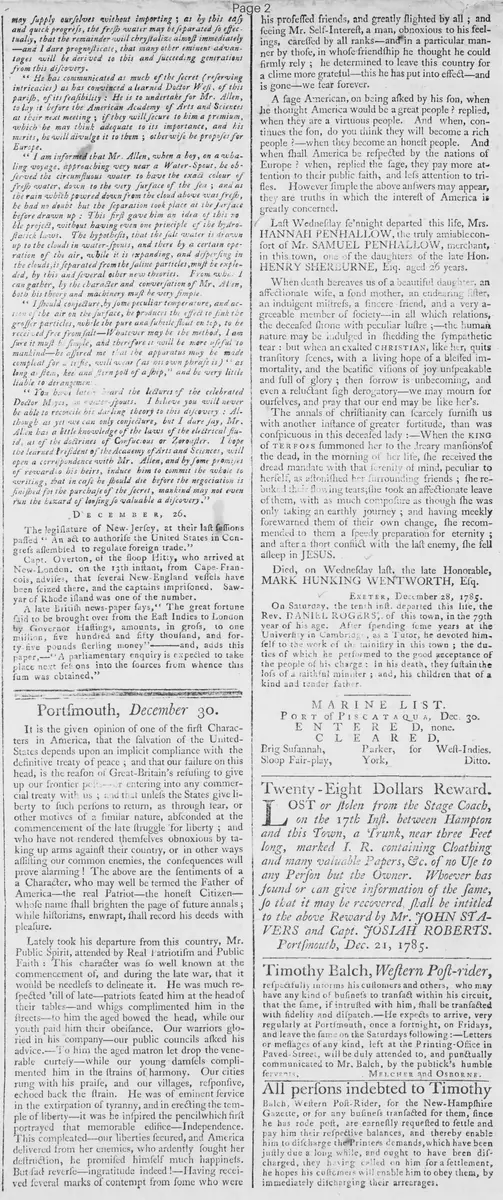
It is the given opinion of one of the first Characters in America, that the salvation of the United-States depends upon an implicit compliance with the definitive treaty of peace; and that our failure on this head, is the reason of Great-Britain's refusing to give up our frontier posts—or entering into any commercial treaty with us; and that unless the States give liberty to such persons to return, as through fear, or other motives of a similar nature, absconded at the commencement of the late struggle for liberty; and who have not rendered themselves obnoxious by taking up arms against their country, or in other ways assisting our common enemies, the consequences will prove alarming! The above are the sentiments of a Character, who may well be termed the Father of America—the real Patriot—the honest Citizen—whose name shall brighten the page of future annals: while historians, enrapt, shall record his deeds with pleasure.
Lately took his departure from this country, Mr. Public Spirit, attended by Real Patriotism and Public Faith: This character was so well known at the commencement of, and during the late war, that it would be needless to delineate it. He was much respected 'till of late—patriots seated him at the head of their tables—and whigs complimented him in the streets—to him the aged bowed the head, while our youth paid him their obeisance. Our warriors gloried in his company—our public councils asked his advice.—To him the aged matron let drop the venerable curtsy—while our young damsels complimented him in the strains of harmony. Our cities rung with his praise, and our villages, responsive, echoed back the strain. He was of eminent service in the extirpation of tyranny, and in erecting the temple of liberty—it was he inspired the pencil which first portrayed that memorable edifice—Independence. This completed—our liberties secured, and America delivered from her enemies, who ardently sought her destruction, he promised himself much happiness.
But sad reverse—ingratitude indeed!—Having received several marks of contempt from some who were his professed friends, and greatly slighted by all: and seeing Mr. Self-Interest, a man, obnoxious to his feelings, caressed by all ranks—and in a particular manner by those, in whose friendship he thought he could firmly rely; he determined to leave this country for a clime more grateful—this he has put into effect—and is gone—we fear forever.
It is the given opinion of one of the first Characters in America, that the salvation of the United-States depends upon an implicit compliance with the definitive treaty of peace; and that our failure on this head, is the reason of Great-Britain's refusing to give up our frontier posts—or entering into any commercial treaty with us; and that unless the States give liberty to such persons to return, as through fear, or other motives of a similar nature, absconded at the commencement of the late struggle for liberty; and who have not rendered themselves obnoxious by taking up arms against their country, or in other ways assisting our common enemies, the consequences will prove alarming! The above are the sentiments of a Character, who may well be termed the Father of America—the real Patriot—the honest Citizen—whose name shall brighten the page of future annals: while historians, enrapt, shall record his deeds with pleasure.
Lately took his departure from this country, Mr. Public Spirit, attended by Real Patriotism and Public Faith: This character was so well known at the commencement of, and during the late war, that it would be needless to delineate it. He was much respected 'till of late—patriots seated him at the head of their tables—and whigs complimented him in the streets—to him the aged bowed the head, while our youth paid him their obeisance. Our warriors gloried in his company—our public councils asked his advice.—To him the aged matron let drop the venerable curtsy—while our young damsels complimented him in the strains of harmony. Our cities rung with his praise, and our villages, responsive, echoed back the strain. He was of eminent service in the extirpation of tyranny, and in erecting the temple of liberty—it was he inspired the pencil which first portrayed that memorable edifice—Independence. This completed—our liberties secured, and America delivered from her enemies, who ardently sought her destruction, he promised himself much happiness.
But sad reverse—ingratitude indeed!—Having received several marks of contempt from some who were his professed friends, and greatly slighted by all: and seeing Mr. Self-Interest, a man, obnoxious to his feelings, caressed by all ranks—and in a particular manner by those, in whose friendship he thought he could firmly rely; he determined to leave this country for a clime more grateful—this he has put into effect—and is gone—we fear forever.
What sub-type of article is it?
Foreign Affairs
Satire
Moral Or Religious
What keywords are associated?
Peace Treaty Compliance
Frontier Posts
Loyalist Return
Public Spirit
Self Interest
Patriotism Decline
Post War Ingratitude
What entities or persons were involved?
Father Of America
Mr. Public Spirit
Real Patriotism
Public Faith
Mr. Self Interest
Great Britain
Editorial Details
Primary Topic
Compliance With Peace Treaty And Decline Of Public Spirit
Stance / Tone
Urgent Exhortation And Satirical Lament
Key Figures
Father Of America
Mr. Public Spirit
Real Patriotism
Public Faith
Mr. Self Interest
Great Britain
Key Arguments
Salvation Of U.S. Depends On Implicit Compliance With Peace Treaty
Failure To Comply Causes Britain To Withhold Frontier Posts And Commercial Treaty
States Must Allow Return Of Non Obnoxious Absconders
Public Spirit Respected During War But Now Slighted
Rise Of Self Interest Leads To Ingratitude And Departure Of Patriotism