Thank you for visiting SNEWPapers!
Sign up free
Literary
July 14, 1838
The Native American
Washington, District Of Columbia
What is this article about?
The essay advocates for practical education teaching American youth honorable self-reliance through productive labor guided by scientific knowledge, critiquing colleges for fostering idleness in the privileged and common schools for inadequate preparation for useful societal roles.
Clipping
OCR Quality
98%
Excellent
Full Text
WHAT IS A USEFUL EDUCATION?
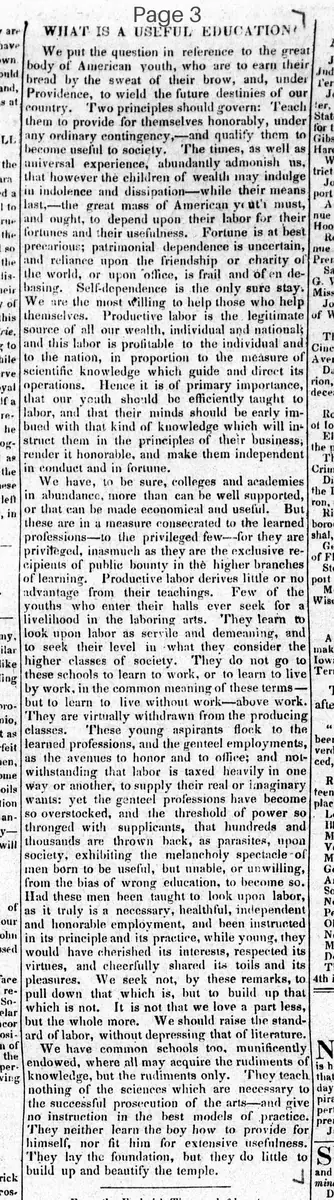
We put the question in reference to the great body of American youth, who are to earn their bread by the sweat of their brow, and, under Providence, to wield the future destinies of our country. Two principles should govern: Teach them to provide for themselves honorably, under any ordinary contingency,—and qualify them to become useful to society. The times, as well as universal experience, abundantly admonish us, that however the children of wealth may indulge in indolence and dissipation—while their means last,—the great mass of American youth must, and ought, to depend upon their labor for their fortunes and their usefulness. Fortune is at best precarious; patrimonial dependence is uncertain, and reliance upon the friendship or charity of the world, or upon office, is frail and often debasing. Self-dependence is the only sure stay: We are the most willing to help those who help themselves. Productive labor is the legitimate source of all our wealth, individual and national; and this labor is profitable to the individual and to the nation, in proportion to the measure of scientific knowledge which guide and direct its operations. Hence it is of primary importance, that our youth should be efficiently taught to labor, and that their minds should be early imbued with that kind of knowledge which will instruct them in the principles of their business: render it honorable, and make them independent in conduct and in fortune.
We have, to be sure, colleges and academies in abundance, more than can be well supported, or that can be made economical and useful. But these are in a measure consecrated to the learned professions—to the privileged few—for they are privileged, inasmuch as they are the exclusive recipients of public bounty in the higher branches of learning. Productive labor derives little or no advantage from their teachings. Few of the youths who enter their halls ever seek or a livelihood in the laboring arts. They learn to look upon labor as servile and demeaning, and to seek their level in what they consider the higher classes of society. They do not go to these schools to learn to work, or to learn to live by work, in the common meaning of these terms—but to learn to live without work—above work. They are virtually withdrawn from the producing classes. These young aspirants flock to the learned professions, and the genteel employments, as the avenues to honor and to office; and notwithstanding that labor is taxed heavily in one way or another, to supply their real or imaginary wants: yet the genteel professions have become so overstocked, and the threshold of power so thronged with supplicants, that hundreds and thousands are thrown back, as parasites, upon society, exhibiting the melancholy spectacle of men born to be useful, but unable, or unwilling, from the bias of wrong education, to become so.
Had these men been taught to look upon labor, as it truly is a necessary, healthful, independent and honorable employment, and been instructed in its principle and its practice, while young, they would have cherished its interests, respected its virtues, and cheerfully shared its toils and its pleasures. We seek not, by these remarks, to pull down that which is, but to build up that which is not. It is not that we love a part less, but the whole more. We should raise the standard of labor, without depressing that of literature.
We have common schools too, munificently endowed, where all may acquire the rudiments of knowledge, but the rudiments only. They teach nothing of the sciences which are necessary to the successful prosecution of the arts—and give no instruction in the best models of practice. They neither learn the boy how to provide for himself, nor fit him for extensive usefulness. They lay the foundation, but they do little to build up and beautify the temple.
We put the question in reference to the great body of American youth, who are to earn their bread by the sweat of their brow, and, under Providence, to wield the future destinies of our country. Two principles should govern: Teach them to provide for themselves honorably, under any ordinary contingency,—and qualify them to become useful to society. The times, as well as universal experience, abundantly admonish us, that however the children of wealth may indulge in indolence and dissipation—while their means last,—the great mass of American youth must, and ought, to depend upon their labor for their fortunes and their usefulness. Fortune is at best precarious; patrimonial dependence is uncertain, and reliance upon the friendship or charity of the world, or upon office, is frail and often debasing. Self-dependence is the only sure stay: We are the most willing to help those who help themselves. Productive labor is the legitimate source of all our wealth, individual and national; and this labor is profitable to the individual and to the nation, in proportion to the measure of scientific knowledge which guide and direct its operations. Hence it is of primary importance, that our youth should be efficiently taught to labor, and that their minds should be early imbued with that kind of knowledge which will instruct them in the principles of their business: render it honorable, and make them independent in conduct and in fortune.
We have, to be sure, colleges and academies in abundance, more than can be well supported, or that can be made economical and useful. But these are in a measure consecrated to the learned professions—to the privileged few—for they are privileged, inasmuch as they are the exclusive recipients of public bounty in the higher branches of learning. Productive labor derives little or no advantage from their teachings. Few of the youths who enter their halls ever seek or a livelihood in the laboring arts. They learn to look upon labor as servile and demeaning, and to seek their level in what they consider the higher classes of society. They do not go to these schools to learn to work, or to learn to live by work, in the common meaning of these terms—but to learn to live without work—above work. They are virtually withdrawn from the producing classes. These young aspirants flock to the learned professions, and the genteel employments, as the avenues to honor and to office; and notwithstanding that labor is taxed heavily in one way or another, to supply their real or imaginary wants: yet the genteel professions have become so overstocked, and the threshold of power so thronged with supplicants, that hundreds and thousands are thrown back, as parasites, upon society, exhibiting the melancholy spectacle of men born to be useful, but unable, or unwilling, from the bias of wrong education, to become so.
Had these men been taught to look upon labor, as it truly is a necessary, healthful, independent and honorable employment, and been instructed in its principle and its practice, while young, they would have cherished its interests, respected its virtues, and cheerfully shared its toils and its pleasures. We seek not, by these remarks, to pull down that which is, but to build up that which is not. It is not that we love a part less, but the whole more. We should raise the standard of labor, without depressing that of literature.
We have common schools too, munificently endowed, where all may acquire the rudiments of knowledge, but the rudiments only. They teach nothing of the sciences which are necessary to the successful prosecution of the arts—and give no instruction in the best models of practice. They neither learn the boy how to provide for himself, nor fit him for extensive usefulness. They lay the foundation, but they do little to build up and beautify the temple.
What sub-type of article is it?
Essay
What themes does it cover?
Moral Virtue
Liberty Freedom
Political
What keywords are associated?
Useful Education
American Youth
Productive Labor
Self Dependence
Common Schools
Learned Professions
Literary Details
Title
What Is A Useful Education?
Subject
On Useful Education For American Youth Emphasizing Labor And Self Dependence
Key Lines
Self Dependence Is The Only Sure Stay: We Are The Most Willing To Help Those Who Help Themselves.
Productive Labor Is The Legitimate Source Of All Our Wealth, Individual And National; And This Labor Is Profitable To The Individual And To The Nation, In Proportion To The Measure Of Scientific Knowledge Which Guide And Direct Its Operations.
They Learn To Look Upon Labor As Servile And Demeaning, And To Seek Their Level In What They Consider The Higher Classes Of Society.
We Should Raise The Standard Of Labor, Without Depressing That Of Literature.
They Lay The Foundation, But They Do Little To Build Up And Beautify The Temple.