Thank you for visiting SNEWPapers!
Sign up free
Belmont Chronicle
Saint Clairsville, Belmont County, Ohio
What is this article about?
Stubborn farmer Joel Shellenbarger opposes his son Anson's romance with professor's daughter Barbie Halstead, deeming her unfit as a 'town girl.' Disguised as Irish servant Biddy, Barbie infiltrates the home, wins Joel's approval through her skills, reveals her identity, and secures the marriage, transforming the household.
Clipping
OCR Quality
Full Text
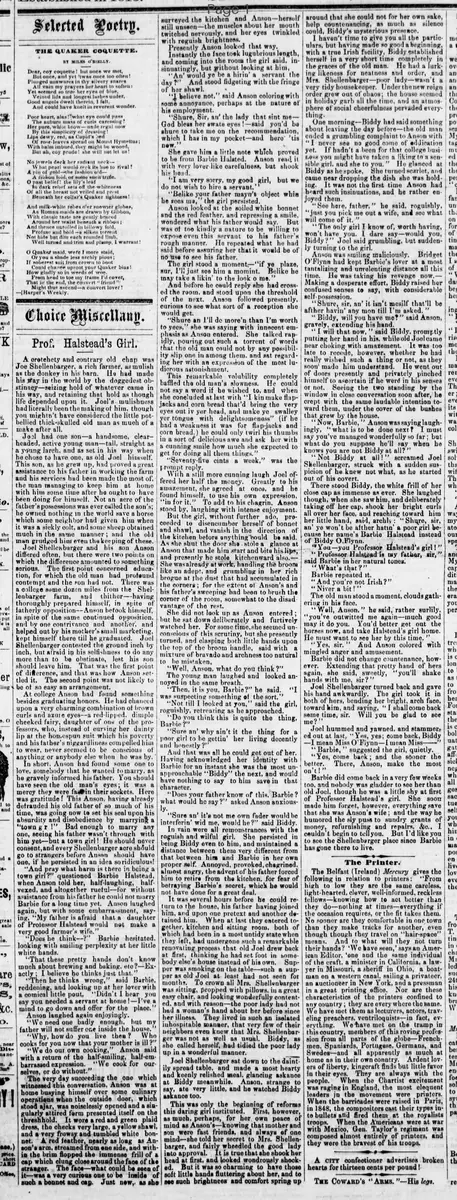
Joe Shellenbarger, a rich farmer, as mulish
as the donkey in his barn. He had made
his way in the world by the doggedest ob-
stinacy—seizing hold of whatever came in
his way, and retaining that hold as though
life depended upon it. Joel's mulishness
had literally been the making of him, though
you mightn't have considered the little pot-
bellied thick-skulled old man as much of a
make after all.
Joel had one son—a handsome, clear-
headed, active young man—tall, straight as
a young larch, and as set in his way when
he chose to have one, as old Joel himself.
This son, as he grew up, had proved a great
assistance to his father in working the farm
and his services had been made the most of,
the man managing to keep him at home
with him some time after he ought to have
been doing for himself. Not an acre of the
father's possessions was ever called the son's:
he owned nothing in the world save a horse
which some neighbor had given him when
it was a sickly colt, and some sheep obtained
much in the same manner; and the old
man grudged him even the keeping of these.
Joel Shellenbarger and his son Anson
differed often, but there were two points on
which the difference amounted to something
serious. The first point concerned education,
for which the old man had profound
contempt and the son had not. There was
a college some dozen miles from the Shel-
lenbarger farm, and thither—having
thoroughly prepared himself, in spite of
fatherly opposition—Anson betook himself
in spite of the same continued opposition,
and by one contrivance and another, and
helped out by his mother's small marketing,
kept himself there till he graduated. Joel
Shellenbarger contested the ground inch by
inch, but afraid in his selfishness to do any
more than to be obstinate, lest his son
should leave him. That was the first point
of difference, and that was how Anson set-
tled it. The second point was not likely to
be of so easy an arrangement.
At college Anson had found something
besides graduating honors. He had chanced
upon a very charming combination of brown
curls and azure eyes—a red-lipped, dimple
cheeked fairy, daughter of one of the pro-
fessors, who, instead of curving her dainty
lip at the homespun suit which his poverty
and his father's niggardliness compelled him
to wear, never seemed to be conscious of
anything or anybody else when he was by.
In short, Anson had found some one to
love, somebody that he wanted to marry, as
he gravely informed his father. You should
have seen the old man's eyes; it was a
mercy they were fast in their sockets. Here
was gratitude! This Anson, having already
defrauded his old father of so much of his
time, was going now to set his seal upon his
absurdity and disobedience by marrying a
"town girl!"
Bad enough to marry any
one, seeing his father wasn't through with
him yet—but a town girl! He should never
consent, and every Shellenbarger acre should
go to strangers before Anson should have
one, if he persisted in an idea so ridiculous!
"And pray what harm is there in being a
town girl?" questioned Barbie Halstead,
when Anson told her, half-laughing, half
vexed, and altogether rueful—for without
assistance from his father he could not marry
Barbie for a long time yet. Anson laughed
again, but with some embarrassment, say-
ing, "My father is afraid that a daughter
of Professor Halstead would not make a
very good farmer's wife."
"Does he think—?" Barbie hesitated,
looking with smiling perplexity at her little
white hands.
"That these pretty hands don't know
much about brewing and baking, etc.?—Ex-
actly; I believe he thinks just that."
"Then he thinks wrong," said Barbie,
reddening, and looking up at her lover with
a comical little pout. "Didn't I hear you
say you needed a servant at home!—I've a
mind to go down and offer for the place."
Anson laughed again enjoyingly.
"We need one badly enough, but my
father will not suffer one inside the house.
"Why, how do you live then? Who
cooks for you now that your mother is ill?"
"We do our own cooking," Anson said
with a return of the half-smiling, half-em-
barrassed expression. "We cook for our-
selves, or do without."
The very day succeeding the one which
witnessed this conversation, Anson was at
home busying himself over some culinary
operations when the outside door, which
stood ajar, was noiselessly opened and a sin-
gularly attired form presented itself on the
threshhold. It wore a red and green plaid
dress, the checks very large, a yellow shawl,
and a very frowsy and tumbled white bon-
net. A red feather, nearly as long as An-
son's arm, streamed from one side, and with-
in the brim flopped the immense frill of a
cap which clung close around the face of the
stranger. The face—what could be seen of
it—was a very curious one to be inside of
such a bonnet and cap. Just now, as she
surveyed the kitchen and Anson—herself
still unseen—the muscles about her mouth
twitched nervously, and her eyes twinkled
with roguish brightness.
Presently Anson looked that way.
Instantly the face took lugubrious length.
and coming into the room the girl said, in-
sinuatlingly, but without looking at him,
"An' would ye be a hirin' a servant the
day?" And stood fidgeting with the fringe
of her shawl.
"I believe not," said Anson coloring with
some annoyance, perhaps at the nature of
his employment.
"Shure, Sir, an' the lady that sint me—
God bless her swate eyes!—said you'd be
ahure to take me on the recoinmendation.
which I has in my pocket—and hero' 'tis
new."
She gave him a little note which proved
to be from Barbie Halstead. Anson read it
with very lover-like carefulness, but shook
his head.
"I am very sorry, my good girl, but we
do not wish to hire a servant."
"Belike your father mayn't object whin
he sees me," the girl persisted.
Anson looked at the soiled white bonnet
and the red feather, and repressing a smile
wondered what his father would say. But
was of too kindly a nature to be willing to
expose even this servant to his father's
rough manner. He repeated what he had
said before assuring her that it would be of
no use to see his father
The girl stood a moment. "If ye plaze,
sur, I'll just see him a momint. Belike he
may take a likin' to the look o' me."
And before he could reply she had crossed
the room, and stood upon the threshold
of the next. Anson followed presently,
curious to see what sort of a reception she
would get.
"Shure an' I'll do more'n than I'm worth
to yees," she was saying with innocent em-
phasis as Anson entered. She talked rap-
idly, pouring out such a torrent of words
that the old man could not by any possibil-
ity slip one in among them, and sat regard-
ing her with an expression of the most lu-
dicrous astonishment.
This remarkable volubility completely
baffled the old man's slowness. He could
not say a word if he wished to, and when
she concluded at last with "I kin make flap
jacks and corn bread that'd bring the very
eyes out iv yer head, and make ye swalley
yer tongue with delightsomeness" (if he
had a weakness it was for flap-jacks and
corn bread.) he could only twirl his thumbs
in a sort of delicious awe and ask her with
a cunning smile how much she expected to
get for doing all them things.
"Seventy-five cints a week,"
was the
prompt reply.
With a still more cunning laugh Joel of-
fered her half the money. Greatly to his
amazement, she agreed at once, and he
found himself, to use his own expression,
"in for it." To add to his chagrin, Anson
stood by, laughing with intense enjoyment.
But the girl, without further ado, pro-
ceeded to disencumber herself of bonnet
and shawl, and vanish in the direction of
the kitchen before anything could be said.
As she shut the door she stole a glance at
Anson that made him start and bite his lips.
and presently he stole kitchenward also.—
She was already at work, handling the broom
like an adept, and grumbling in her rich
brogue at the dust that had accumulated in
the corpers: for the extent of Anson's and
his father's sweeping had been to brush the
corner of the room, somewhat to the disad-
vantage of the rest.
She did not look up as Anson entered;
but he sat down deliberately and furtively
watched her. For some time she seemed un-
conscious of this scrutiny, but she presently
turned, and clasping both little hands upon
the top of the broom handle, said with a
mixture of bravado and archness too natural
to be mistaken,
"Well, Anson, what do you think?"
The young man laughed and looked an-
noyed in the same breath.
Then, it is you, Barbie?" he said. "I
was suspecting something of the sort.
"Not till I looked at you," said the girl,
roguishly, retreating as he approached.
Do you think this is quite the thing,
Barbie?"
"Sure an' why ain't it the thing for a
poor girl to be gettin' her living decently
and honestly?'
And that was all he could get out of her.
Having acknowledged her identity with
Barbie for an instant she was the most un-
approachable "Biddy" the next, and would
have nothing to say to him save in that
character.
"Does your father know of this, Barbie?
what would he say?" asked Anson anxious-
ly.
"Sure an' it'e not me own fader would be
interferin' wid me, would he?" said Biddy.
In vain were all remonstrances with the
roguish and wilful girl. She persisted in
being Biddy even to him, and maintained a
distance between them very different from
that between her and Barbie in her own
proper self. Annoyed, provoked, chagrined,
almost angry, the advent of his father forced
him to retire from the kitchen, for fear of
betraying Barbie's secret, which he would
not have done for a great deal.
It was several hours before he could re-
turn to the house, his father having joined
him, and upon one pretext and another de-
tained him. When at last they entered to-
gether, kitchen and sitting room, both of
which had been in a most untidy state when
they left, had undergone such a remarkable
renovating process that old Joel drew back
at first, thinking he had set foot in some-
body else's house instead of his own. Sup-
per was smoking on the table—such a sup-
per as old Joel at least had not seen for
months. To crown all Mrs. Shellenbarger
was sitting, propped with pillows, in a great
easy chair, and looking wonderfully content-
ed, and with reason—the poor lady had not
had a woman's hand about her before since
her illness. They lived in such an isolated
inhospitable manner, that very few of their
neighbors even knew that Mrs. Shellenbar-
ger was not as well as usual. Biddy, as
she called herself, had tidied the poor lady
up in a wonderful manner.
Joel Shellenbarger sat down to the daint-
ily spread table, and made a most hearty
and keenly relished meal, glancing askance
at Biddy meanwhile. Anson, strange to
say, ate very little, and he watched Biddy
askance too.
This was only the beginning of reforms
this daring girl instituted. First, however,
as much, perhaps, for her own peace of
mind as Anson's—knowing that mother and
son were fast friends, and always of one
mind—she told her secret to Mrs. Shellen-
barger, and fairly wheedled the good lady
into approval. It is true that she shook her
head at first, and looked wondrously shock-
ed. But it was so charming to have those
soft little hands fluttering about her, and to
see such brightness and comfort spring up
around that she could not for her own sake.
help countenancing, as much as silence
could, Biddy's mysterious presence.
I haven't time to give you all the partic-
ulars, but having made so good a beginning,
with a true Irish facility, Biddy established
herself in a very short time completely in
the graces of the old man. He had a lurk-
ing likeness for neatness and order, and
Mrs. Shellenbarger—poor lady—wasn't a
very tidy housekeeper. Under the new reign
order grew out of chaos; the house seemed
in holiday garb all the time, and an atmos-
phere of social cheerfulness pervaded every-
thing
One morning—Biddy had said something
about leaving the day before—the old man
ended a grumbling complaint to Anson with
"I never see no good come of eddication
yet. If it hadn't a been for that college busi-
ness you might have taken a liking to a sen-
sible girl, and she to you." He glanced at
Biddy as he spoke. She turned scarlet, and
came near dropping the dish she was hold-
ing. It was not the first time Anson had
heard such insinuations, and he rather en-
joyed them.
"See here, father," he said, roguishly
"just you pick me out a wife, and see what
will come of it."
"The only girl I know of, worth having,
won't have you. I dare say—would you,
Biddy?" Joel said grumbling, but sudden-
ly turning to the girl.
Anson was smiling maliciously. Bridget
O'Flynn had kept Barbie's lover at a most
tantalizing and unrelenting distance all this
time. He was taking his revenge now.—
Making a desperate effort, Biddy raised her
confused senses to say, with considerable
self-possession.
"Shure, sir, an' it isn't mesilf that'll be
afther havin' any mon till I'm asked."
"Biddy, will you have me?" said Anson,
gravely, extending his hand.
"I will that now," said Biddy, promptly
putting her hand in his, while old Joel came
near choking with amazement. It was too
late to recede, however, whether he had
really wished such a thing or not, as they
soon made him understand. He went out
of doors presently and privately pinched
himself to ascertain if he were in his senses
or not. Seeing the two standing by the
window in close conversation soon after, he
crept with the same laudable intention to-
ward them, under the cover of the bushes
that grew by the house.
"Now, Barbie," Anson was saying laugh-
ingly, "what is to be done next? I must
say you've managed wonderfully so far: but
what do you suppose he'll say when he
knows you are not Biddy at all?"
"Not Biddy at all!" screamed Joel
Shellenbarger, struck with a sudden sus-
picion of he knew not what, as he started
out of his covert.
There stood Biddy, the white frill of her
close cap as immense as ever. She laughed
though, when she saw him, and deliberately
taking off her cap, shook her bright curls
all over her face, and reaching toward him
her little hand, said, archly: "Shure, sir,
an' ye won't be afther hatin' a poor girl be-
cause her name's Barbie Halstead instead
of Biddy O'Flynn."
"You—you Professor Halstead's girl!"
"Professor Halstead is my father, sir,"
said Barbie in her natural tones.
"What's that?"
Barbie repeated it.
"And you're not Irish?"
"Niver a bit!"
The old man stood a moment, clouds gath-
ering in his face.
"Well, Anson,"
he said, rather surlily,
"you've outwitted me again—much good
may it do you. You'd better get out the
horses now, and take Halstead's girl home.
He must want to see her by this time."
"Yes, sir." And Anson colored with
mingled anger and amusement.
Barbie did not change countenance, how-
ever. Extending that pretty hand of hers
again, she said, sweetly, "you'll shake
hands with me, sir?"
Joel Shellenbarger turned back and gave
his hand awkwardly. The girl took it in
both of hers, bending her bright, arch face,
toward him, and saying, "I shall come back
some time, sir. Will you be glad to see
me?"
Joel hummed and yawned, and stammered
out at last. "Yes, yes; come back, Biddy
—I mean Miss O'Flynn—I mean Miss
"Barbie," suggested the girl, quietly.
"Yes, come back; and the sooner the
better.
There, Anson, make the most
on't"
Barbie did come back in a very few weeks
too, and nobody was gladder to see her than
old Joel, though he was a little shy at first
of Professor Halstead's girl. She soon
made him forget, however, everything save
that she was Anson's wife: and the way he
humored the sly puss to sundry grants of
money, refurnishing and repairs, &c., I
couldn't begin to tell you. But I'd like you
to see the Shellenbarger place since Barbie
has gone there to live.
What sub-type of article is it?
What themes does it cover?
What keywords are associated?
What entities or persons were involved?
Where did it happen?
Story Details
Key Persons
Location
Shellenbarger Farm, College Dozen Miles Away
Story Details
Stubborn farmer Joel opposes son Anson's marriage to town girl Barbie Halstead. Barbie disguises as Irish servant Biddy, enters the home, demonstrates domestic skills, wins Joel's favor, reveals identity, gains approval, marries Anson, and improves the household.