Thank you for visiting SNEWPapers!
Sign up free
Foreign News
October 14, 1823
Alexandria Gazette & Advertiser
Alexandria, Virginia
What is this article about?
During the Turkish sacking of Scio, a Greek woman was enslaved, forced to convert, and married to her captor. In Cognia, Anatolia, on July 11, she killed him in revenge for her family's murder, confessed, and was pardoned by the Pacha, astonishing locals.
Clipping
OCR Quality
95%
Excellent
Full Text
SCIO.
From the Baltimore American,
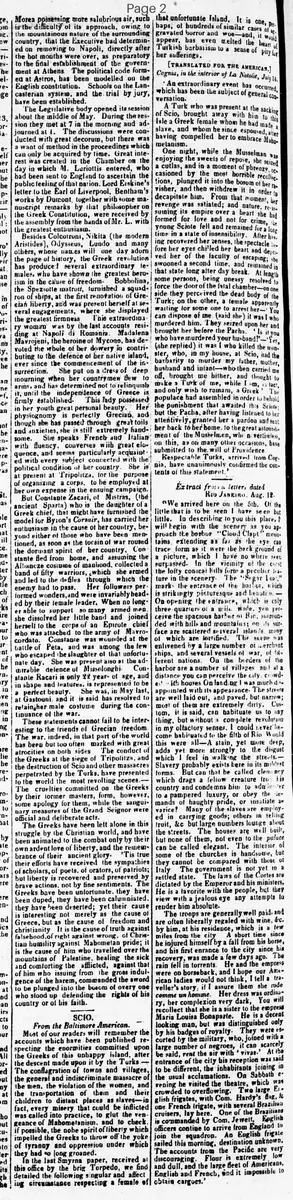
Most of our readers will remember the accounts which have been published respecting the enormities committed upon the Greeks of this unhappy island, after the descent made upon it by the Turks.— The conflagration of towns and villages, the general and indiscriminate massacre of the men, the violation of the women, and the transportation of them and their children to distant places as slaves—in fact, every misery that could be inflicted was called into practice, to glut the vengeance of Mahometanism, and to check, if possible, the noble spirit of liberty which impelled the Greeks to throw off the yoke of tyranny and oppression under which they had long groaned.
In the last Smyrna paper, received at this office by the brig Torpedo, we find detailed the following singular and affecting circumstance respecting a female of that unfortunate Island. It is one, perhaps, of hundreds of similar cases of aggravated horror and woe—and, it would appear, has even melted the heart of Turkish barbarism to a sense of pity for her sufferings.
[Translated for the American.]
Cognia, in the interior of La Notolie, July 11: An extraordinary event has occurred, which has been the subject of general conversation.
A Turk who was present at the sacking of Scio, brought away with him to this Isle a Greek female whom he had made a slave, and whom he since espoused, after having compelled her to embrace Mahometanism.
One night, while the Musselman was enjoying the sweets of repose, she seized a cutlas, and in a moment of phrenzy, occasioned by the most horrible recollections, plunged it into the bosom of her ravisher, and then withdrew it in order to decapitate him. From that moment, her revenge was satiated; and nature, re-assuming its empire over a heart she had formed for love and not for crime, the young Sciote fell and remained for a long time in a state of insensibility. After having recovered her senses, the spectacle before her eyes chilled her heart and deprived her of the faculty of escaping; she swooned a second time, and remained in that state long after day break. At length some persons, being uneasy resolved to force the door of the fatal chamber—on one side they perceived the dead body of the Turk; on the other, a female apparently waiting for some one to arrest her— 'You can dispose of me (said she) it was I who murdered him.' They seized upon her and brought her before the Pacha. 'Is it you who have murdered your husband?'—'Yes, (she replied) it was I who killed the monster, who, in my house, at Scio, had the barbarity to murder my father, mother, husband and infant—who then carried me off, brought me hither, and thought to make a Turk of me, while I am, in fact, and only wish to remain, a Greek.' The populace had assembled in order to behold the punishment that awaited this Sciote; but the Pacha, after having listened to her attentively, granted her a pardon and sent her back to her home, to the great astonishment of the Musselmen, who nevertheless, on this, as on many other occasions, have submitted to the will of Providence.
Respectable Turks, arrived from Cognia, have unanimously confirmed the contents of this statement.
From the Baltimore American,
Most of our readers will remember the accounts which have been published respecting the enormities committed upon the Greeks of this unhappy island, after the descent made upon it by the Turks.— The conflagration of towns and villages, the general and indiscriminate massacre of the men, the violation of the women, and the transportation of them and their children to distant places as slaves—in fact, every misery that could be inflicted was called into practice, to glut the vengeance of Mahometanism, and to check, if possible, the noble spirit of liberty which impelled the Greeks to throw off the yoke of tyranny and oppression under which they had long groaned.
In the last Smyrna paper, received at this office by the brig Torpedo, we find detailed the following singular and affecting circumstance respecting a female of that unfortunate Island. It is one, perhaps, of hundreds of similar cases of aggravated horror and woe—and, it would appear, has even melted the heart of Turkish barbarism to a sense of pity for her sufferings.
[Translated for the American.]
Cognia, in the interior of La Notolie, July 11: An extraordinary event has occurred, which has been the subject of general conversation.
A Turk who was present at the sacking of Scio, brought away with him to this Isle a Greek female whom he had made a slave, and whom he since espoused, after having compelled her to embrace Mahometanism.
One night, while the Musselman was enjoying the sweets of repose, she seized a cutlas, and in a moment of phrenzy, occasioned by the most horrible recollections, plunged it into the bosom of her ravisher, and then withdrew it in order to decapitate him. From that moment, her revenge was satiated; and nature, re-assuming its empire over a heart she had formed for love and not for crime, the young Sciote fell and remained for a long time in a state of insensibility. After having recovered her senses, the spectacle before her eyes chilled her heart and deprived her of the faculty of escaping; she swooned a second time, and remained in that state long after day break. At length some persons, being uneasy resolved to force the door of the fatal chamber—on one side they perceived the dead body of the Turk; on the other, a female apparently waiting for some one to arrest her— 'You can dispose of me (said she) it was I who murdered him.' They seized upon her and brought her before the Pacha. 'Is it you who have murdered your husband?'—'Yes, (she replied) it was I who killed the monster, who, in my house, at Scio, had the barbarity to murder my father, mother, husband and infant—who then carried me off, brought me hither, and thought to make a Turk of me, while I am, in fact, and only wish to remain, a Greek.' The populace had assembled in order to behold the punishment that awaited this Sciote; but the Pacha, after having listened to her attentively, granted her a pardon and sent her back to her home, to the great astonishment of the Musselmen, who nevertheless, on this, as on many other occasions, have submitted to the will of Providence.
Respectable Turks, arrived from Cognia, have unanimously confirmed the contents of this statement.
What sub-type of article is it?
Rebellion Or Revolt
Military Campaign
What keywords are associated?
Scio Sacking
Greek Woman Revenge
Turkish Pardon
Greek Revolt
Family Massacre
What entities or persons were involved?
Pacha
Where did it happen?
Scio
Foreign News Details
Primary Location
Scio
Event Date
July 11
Key Persons
Pacha
Outcome
turk killed by the greek woman; woman pardoned by the pacha.
Event Details
A Greek woman from Scio, enslaved and forced to marry a Turk after the sacking, killed him in revenge for murdering her family, confessed, and was pardoned by the Pacha in Cognia.