Thank you for visiting SNEWPapers!
Sign up free
Story
November 18, 1872
Rock Island Argus
Rock Island, Rock Island County County, Illinois
What is this article about?
A philosophical reflection on the universal instinctive fear of death, contrasted with suicides driven by passion, portraying death as gentle, painless, and a beneficent end to suffering, drawing on observations by Lord Bacon and Theodore Parker.
Clipping
OCR Quality
95%
Excellent
Full Text
Daily Argus.
The Fear of Death,
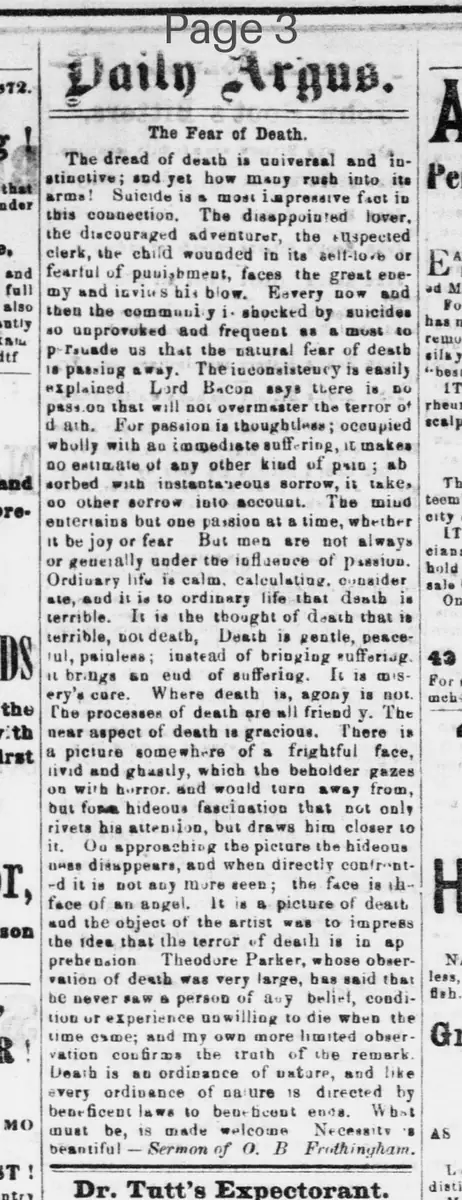
The dread of death is universal and instinctive; and yet how many rush into its arms! Suicide is a most impressive fact in this connection. The disappointed lover, the discouraged adventurer, the suspected clerk, the child wounded in its self-love or fearful of punishment, faces the great enemy and invites his blow. Every now and then the community is shocked by suicides so unprovoked and frequent as to force upon us that the natural fear of death is passing away. The inconsistency is easily explained. Lord Bacon says there is no passion that will not overmaster the terror of death. For passion is thoughtless; occupied wholly with an immediate suffering, it makes no estimate of any other kind of pain; absorbed with instantaneous sorrow, it takes no other sorrow into account. The mind entertains but one passion at a time, whether it be joy or fear. But men are not always or generally under the influence of passion. Ordinary life is calm, calculating, considerate, and it is to ordinary life that death is terrible. It is the thought of death that is terrible, not death. Death is gentle, peaceful, painless; instead of bringing suffering, it brings an end of suffering. It is misery's cure. Where death is, agony is not.
The processes of death are all friendly. The near aspect of death is gracious. There is a picture somewhere of a frightful face, livid and ghastly, which the beholder gazes on with horror, and would turn away from, but for a hideous fascination that not only rivets his attention, but draws him closer to it. On approaching the picture the hideousness disappears, and when directly confronted it is not any more seen; the face is the face of an angel. It is a picture of death and the object of the artist was to impress the idea that the terror of death is in apprehension. Theodore Parker, whose observation of death was very large, has said that he never saw a person of any belief, condition or experience unwilling to die when the time came; and my own more limited observation confirms the truth of the remark. Death is an ordinance of nature, and like every ordinance of nature is directed by beneficent laws to beneficent ends. What must be, is made welcome. Necessity is beautiful. -Sermon of O. B Frothingham.
The Fear of Death,
The dread of death is universal and instinctive; and yet how many rush into its arms! Suicide is a most impressive fact in this connection. The disappointed lover, the discouraged adventurer, the suspected clerk, the child wounded in its self-love or fearful of punishment, faces the great enemy and invites his blow. Every now and then the community is shocked by suicides so unprovoked and frequent as to force upon us that the natural fear of death is passing away. The inconsistency is easily explained. Lord Bacon says there is no passion that will not overmaster the terror of death. For passion is thoughtless; occupied wholly with an immediate suffering, it makes no estimate of any other kind of pain; absorbed with instantaneous sorrow, it takes no other sorrow into account. The mind entertains but one passion at a time, whether it be joy or fear. But men are not always or generally under the influence of passion. Ordinary life is calm, calculating, considerate, and it is to ordinary life that death is terrible. It is the thought of death that is terrible, not death. Death is gentle, peaceful, painless; instead of bringing suffering, it brings an end of suffering. It is misery's cure. Where death is, agony is not.
The processes of death are all friendly. The near aspect of death is gracious. There is a picture somewhere of a frightful face, livid and ghastly, which the beholder gazes on with horror, and would turn away from, but for a hideous fascination that not only rivets his attention, but draws him closer to it. On approaching the picture the hideousness disappears, and when directly confronted it is not any more seen; the face is the face of an angel. It is a picture of death and the object of the artist was to impress the idea that the terror of death is in apprehension. Theodore Parker, whose observation of death was very large, has said that he never saw a person of any belief, condition or experience unwilling to die when the time came; and my own more limited observation confirms the truth of the remark. Death is an ordinance of nature, and like every ordinance of nature is directed by beneficent laws to beneficent ends. What must be, is made welcome. Necessity is beautiful. -Sermon of O. B Frothingham.
What sub-type of article is it?
Curiosity
What themes does it cover?
Moral Virtue
Fate Providence
Misfortune
What keywords are associated?
Fear Of Death
Suicide
Passion Overriding Fear
Death As Peaceful
Natural Ordinance
What entities or persons were involved?
Lord Bacon
Theodore Parker
O. B Frothingham
Story Details
Key Persons
Lord Bacon
Theodore Parker
O. B Frothingham
Story Details
The universal dread of death is instinctive, yet passions like despair lead to suicides by overriding fear. Death itself is portrayed as gentle and painless, ending suffering, with observations showing acceptance at the end. It is a beneficent natural ordinance.