Thank you for visiting SNEWPapers!
Sign up free
Wilmington Journal
Wilmington, New Hanover County, North Carolina
What is this article about?
Detailed eyewitness reports on the 1871 Triennial Convention of the Protestant Episcopal Church in Baltimore, MD, covering opening services on Oct. 4, daily proceedings including elections, committees, sermons, and discussions on church uniformity, new dioceses, and missions through Oct. 6 and beyond, emphasizing unity and harmony.
Merged-components note: These components contain sequential reports on the Protestant Episcopal Church Triennial Convention, continuing across pages in reading order; merge into single coherent story.
Clippings
1 of 2
OCR Quality
Full Text
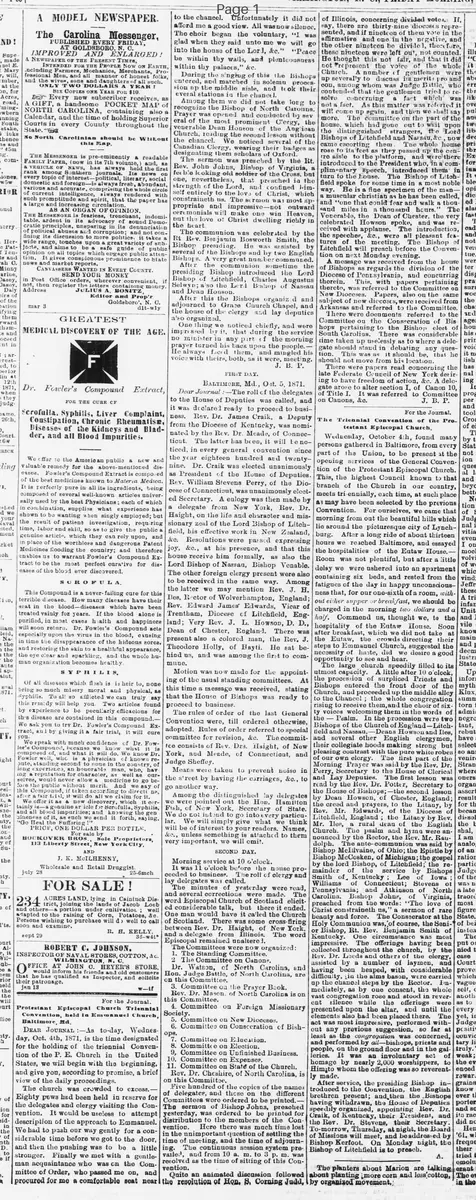
Protestant Episcopal Church Triennial Convention, held in Emmanuel Church, Baltimore, Md.
Dear Journal:—As to-day, Wednesday, Oct. 4th, 1871, is the time designated for the holding of the triennial Convention of the P. E. Church in the United States, we will begin with the beginning, and give you, according to promise, a brief view of the daily proceedings.
The church was crowded to excess. Eighty pews had been held in reserve for the delegates and clergy visiting the Convention. It would be useless to attempt description of the approach to Emmanuel. We had to push our way gently for a considerable time before we got to the door, and then the pushing was to be a little stronger. Finally we met with a gentleman acquaintance who was on the Committee of Order, who passed me on, and procured for me a comfortable seat near to the chancel. Unfortunately it did not afford me a good view. All was now silence. The choir began the voluntary, "I was glad when they said unto me we will go into the house of the Lord, &c." "Peace be within thy walls, and plenteousness within thy palaces," &c.
During the singing of this the Bishops entered, and marched in solemn procession up the middle aisle, and took their several stations in the chancel. Among them we did not take long to recognize the Bishop of North Carolina.
Prayer was opened and conducted by several of the most prominent Clergy, the venerable Dean Howson of the Anglican Church, reading the second lesson without the chancel. We noticed several of the Canadian Clergy, wearing their badges as designating them scholars of Oxford.
The sermon was preached by the Rt. Rev. John Johns, Bishop of Virginia, a feebler looking old soldier of the Cross, but one, nevertheless, that preached in the strength of the Lord, and confined himself entirely to the love of Christ, which constraineth us. The sermon was most appropriate and impressive—not outward ceremonials will make one win Heaven, but the love of Christ dwelling richly in the heart.
The communion was celebrated by the Rt. Rev. Benjamin Bosworth Smith, the Bishop presiding. He was assisted by several of the Bishops and by two English Bishops. A very great number communed.
After the communion sometime the presiding Bishop introduced the Lord Bishop of Litchfield, Charles Augustus Selwyn; also the Lord Bishop of Nassau and Dean Howson.
After this the Bishops organized and adjourned to Grace Church Chapel, and the house of the clergy and lay deputies also organized.
One thing we noticed chiefly, and were impressed by it, that during the service no minister in any part of the morning prayer turned his back upon the people. He always faced them, and mingled his voice with theirs, both, as it were, meeting.
J. B. P.
FIRST DAY.
BALTIMORE, Md., Oct. 5, 1871.
Dear Journal:—The roll of the delegates to the House of Deputies was called, and it was declared ready to proceed to business.
Rev. Dr. James Craik, a Deputy from the Diocese of Kentucky, was nominated by the Rev. Dr. Meade, of Connecticut. The latter has been, it will be known, in every general convention since the year eighteen hundred and twenty-nine.
Dr. Craik was elected unanimously as President of the House of Deputies.
Rev. William Stevens Perry, of the Diocese of Connecticut, was unanimously elected Secretary. A eulogy was then made by a delegate from New York, Rev. Dr. Haight, on the life and character and missionary zeal of the Lord Bishop of Litchfield, his effective work in New Zealand, &c.
Resolutions were passed expressing joy, &c., at his presence, and that this house receive him formally, as also the Lord Bishop of Nassau, Bishop Venable.
The other foreign clergy present were also to be received in the same way. Among the latter we may mention Rev. J. H. Iles, Rector of Wolverhampton, England; Rev. Edward James Edwards, Vicar of Trentham, Diocese of Litchfield, England; Very Rev. J. L. Howson, D. D., Dean of Chester, England. There was present also a colored man, the Rev. J. Theodore Holly, of Hayti. He sat behind us, and was among the first to commune.
Motion was now made for the appointing of the usual standing committees. At this time a message was received, stating that the House of Bishops was ready to proceed to business.
The rules of order of the last General Convention were, till ordered otherwise, adopted. Rules of order referred to special committee for revision, &c. The committee consists of Rev. Drs. Haight, of New York, and Meade, of Connecticut, and Judge Sheffey.
Means were taken to prevent noise in the street by having the carriages, &c., to go another way.
Among the distinguished lay delegates we were pointed out the Hon. Hamilton Fish, of New York, Secretary of State.
We do not intend to go into every particular. We will simply give what we think will be of interest to your readers. Names, &c., unless something is attached to them very important, we will omit.
SECOND DAY.
Morning service at 10 o'clock.
It was 11 o'clock before the house proceeded to business. The roll of clergy and lay delegates was called.
The minutes of yesterday were read, and several corrections were made. The word Episcopal Church of Scotland elicited considerable talk, but there it ended. One man would have it called the Church of Scotland. There was some cross-firing between Rev. Dr. Haight, of New York, and a delegate from Illinois. The word Episcopal remained unaltered.
The Committees were now organized:
1. The Standing Committee.
2. The Committee on Canons. Dr. Watson, of North Carolina, and Hon. Judge Battle, of North Carolina, are on this Committee.
3. Committee on the Prayer Book. Rev. Dr. Mason, of North Carolina is on this Committee.
4. Committee on Foreign Missionary Society.
5. Committee on New Dioceses.
6. Committee on Consecration of Bishops.
7. Committee on Education.
8. Committee on Election.
9. Committee on Unfinished Business.
10. Committee on Expenses.
11. Committee on State of the Church. Rev. Dr. Cheshire, of North Carolina, is on this Committee.
Five hundred of the copies of the names of delegates, and those on the different Committees were ordered to be printed.
The sermon of Bishop Johns, preached yesterday, was ordered to be printed for distribution to the members of the Convention.
Here there was much time lost in the unimportant question of settling the time of meeting, and the time of adjourning. The continuous session system prevailed, and from 10 a. m. to 3 p. m. was resolved as the time of sitting of this Convention.
Quite an animated discussion followed the resolution of Hon. S. Corning Judd, of Illinois, concerning divided votes. If, say, there are thirty-nine dioceses represented, and if nineteen of them vote in the affirmative and one in the negative, and the other nineteen be divided, therefore, these nineteen were left out, not counted. He thought this not fair, and that it did not represent the voice of the whole Church. A number of gentlemen were up severally to discuss its merits pro and con, among whom was Judge Battle, who contended that the gentlemen tried to resolve concerning a fact which was not a fact. As this matter was referred it will come up again, and then we shall say more. The committee on the part of the house, which had gone out to wait upon the distinguished strangers, the Lord Bishops of Litchfield and Nassau, &c., now came escorting them. The whole house rose to its feet as they passed up the centre aisle to the platform, and were there introduced to the President who, in a complimentary speech, introduced them in turn to the house. The Bishop of Litchfield spoke for some time in a most noble way. He is a fine specimen of the man—a muscular Christian as he has been called, and "one that could fear and walk a thousand miles in a thousand hours." The Venerable, the Dean of Chester, the very celebrated Howson spoke, and was received with applause. The introduction, the speeches, &c., were all pleasant features of the meeting. The Bishop of Litchfield will preach before the Convention on next Monday evening.
A message was received from the house of Bishops as regards the division of the Diocese of Pennsylvania, and concurring therein. This, with papers pertaining thereto, was referred to the Committee on New Dioceses. Papers, also on the same subject of new dioceses, were received from Arkansas and referred to the Committee.
There were documents referred to the Committee on the Consecration of Bishops pertaining to the Bishop elect of South Carolina.
There was considerable time taken up uselessly as to where a delegate should stand in debating any question. This was as it should be, that he should not move from his location.
There were papers read concerning the late Federal Council of New York desiring to have freedom of action, &c. A delegate arose to alter section I. of Canon 10, of Title I. It was referred to Committee on Canons, &c.
J. B. P.
Wednesday, October 4th, found many persons gathered in Baltimore, from every part of the Union, to be present at the opening Services of the General Convention of the Protestant Episcopal Church.
This, the highest Council known to that branch of the Church in our country, meets tri-ennially, each time, at such place as may have been selected by the previous Convention. For ourselves, we came that morning from out the beautiful hills which lie around the picturesque city of Lynchburg.
After a long ride of about thirteen hours we reached Baltimore, and essayed the hospitalities of the Eutaw House. Room was not plentiful, but after a little delay we were ushered into an apartment containing six beds, and rested from the fatigues of the day in happy unconsciousness that, for our one-sixth of a room, without either supper or breakfast, we should be charged in the morning two dollars and a half. Commend us, thought we, to the hospitality of the Eutaw House. Soon after breakfast, which we did not take at the Eutaw, the crowds directing their steps to Emmanuel Church, suggested the necessity of haste, did we desire a good opportunity to see and hear.
The large church speedily filled to its utmost capacity. A little after 10 o'clock, the procession of surpliced Priests and Bishops entered the front door of the Church, and proceeded up the middle alley to the Chancel; the whole congregation rising to receive them, and the choir of sixty voices welcoming them in the words of the Psalm. In the procession were two Bishops of the Church of England—Litchfield and Nassau,—Deans Howson and Iles, and several other English clergymen, their collegiate hoods making strong but pleasing contrast with the pure white robes of our own clergy. The first part of the Morning Prayer was said by the Rev. Dr. Perry, Secretary to the House of Clerical and Lay Deputies. The first lesson was read by the Rev. Dr. Potter, Secretary to the House of Bishops;—the second lesson by Dean Howson, of Chester, England; the creed and prayers, to the Litany, by Rev. Mr. Edwards, of the Diocese of Litchfield, England; the Litany by Rev. Mr. Iles, a rural dean of the English Church. The psalm and hymns were announced by the Rector, the Rev. Mr. Randolph. The ante-communion was said by Bishop McIlvaine, of Ohio; the Epistle by Bishop McCoskry, of Michigan; the gospel by the Lord Bishop, of Litchfield; the remainder of the service by Bishops Smith of Kentucky; Lee of Iowa; Williams of Connecticut; Stevens of Pennsylvania; and Atkinson of North Carolina. Bishop Johns, of Virginia, preached from the words: "The love of Christ constraineth us," a sermon of rare beauty and force. The Consecrator at the Holy Communion was, of course, the Senior Bishop, Rt. Rev. Benjamin Smith of Kentucky.
One circumstance was most impressive. The offerings having been collected throughout the church, by the Rev. Dr. Leods and others of the clergy, assisted by a number of laymen, and having been heaped, with considerable difficulty, in the alms basin, were carried up the chancel steps by the Rector. Immediately, as by one consent, the whole vast congregation rose and stood in reverent silence while the offerings were presented upon the altar, and until the elements also had been placed there. The act was most impressive, performed without any previous suggestion, so far at least as the congregation was concerned, and performed by all—bishops, priests and people, on the ground floor and in the galleries. It was an involuntary act of homage by nearly 2,000 worshippers, to Him to whom the offering was so reverently made.
After service, the presiding Bishop introduced to the Convention, the English brethren present; and then the Bishops having withdrawn, the House of Deputies speedily organized, appointing Rev. Dr. Craik, of Kentucky, their President, and the Rev. Dr. Stevens, their Secretary.
To-morrow, Thursday, at night, the Board of Missions will meet, and be addressed by Bishop Kerfoot. On Monday night, the Bishop of Litchfield is to preach.
A.
The planters about Marion are talking about planting more corn and less cotton, by organized movement.
General Triennial Convention of the Protestant Episcopal Church in the United States, A. D. 1871,
BALTIMORE, MD., Oct. 6th, 1871.
THIRD DAY.
Dear Journal:—Emmanuel was as thronged to-day as it was yesterday, but last evening it was filled to repletion. The occasion was that of the meeting of the Board of Missions. Rt. Rev. Bishop McCoskey was elected President, and Rev. Wm. A. Matlison, Secretary. Rt. Rev. Bishop Kerfoot preached a sermon of an hour and thirteen minutes, and so interesting that every mind was held in attention. It was full of the most encouraging data, and to me, and to many, no doubt, seemed wonderful. The text was taken from Numbers, XXXII, 6th. In connection with this it was resolved to-day that next Thursday be the day for celebrating the fiftieth anniversary of the Board of Missions. We shall speak of that, therefore, in its proper place.
After morning prayer the house proceeded to business.
The roll of those of the House of Deputies who had not as yet answered to their names was called. The minutes of the preceding day were read, corrected and approved.
It was in order for committees to report. No reports were at the time ready. It was in order for petitions and memorials. The Committee on the Consecration of Bishops reported. The testimonial as to the Assistant Bishop elect of South Carolina, Rev. Dr. Howe, was concurred in to be presented to the House of Bishops.
Dr. Haight on the Committee on Canons reported for said Committee that the proposed alteration of Section I, Can. X of Title I, was inexpedient, and hoped that the house would so consider it. This change was to strike out all the words after 'acquirements,' in the eighteenth line of this section, and insert such words (it is not necessary to introduce these here) as would in effect deprive the Bishop of any diocese, any right in the premises as to a foreign clergyman of a Church in union with this Church of officiating in any parish of this Church. The discussion took up much time, and the debate was pretty warm.
Judge Battle, of North Carolina, showed wherein the proposed amendment would throw discredit on the clergy of this Church, arguing ad hominem.
The Rev. Benj. Franklin, of Indiana, who proposed this change warmly debated the expediency both as a matter of showing a better spirit to the mother Church of England as well as allowing parishes to use the temporary administration who desired it of a foreign minister without subjecting him to all the delays, &c., which the section of this Canon involved. It was voted down by a very great majority.
A message was received from the House of Bishops that a joint committee be appointed to consult as to the union of both houses in morning prayer. Another message was also received for a joint committee to call on the Lord Bishop of Lichfield and request him to preach before the Convention on next Monday evening.
The Committee on New Dioceses reported their action on the message from the House of Bishops as regards the formation of a new Diocese. There was a lengthy discussion as to the name to be given to the Diocese, where rested the authority to give that name, and when was the Diocese to become a Diocese. This took up nearly the rest of the session. It was finally carried as it came from the House of Bishops.
The delegates were called upon to come forward and sign the paper of the Assistant Bishop elect of South Carolina. It was understood that as soon as this was done the House would adjourn. The greatest harmony seems to prevail in all the deliberations. If there is any thunder brewing, certainly none of the lightning yet shows itself. In fear that some have created that there will be a 'split' in the Episcopal Body we can foresee will be but a fear, a mere nervous sensation. The hope of those who would like to see such a thing will be, happily, one not at this present to be realized. It is a glorious thing to see men of age and experience here from every part of the country actuated with one common idea, love and unity. Nothing so far indicates that this will be broken.
FOURTH DAY.
After the usual morning services, the roll call of the still non-reported delegates, the reading of the minutes of the day previous, and their approval, the morning hours were taken up by hearing eulogies passed on members that have died since the last meeting of the General Convention, both clerical and lay. The first honorable name was that of the Hon. John N. Conyngham, who was killed by a railroad accident at Magnolia, Miss., in February.
Among other tribute was paid to his memory by several gentlemen of the House who knew him as a member since 1859.—Judge Battle, of North Carolina, contributed his measure of praise in a few words.
The Rev. Christopher P. Gadsden, deceased member from South Carolina, was called to memory by Rev. Charles Cotesworth Pinckney, of South Carolina, paying him a tribute which few clergy in the South or elsewhere earn; that all denominations mourned his loss, and that even over two thousand of the colored people of Charleston prayed while he was yet living, that God would preserve his life and health to go on doing the good work for years yet to come.
Several remembered the work of this noble presbyter, and spoke of him with tears in their eyes. Jackson Kemper, first Missionary Bishop, was spoken of by a great many delegates. It would be useless to attempt the description of the feeling which this name created in this body.
The following deceased members were also placed upon the journal with fitting tributes of respect: Herman Cope, Esq., of Pennsylvania; Rev. Dr. Milo Mahan, of Maryland; James Mason Campbell, of Maryland; Rev. Dr. Selon W. Manney, of Minnesota; Hon. Wm. L. Taylor, of Texas, who died in this city on the 23d ult.; Rev. Dr. Edward Ballard, of Maine. All this took up indeed the greater part of the hours of the session. The solemnity of the house was soon changed. A message was received from the House of Bishops which stirred up the Convention considerably. We shall endeavor to give a brief view of this message.
The committee of five Bishops, which was appointed at the last General Convention held in New York, was 'to consider whether any additional provision for uniformity, by canon or otherwise, is practicable and expedient, and to report to the next General Convention.' that is, to this. The committee has held several meetings.
The great question arising before it was, 'Is any legislation touching the performance of Divine Service and the administration of the Sacraments and other Rites and Ceremonies of the church practicable? If practicable, is it, at this time, expedient? If practicable and expedient, shall it take the shape of a canon or canons; or shall it be otherwise provided for? And finally, what shall the actual details of legislation be?' The committee considered this general subject—both vital and delicate.
It has never forgotten that 'substantial uniformity is entirely compatible with very considerable individual liberty.' Non-essentials were not to be magnified, and never raised 'to an equality with essentials.' The committee held in view the XXXIVth article of Religion: q. v.
It is the conviction of the committee that it is important for this General Convention to take some action in regard to the matters which called forth the committee. There are obvious things, that (1) there are 'diversities of use' in performing the offices of the church. (2) That there are services over and above what are in Prayer Book, and as set forth by Title II, Can. 13, Paragraph XIV of Digest—q. v. (3.) In some instances the services of Prayer Book altered without authority.
For these reasons, &c., the committee recommends action. It recommends also that any action which it may take shall be in the form of a canon or canons.
Uniformity implies the giving up of some things and the accepting of some things.
On the following points the committee, therefore, recommends legislation. I take great pleasure in sending you the printed matter as regards those things to be given up and things to be accepted, informing you at the same time that they are merely for the present consideration of both Houses. The whole matter was laid on the table to be taken up the first thing for action on next Tuesday.
The Maryland Historical Society has invited the delegates to rooms during their stay in the city.
The Committee on Canons report it inexpedient to the altering of the second article of the Constitution so as to reduce the number of clerical and lay deputies to three of each. It also reports for correction the same article, so as to make the word 'and' in the present edition of the Constitution, &c., and as found in the seventh line between 'clerical and lay,' read 'or,' the former being a typographical error. It also reported it inexpedient to touch the canon as to the half vote question. This matter will be brought up again.
A memorial from the Texas delegation was read asking for a missionary Bishop. I have marked what would be well to publish of the 'Report' which I send you.—This will lead to a great, very great deal of discussion.
FIFTH DAY.
Dear Journal:—After a Sunday's rest the Convention met this morning, and after prayer the usual reading of the minutes, &c., proceeded to business. Nothing was known beforehand of such interest as to call forth any warm debate. On taking a seat in a pew a pamphlet was found by each delegate. It was a sermon delivered last January by the present President of this house, Rev. Dr. Craik, of Louisville, Ky. I could hear the word pass from lip to lip, 'unfortunate.' I looked at the thing, and noticed it a partisan attack on what people commonly call 'low Church.' Now here was first brand unnecessarily flung into the midst of the house of deputies. Rev. Dr. Alexander H. Vinton, of Massachusetts, demanded an explanation, as his name was more or less connected with its contents. There was a good deal of buzz and talk, still peace and order prevailed. I will refer to this again to-morrow.
The new diocese in Pennsylvania will go into existence on the 8th of November next.
A memorial from Iowa was read requesting that Evangelists be sent to the Northwestern part of the State. It was referred to the Committee on the State of the Church. Several other things of similar import, but not of an interest to your column, were transacted.
The rules were suspended for having a telegram read relating to the awful conflagration that is now raging in Chicago. Everybody seemed to turn pale as each word fell on the startled, upturned faces. The Litany at intercessory prayers was read, and it was followed by silent prayer for five minutes. The moments as usual in the election to-night to be for the homeless and suffering of Chicago.
Baltimore, on Sunday is not so quiet as Wilmington. Our cars run all the day long. The streets are Sunday crowded. 'I was in St. Luke's Church—the morning service. Ritual service of Benediction. I had their aid in some measure. The boys, very little fellows, robed in surplices and cassocks, with torches in their hands, and chanting the cimi. They destroy and sing. They are me beck to their aids and admit he rt-bows oile bib wart. The procession rh ie, divit gas it ap- oro act clt E c to id mi.n bowed to the ceclls, aid ith hanls placelf lai y t cel aod with rv rt looks turned ir t st-lle. A(y y Glore, and : eGmi Saviour, a da tho n s H i. &,f the Te Dum aDow o !. d Tn" sltar wasi tcd fect fond Ruman C.bolic cne. As: silott .f candks w roo it, aa cn eitherside of it. Oaeach -ileniccosoithdlac was a ta'l cuadletiol: atd cndie. Ths sas not comauaponS ed or I sboa have seen a good deal og stration, ador ation e alia Ev rvtlingiselmytchant ed. I eoticed thnt in th·m rung serv.es -it being Snnday-bo an-e mmubiot, no Epistle, or G pel sas read. Brfore the Litany ther- was a hynn. The Litany was then chanted. A'tr te Litany th noticos wore read. Th a?,thner h.mi.— Theu the sermon. Tuen the end. I. was all pery prety. Ia the afteruoou I visitI the Sunday Scho l Missionary Soce s held at St. Peter's Chuich. ILis is eo irely compo-ed of children. S. Peter's is whit is called a 'low churcb.' It is the fine-t chureh in the cty. I's immense area vas filled. I ! al to wait and wait. b-fore I could gan entrancs. Iie venerabe Bishop of Va. pre ided. aud D:. Nuzee and others presided. Ino swall ofle voices as the chilirel sang was trn'y mig- nificent. I lookei atoun i on thousandt of peopie, all a imttei with the commom idea, place, g oi will ald fraternity with all that simply carry the Cr ssof Jesus to all alike, and seeng in every man a ciri,- tian brother, a co-aborer ia thisvipe- yard, no matter wLat miw bo the humaa differences. I caugut th ides, and I fel that that idea I hava had always, and I al. ways will cherish. A' St. Pani's churc the Lord Bishop of Litcbfi Id preache I on the occasion of tho cous crition cfth Assistant Bishop cf South Caro.ina. Tne papers made a mistuke in suing, of Norta Carolina. I will try to make my peucit scratchinge plainer. To morrow a hot time is ex pected. Bat if your readers were to lock in on the delegates from forty t fift, dioces s, many of ibam-hal, ad mo,to tham gray, they would thitk with m", that tbe hot time wili simply bea diga: fied and learned debate on imaportan nt: ters. J.P. P
What sub-type of article is it?
What themes does it cover?
What keywords are associated?
What entities or persons were involved?
Where did it happen?
Story Details
Key Persons
Location
Emmanuel Church, Baltimore, Md.
Event Date
1871 10 04
Story Details
Reports from correspondents J.B.P. and A. detail the opening service, elections of officers, organization of committees, discussions on church canons, new dioceses, uniformity in services, eulogies for deceased members, missionary board meeting, and emphasis on unity among delegates from various U.S. dioceses and foreign clergy.