Thank you for visiting SNEWPapers!
Sign up free
The Enquirer
Richmond, Henrico County, Virginia
What is this article about?
During a British parliamentary debate on the India Budget in 1804, revelations included early planning for the 1803 Mahratta war in late 1802, high costs, Company debt deterioration of £600,000, tea sales drop over 2 million pounds, payments to the Guicowar prince exceeding £320,000, bullion exports, and accumulating claims against government totaling over £4 million plus Egypt expedition costs.
Clipping
OCR Quality
Full Text
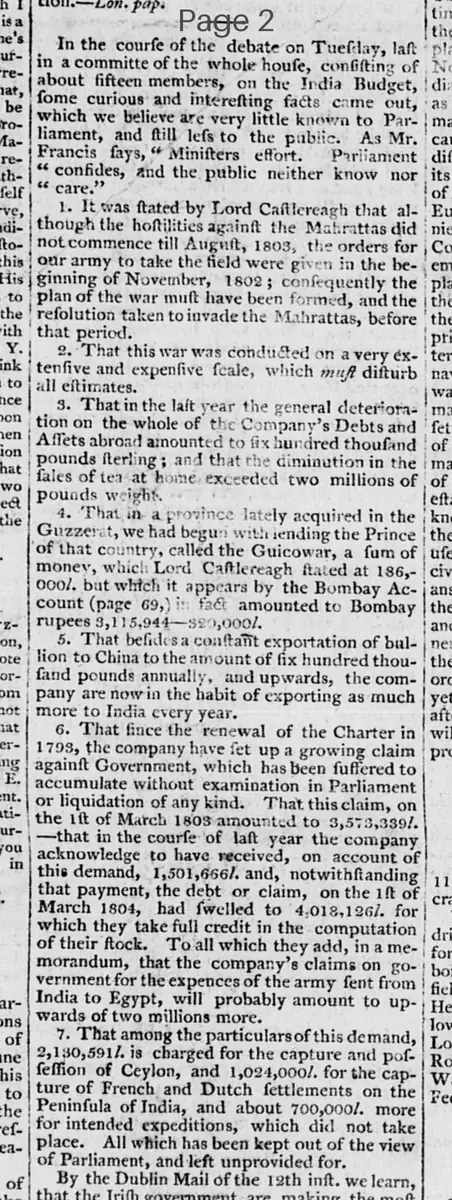
1. It was stated by Lord Castlereagh that although the hostilities against the Mahrattas did not commence till August, 1803, the orders for our army to take the field were given in the beginning of November, 1802; consequently the plan of the war must have been formed, and the resolution taken to invade the Mahrattas, before that period.
2. That this war was conducted on a very extensive and expensive scale, which must disturb all estimates.
3. That in the last year the general deterioration on the whole of the Company's Debts and Assets abroad amounted to six hundred thousand pounds sterling; and that the diminution in the sales of tea at home exceeded two millions of pounds weight.
4. That in a province lately acquired in the Guzzerat, we had begun with sending the Prince of that country, called the Guicowar, a sum of money, which Lord Castlereagh stated at 186,000l. but which it appears by the Bombay Account (page 69,) in fact amounted to Bombay rupees 3,115,944—320,000l.
5. That besides a constant exportation of bullion to China to the amount of six hundred thousand pounds annually, and upwards, the company are now in the habit of exporting as much more to India every year.
6. That since the renewal of the Charter in 1793, the company have set up a growing claim against Government, which has been suffered to accumulate without examination in Parliament or liquidation of any kind. That this claim, on the 1st of March 1803 amounted to 3,573,339l.—that in the course of last year the company acknowledge to have received, on account of this demand, 1,501,666l. and, notwithstanding that payment, the debt or claim, on the 1st of March 1804, had swelled to 4,018,126l. for which they take full credit in the computation of their stock. To all which they add, in a memorandum, that the company's claims on government for the expenses of the army sent from India to Egypt, will probably amount to upwards of two millions more.
7. That among the particulars of this demand, 2,130,591l. is charged for the capture and possession of Ceylon, and 1,024,000l. for the capture of French and Dutch settlements on the Peninsula of India, and about 700,000l. more for intended expeditions, which did not take place. All which has been kept out of the view of Parliament, and left unprovided for.
What sub-type of article is it?
What keywords are associated?
What entities or persons were involved?
Where did it happen?
Foreign News Details
Primary Location
India
Event Date
Tuesday Last
Key Persons
Outcome
company debts and assets deteriorated by £600,000; tea sales diminished by over 2 million pounds weight; claims against government swelled to £4,018,126 by march 1, 1804, plus over £2 million for egypt expedition; payments to guicowar of 320,000l.
Event Details
In a committee debate on the India Budget, facts revealed included: war plans against Mahrattas formed before November 1802, with hostilities starting August 1803; war conducted on extensive expensive scale; annual bullion exports to China and India of £600,000 each; growing unexamined claims since 1793 Charter renewal, including costs for Ceylon capture (£2,130,591), French/Dutch settlements (£1,024,000), and unexecuted expeditions (£700,000).