Thank you for visiting SNEWPapers!
Sign up free
Phenix Gazette
Alexandria, Virginia
What is this article about?
The London Morning Post comments on the inflammatory rhetoric in the French press against the King and ministers, seeing it as symptomatic of potential rebellion but attributing it to France's theatrical national character rather than real grievances, predicting no actual civil war.
Clipping
OCR Quality
Full Text
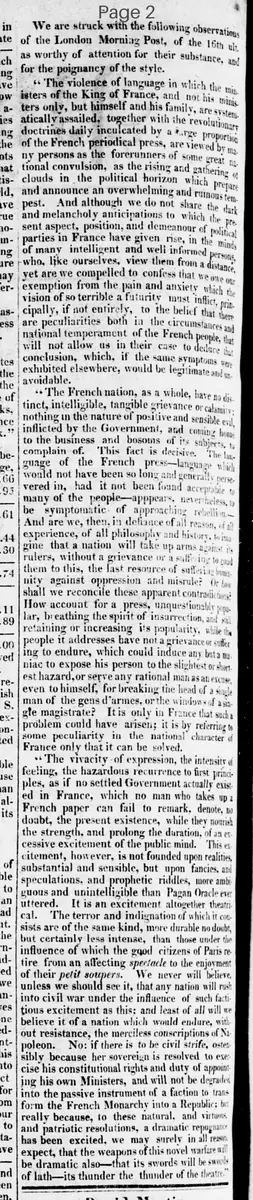
The violence of language in which the ministers are fanatically assailed, not only of the King himself, together with the King of France and his family, are not his doctrines daily inculcated by a large part of the French periodical press are viewed national convulsion as the forerunners as the rising of some great and clouds announce in the an political overwhelming horizon and melancholy And although anticipations we do not to share which the pre sent aspect position and demeanour of political parties in intelligent France have and given weli rise informed in persons who like ourselves view them from a distance vet are we compelled to confess that we owe our exemption from the pain and anxiety which the vision of so terrible a futurity must inflict prin cipally if not entirely to the belief that there are peculiarities both in the circumstances and national temperament of the French people the not allow us in their case to deduce the which if the same symptoms were exhbited elsewhere, would be legitimate and unavoidable.
"The French nation, as a whole, have no distinct, intelligible, tangible grievance or calamity nothing in the nature of positive and sensible evil inflicted by the Government, and coming home to the business and bosoms of its subjects, to complain of. This fact is decisive. The language of the French press—language which would not have been so long and generally persevered in, had it not been found acceptable to many of the people—appears, nevertheless, to be symptomatic of approaching rebellion.— And are we, then, in defiance of all reason, of all experience, of all philosophy and history, to imagine that a nation will take up arms against its rulers, without a grievance or a suffering to goad them to this, the last resource of suffering humanity against oppression and misrule? Or how shall we reconcile these apparent contradictions? How account for a press, unquestionably popular, breathing the spirit of insurrection, and still retaining or increasing its popularity, while the people it addresses have not a grievance or suffering to endure, which could induce any but a maniac to expose his person to the slightest or shortest hazard, or serve any rational man as an excuse, even to himself, for breaking the head of a single man of the gens d'armes, or the windows of a single magistrate? It is only in France that such a problem could have arisen; it is by referring to some peculiarity in the national character of France only that it can be solved.
The vivacity of expression, the intensity of feeling, the hazardous recurrence to first principles, as if no settled Government actually existed in France, which no man who takes up a French paper can fail to remark, denote, no doubt, the present existence, while they nourish the strength, and prolong the duration, of an excessive excitement of the public mind. This excitement, however, is not founded upon realities, substantial and sensible, but upon fancies, and speculations, and prophetic riddles, more ambiguous and unintelligible than Pagan Oracle ever uttered. It is an excitement altogether theatrical. The terror and indignation of which it consists are of the same kind, more durable no doubt but certainly less intense, than those under the influence of which the good citizens of Paris retire from an affecting spectacle to the enjoyment of their petit soupers. We never will believe, unless we should see it, that any nation will rush into civil war under the influence of such factitious excitement as this: and least of all will we believe it of a nation which would endure, without resistance, the merciless conscriptions of Napoleon. No: if there is to be civil strife, ostensibly because her sovereign is resolved to exercise his constitutional rights and duty of appointing his own Ministers, and will not be degraded into the passive instrument of a faction to transform the French Monarchy into a Republic: but really because, to these natural, and virtuous and patriotic resolutions, a dramatic repugnance has been excited, we may surely in all reason expect, that the weapons of this novel warfare will be dramatic also—that its swords will be swords of lath; its thunder the thunder of the theatre."
What sub-type of article is it?
What keywords are associated?
What entities or persons were involved?
Where did it happen?
Foreign News Details
Primary Location
France
Event Date
As Of 16th Ult.
Key Persons
Outcome
no real grievances; excitement deemed theatrical, unlikely to lead to actual civil war.
Event Details
Commentary on violent language in French press against King and ministers, seen as symptomatic of approaching rebellion but attributed to national vivacity and theatrical excitement rather than tangible evils, predicting dramatic rather than violent conflict.