Thank you for visiting SNEWPapers!
Sign up free
Literary
June 17, 1823
The Virginian
Lynchburg, Virginia
What is this article about?
A biographical narrative from D'Israeli's Curiosities of Literature detailing Sir Walter Raleigh's final hours, trial sentencing, imprisonment reflections, poetic compositions, execution on the scaffold with composure, and public reactions, highlighting his courage and loyalty.
Clipping
OCR Quality
88%
Good
Full Text
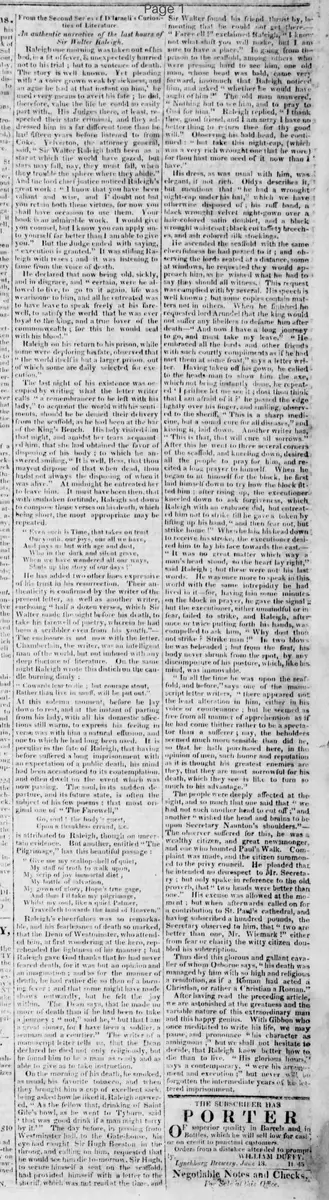
From the Second Series of D'Israeli's Curiosities of Literature.
In authentic narrative of the last hours of
Sir Walter Raleigh.
Raleigh one morning was taken out of his
bed, in a fit of fever, & unexpectedly hurried
not to his trial; but to a sentence of death.
The story is well known. Yet pleading
with 'a voice grown weak by sickness, and
an ague he had at that instant on him,' he
used every means to avert his fate; he did,
therefore, value the life he could so easily
part with. His Judges there, at least, respected their state criminal, and they addressed him in a far different tone than he
had fifteen years before listened to from
Coke. Yelverton, the attorney general,
said, "Sir Walter Raleigh hath been as a
star at which the world have gazed, but
stars may fall, nay, they must fall, when
they trouble the sphere where they abide."
And the lord chief justice noticed Raleigh's
great work: "I know that you have been
valiant and wise, and I doubt not but
you retain both these virtues, for now you
shall have occasion to use them. Your
book is an admirable work. I would give
you counsel, but I know you can apply unto yourself far better than I am able to give
you." But the Judge ended with saying,
"execution is granted." It was stifling Raleigh with roses; and it was hastening to
fame from the voice of death.
He declared that now being old, sickly,
and in disgrace, and "certain, were he allowed to live, to go to it again, life was
wearisome to him, and all he entreated was
to have leave to speak freely at his farewell, to satisfy the world that he was ever
loyal to the king, and a true lover of the
commonwealth; for this he would seal
with his blood."
Raleigh on his return to his prison, while
some were deploring his fate, observed that
"the world itself is but a larger prison, out
of which some are daily selected for execution."
The last night of his existence was occupied by writing. what the letter writer
calls "a remembrancer to be left with his
lady," to acquaint the world with his sentiments. should he be denied their delivery
from the scaffold, as he had been at the bar
of the King's Bench. His lady visited him
that night, and amidst her tears acquainted him, that she had obtained the favor of
disposing of his body; to which he answered smiling, "It is well, Bess, that thou
mayest dispose of that when dead, thou
hadst not always the disposing of when it
was alive." At midnight he entreated her
to leave him. It must have been then, that
with unshaken fortitude, Raleigh sat down
to compose those verses on his death, which
being short, the most appropriate may be
repeated.
"Even such is Time, that takes on trust
Our youth, our joys, our all we have,
And pays us but with age and dust,
Who in the dark and silent grave,
When we have wandered all our ways,
Shuts up the story of our days!'
He has added two other lines expressive
of his trust in his resurrection. Their authenticity is confirmed by the writer of the
present letter, as well as another writer
enclosing "half a dozen verses, which Sir
Walter made the night before his death, to
take his farewell of poetry, wherein he had
been a scribbler even from his youth."
The enclosure is not now with the letter.
Chamberlain, the writer, was an intelligent
man of the world, but not imbued with any
deep tincture of literature. On the same
night Raleigh wrote this distich on the candle burning dimly:
"Cowards fear to die: but courage stout,
Rather than live in snuff, will be put out."
At this solemn moment, before he lay
down to rest, and at the instant of parting
from his lady, with all his domestic affections still warm, to express his feeling in
verse was with him a natural effusion, and
one to which he had long been used. It is
peculiar in the fate of Raleigh, that having
before suffered a long imprisonment with
an expectation of a public death, his mind
had been accustomed to its contemplation
and often dwelt on the event which was
now passing. The soul, in its sudden departure, and its future state, is often the
subject of his few poems; that most original one of "The Farewell,"
Go, soul! the body's guest,
Upon a thankless errand, &c.
is attributed to Raleigh, though on uncertain evidence. But another. entitled "The
Pilgrimage," has this beautiful passage:
"Give me my scallop-shell of quiet,
My staff of truth to walk upon,
My scrip of joy immortal diet;
My bottle of salvation,
My gown of glory, Hope's true gage,
And thus I'll take my pilgrimage,
Whilst my soul, like a quiet Palmer.
Travelleth towards the land of Heaven."
Raleigh's cheerfulness was so remarkable. and his fearlessness of death so marked.
that the Dean of Westminster, who attended him, at first wondering at the hero, reprehended the lightness of his manner; but
Raleigh gave God thanks that he had never
feared death, for it was but an opinion and
an imagination; and as for the manner of
death. he had rather die so than of a burning fever; and that some might have made
shows outwardly, but he felt the joy
within. The Dean says, that he made no
more of death than if he had been to take
a journey; "not," said he, "but that I am
a great sinner, for I have been a soldier. a
seaman and a courtier." The writer of a
manuscript letter tells us, that the Dean
declared he died not only. religiously, but
he found him to be a man as ready and as
able to give as to take instruction.
On the morning of his death. he smoked.
as usual; his favorite tobacco, and when
they brought him a cup of excellent sack.
being asked how he liked it. Raleigh answered. "As the fellow that, drinking of Saint
Giles's bowl, as he went to Tyburn, said
'that was good drink if a man might tarry
by it.'" The day before. in passing from
Westminster hall, to the Gate-house, his
eye had caught Sir Hugh Beeston in the
throng, and calling on him, requested that
he would see him die to-morrow. Sir Hugh,
to secure himself a seat on the scaffold
had provided himself with a letter to the
sheriff. which was not read at the time, and
Sir Walter found his friend thrust by, Lamenting that he could not get there.
"Farewell!" exclaimed Raleigh, "I know
not what shift you will make, but I am
sure to have a place." In going from the
prison to the scaffold, among others who
were pressing hard to see him, one old
man, whose head was bald, came very
forward. insomuch that Raleigh noticed
Him, and asked "whether he would have
aught of him?" The old man answered.
"Nothing but to see him, and to pray to
God for him." Raleigh replied, "I thank
thee, good friend, and I am sorry I have no
better thing to return thee for thy good
will." Observing his bald head, he continued: "but take this night-cap. (which
was a very rich wrought one that he wore)
for thou hast more need of it now than I
have."
His dress, as was usual with him, was
elegant, if not rich. Oldys describes it,
but mentions that "he had a wrought
night-cap under his hat," which we have otherwise disposed of; his ruff band, a
black wrought velvet night-gown over a
hair-colored satin doublet, and a black
wrought waistcoat; black cut taffety breeches, and ash colored silk stockings.
He ascended the scaffold with the same
cheerfulness he had passed to it; and observing the lords seated at a distance, some
at windows, he requested they would approach him, as he wished what he had to
say they should all witness. This request
was complied with by several. His speech is
well known; but some copies contain matters not in others. When he finished he
requested lord Arundel that the king would
not suffer any libellers to defame him after
death--"And now I have a long journey
to go, and must take my leave." "He,
embraced all the lords and other friends
with such courtly compliments as if he had
met them at some feast," says a letter writer. Having taken off his gown, he called
to the heads-man to show him the axe,
which not being instantly done, he repeated 'I prithee let me see it; dost thou think
that I am afraid of it?' he passed the edge
lightly over his finger, and smiling, observed to the sheriff, "This is a sharp medicine, but a sound cure for all diseases." and
kissing it, laid down. Another writer has,
"This is that, that will cure all sorrows."
After this he went to three several corners
of the scaffold, and kneeling down, desired
all the people to pray for him, and recited a long prayer to himself. When he
began to fit himself for the block, he first
laid himself down to try how the block fitted him; after rising up, the executioner
kneeled down to ask forgiveness, which
Raleigh with an embrace did, but entreated him not to strike till he gave a token by
lifting up his hand, "and then fear not, but
strike home!" When he laid his head down"
to receive his stroke, the executioner desired him to lay his face towards the east.
"It was no great matter which way a
man's head stood, so the heart lay right,"
said Raleigh; but these were not his last
words. He was once more to speak in this
world with the same intrepidity he had
lived in it--for, having lain some minutes.
on the block in prayer, he gave the signal
but the executioner, either unmindful or in
fear, failed to strike, and Raleigh, after
once or twice putting forth his hands, was
compelled to ask him, "Why dost thou
not strike? Strike man!" In two blows
he was beheaded; but from the first, his
body never shrunk from the spot, by any
discomposure of his posture, which, like his
mind, was immovable.
"In all the time he was upon the scaffold, and before," says one of the manuscript letter writers, "there appeared not
the least alteration in him, either in his
voice or countenance; but he seemed as
free from all manner of apprehension as if
he had come thither rather to be a spectator than a sufferer; nay, the beholders
seemed much more sensible than did he,
so that he hath purchased here, in the
opinion of men, such honor and reputation
as it is thought his greatest enemies are
they, that they are most sorrowful for his
death, which they see is like to turn so
much to his advantage."
The people were deeply affected at the
sight, and so much that one said that "we
had not such another head to cut off;" and
another "wished the head and brains to be
upon Secretary Naunton's shoulders."
The observer suffered for this, he was a
wealthy citizen, and great newsmonger,
and one who haunted Paul's Walk. Complaint was made, and the citizen summoned to the privy council. He pleaded that
he intended no disrespect to Mr. Secretary; but only spake in reference to the old
proverb, that "two heads were better than
one." His excuse was allowed at the moment; but when afterwards called on for
a contribution to St. Paul's cathedral, and
having subscribed a hundred pounds, the
Secretary observed to him, that "two are
better than one, Mr. Wenman!" either
from fear or charity the witty citizen doubled his subscription.
Thus died this glorious and gallant cavalier of whom Osborne says, "his death was
managed by him with so high and religious
a resolution, as if a Roman had acted a
Christian, or rather a Christian a Roman."
After having read the preceding article,
we are astonished at the greatness and the
variable nature of this extraordinary man
and this happy genius. With Gibbon who
once meditated to write his life, we may
pause, and pronounce "his character as
ambiguous" but we shall not hesitate to
decide, that Raleigh knew better how to
die than to live." "His glorious hours,
says a contemporary, "were his arraignment
and execution;" but never will be
forgotten the intermediate years of his lettered imprisonment,
In authentic narrative of the last hours of
Sir Walter Raleigh.
Raleigh one morning was taken out of his
bed, in a fit of fever, & unexpectedly hurried
not to his trial; but to a sentence of death.
The story is well known. Yet pleading
with 'a voice grown weak by sickness, and
an ague he had at that instant on him,' he
used every means to avert his fate; he did,
therefore, value the life he could so easily
part with. His Judges there, at least, respected their state criminal, and they addressed him in a far different tone than he
had fifteen years before listened to from
Coke. Yelverton, the attorney general,
said, "Sir Walter Raleigh hath been as a
star at which the world have gazed, but
stars may fall, nay, they must fall, when
they trouble the sphere where they abide."
And the lord chief justice noticed Raleigh's
great work: "I know that you have been
valiant and wise, and I doubt not but
you retain both these virtues, for now you
shall have occasion to use them. Your
book is an admirable work. I would give
you counsel, but I know you can apply unto yourself far better than I am able to give
you." But the Judge ended with saying,
"execution is granted." It was stifling Raleigh with roses; and it was hastening to
fame from the voice of death.
He declared that now being old, sickly,
and in disgrace, and "certain, were he allowed to live, to go to it again, life was
wearisome to him, and all he entreated was
to have leave to speak freely at his farewell, to satisfy the world that he was ever
loyal to the king, and a true lover of the
commonwealth; for this he would seal
with his blood."
Raleigh on his return to his prison, while
some were deploring his fate, observed that
"the world itself is but a larger prison, out
of which some are daily selected for execution."
The last night of his existence was occupied by writing. what the letter writer
calls "a remembrancer to be left with his
lady," to acquaint the world with his sentiments. should he be denied their delivery
from the scaffold, as he had been at the bar
of the King's Bench. His lady visited him
that night, and amidst her tears acquainted him, that she had obtained the favor of
disposing of his body; to which he answered smiling, "It is well, Bess, that thou
mayest dispose of that when dead, thou
hadst not always the disposing of when it
was alive." At midnight he entreated her
to leave him. It must have been then, that
with unshaken fortitude, Raleigh sat down
to compose those verses on his death, which
being short, the most appropriate may be
repeated.
"Even such is Time, that takes on trust
Our youth, our joys, our all we have,
And pays us but with age and dust,
Who in the dark and silent grave,
When we have wandered all our ways,
Shuts up the story of our days!'
He has added two other lines expressive
of his trust in his resurrection. Their authenticity is confirmed by the writer of the
present letter, as well as another writer
enclosing "half a dozen verses, which Sir
Walter made the night before his death, to
take his farewell of poetry, wherein he had
been a scribbler even from his youth."
The enclosure is not now with the letter.
Chamberlain, the writer, was an intelligent
man of the world, but not imbued with any
deep tincture of literature. On the same
night Raleigh wrote this distich on the candle burning dimly:
"Cowards fear to die: but courage stout,
Rather than live in snuff, will be put out."
At this solemn moment, before he lay
down to rest, and at the instant of parting
from his lady, with all his domestic affections still warm, to express his feeling in
verse was with him a natural effusion, and
one to which he had long been used. It is
peculiar in the fate of Raleigh, that having
before suffered a long imprisonment with
an expectation of a public death, his mind
had been accustomed to its contemplation
and often dwelt on the event which was
now passing. The soul, in its sudden departure, and its future state, is often the
subject of his few poems; that most original one of "The Farewell,"
Go, soul! the body's guest,
Upon a thankless errand, &c.
is attributed to Raleigh, though on uncertain evidence. But another. entitled "The
Pilgrimage," has this beautiful passage:
"Give me my scallop-shell of quiet,
My staff of truth to walk upon,
My scrip of joy immortal diet;
My bottle of salvation,
My gown of glory, Hope's true gage,
And thus I'll take my pilgrimage,
Whilst my soul, like a quiet Palmer.
Travelleth towards the land of Heaven."
Raleigh's cheerfulness was so remarkable. and his fearlessness of death so marked.
that the Dean of Westminster, who attended him, at first wondering at the hero, reprehended the lightness of his manner; but
Raleigh gave God thanks that he had never
feared death, for it was but an opinion and
an imagination; and as for the manner of
death. he had rather die so than of a burning fever; and that some might have made
shows outwardly, but he felt the joy
within. The Dean says, that he made no
more of death than if he had been to take
a journey; "not," said he, "but that I am
a great sinner, for I have been a soldier. a
seaman and a courtier." The writer of a
manuscript letter tells us, that the Dean
declared he died not only. religiously, but
he found him to be a man as ready and as
able to give as to take instruction.
On the morning of his death. he smoked.
as usual; his favorite tobacco, and when
they brought him a cup of excellent sack.
being asked how he liked it. Raleigh answered. "As the fellow that, drinking of Saint
Giles's bowl, as he went to Tyburn, said
'that was good drink if a man might tarry
by it.'" The day before. in passing from
Westminster hall, to the Gate-house, his
eye had caught Sir Hugh Beeston in the
throng, and calling on him, requested that
he would see him die to-morrow. Sir Hugh,
to secure himself a seat on the scaffold
had provided himself with a letter to the
sheriff. which was not read at the time, and
Sir Walter found his friend thrust by, Lamenting that he could not get there.
"Farewell!" exclaimed Raleigh, "I know
not what shift you will make, but I am
sure to have a place." In going from the
prison to the scaffold, among others who
were pressing hard to see him, one old
man, whose head was bald, came very
forward. insomuch that Raleigh noticed
Him, and asked "whether he would have
aught of him?" The old man answered.
"Nothing but to see him, and to pray to
God for him." Raleigh replied, "I thank
thee, good friend, and I am sorry I have no
better thing to return thee for thy good
will." Observing his bald head, he continued: "but take this night-cap. (which
was a very rich wrought one that he wore)
for thou hast more need of it now than I
have."
His dress, as was usual with him, was
elegant, if not rich. Oldys describes it,
but mentions that "he had a wrought
night-cap under his hat," which we have otherwise disposed of; his ruff band, a
black wrought velvet night-gown over a
hair-colored satin doublet, and a black
wrought waistcoat; black cut taffety breeches, and ash colored silk stockings.
He ascended the scaffold with the same
cheerfulness he had passed to it; and observing the lords seated at a distance, some
at windows, he requested they would approach him, as he wished what he had to
say they should all witness. This request
was complied with by several. His speech is
well known; but some copies contain matters not in others. When he finished he
requested lord Arundel that the king would
not suffer any libellers to defame him after
death--"And now I have a long journey
to go, and must take my leave." "He,
embraced all the lords and other friends
with such courtly compliments as if he had
met them at some feast," says a letter writer. Having taken off his gown, he called
to the heads-man to show him the axe,
which not being instantly done, he repeated 'I prithee let me see it; dost thou think
that I am afraid of it?' he passed the edge
lightly over his finger, and smiling, observed to the sheriff, "This is a sharp medicine, but a sound cure for all diseases." and
kissing it, laid down. Another writer has,
"This is that, that will cure all sorrows."
After this he went to three several corners
of the scaffold, and kneeling down, desired
all the people to pray for him, and recited a long prayer to himself. When he
began to fit himself for the block, he first
laid himself down to try how the block fitted him; after rising up, the executioner
kneeled down to ask forgiveness, which
Raleigh with an embrace did, but entreated him not to strike till he gave a token by
lifting up his hand, "and then fear not, but
strike home!" When he laid his head down"
to receive his stroke, the executioner desired him to lay his face towards the east.
"It was no great matter which way a
man's head stood, so the heart lay right,"
said Raleigh; but these were not his last
words. He was once more to speak in this
world with the same intrepidity he had
lived in it--for, having lain some minutes.
on the block in prayer, he gave the signal
but the executioner, either unmindful or in
fear, failed to strike, and Raleigh, after
once or twice putting forth his hands, was
compelled to ask him, "Why dost thou
not strike? Strike man!" In two blows
he was beheaded; but from the first, his
body never shrunk from the spot, by any
discomposure of his posture, which, like his
mind, was immovable.
"In all the time he was upon the scaffold, and before," says one of the manuscript letter writers, "there appeared not
the least alteration in him, either in his
voice or countenance; but he seemed as
free from all manner of apprehension as if
he had come thither rather to be a spectator than a sufferer; nay, the beholders
seemed much more sensible than did he,
so that he hath purchased here, in the
opinion of men, such honor and reputation
as it is thought his greatest enemies are
they, that they are most sorrowful for his
death, which they see is like to turn so
much to his advantage."
The people were deeply affected at the
sight, and so much that one said that "we
had not such another head to cut off;" and
another "wished the head and brains to be
upon Secretary Naunton's shoulders."
The observer suffered for this, he was a
wealthy citizen, and great newsmonger,
and one who haunted Paul's Walk. Complaint was made, and the citizen summoned to the privy council. He pleaded that
he intended no disrespect to Mr. Secretary; but only spake in reference to the old
proverb, that "two heads were better than
one." His excuse was allowed at the moment; but when afterwards called on for
a contribution to St. Paul's cathedral, and
having subscribed a hundred pounds, the
Secretary observed to him, that "two are
better than one, Mr. Wenman!" either
from fear or charity the witty citizen doubled his subscription.
Thus died this glorious and gallant cavalier of whom Osborne says, "his death was
managed by him with so high and religious
a resolution, as if a Roman had acted a
Christian, or rather a Christian a Roman."
After having read the preceding article,
we are astonished at the greatness and the
variable nature of this extraordinary man
and this happy genius. With Gibbon who
once meditated to write his life, we may
pause, and pronounce "his character as
ambiguous" but we shall not hesitate to
decide, that Raleigh knew better how to
die than to live." "His glorious hours,
says a contemporary, "were his arraignment
and execution;" but never will be
forgotten the intermediate years of his lettered imprisonment,
What sub-type of article is it?
Essay
What themes does it cover?
Death Mortality
Political
What keywords are associated?
Sir Walter Raleigh
Execution
Scaffold
Death Poetry
Historical Narrative
Courage
Loyalty
Imprisonment
What entities or persons were involved?
From The Second Series Of D'israeli's Curiosities Of Literature
Literary Details
Title
An Authentic Narrative Of The Last Hours Of Sir Walter Raleigh
Author
From The Second Series Of D'israeli's Curiosities Of Literature
Subject
The Last Hours And Execution Of Sir Walter Raleigh
Form / Style
Biographical Prose Narrative
Key Lines
"Even Such Is Time, That Takes On Trust
Our Youth, Our Joys, Our All We Have,
And Pays Us But With Age And Dust,
Who In The Dark And Silent Grave,
When We Have Wandered All Our Ways,
Shuts Up The Story Of Our Days!"
"Cowards Fear To Die: But Courage Stout,
Rather Than Live In Snuff, Will Be Put Out."
"Give Me My Scallop Shell Of Quiet,
My Staff Of Truth To Walk Upon,
My Scrip Of Joy Immortal Diet;
My Bottle Of Salvation,
My Gown Of Glory, Hope's True Gage,
And Thus I'll Take My Pilgrimage,
Whilst My Soul, Like A Quiet Palmer.
Travelleth Towards The Land Of Heaven."