Thank you for visiting SNEWPapers!
Sign up free
The Weekly Visitor
Providence, Providence County, Rhode Island
What is this article about?
Father Aloysius is building a new church, presbytery, and convent at White Earth Mission in Minnesota, serving 800 Catholic Chippewa Indians among 1,700 total. Reports on baptisms, other settlements seeking Catholic schools, and future consolidation of Chippewa tribe.
Clipping
OCR Quality
Full Text
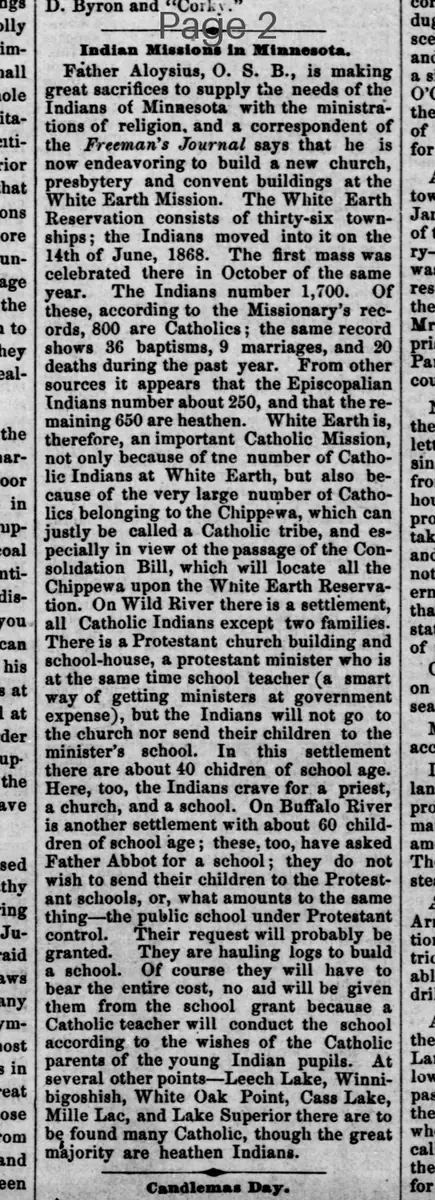
Father Aloysius, O. S. B., is making great sacrifices to supply the needs of the Indians of Minnesota with the ministrations of religion, and a correspondent of the Freeman's Journal says that he is now endeavoring to build a new church, presbytery and convent buildings at the White Earth Mission. The White Earth Reservation consists of thirty-six townships; the Indians moved into it on the 14th of June, 1868. The first mass was celebrated there in October of the same year. The Indians number 1,700. Of these, according to the Missionary's records, 800 are Catholics; the same record shows 36 baptisms, 9 marriages, and 20 deaths during the past year. From other sources it appears that the Episcopalian Indians number about 250, and that the remaining 650 are heathen. White Earth is, therefore, an important Catholic Mission, not only because of the number of Catholic Indians at White Earth, but also because of the very large number of Catholics belonging to the Chippewa, which can justly be called a Catholic tribe, and especially in view of the passage of the Consolidation Bill, which will locate all the Chippewa upon the White Earth Reservation. On Wild River there is a settlement, all Catholic Indians except two families. There is a Protestant church building and school-house, a protestant minister who is at the same time school teacher (a smart way of getting ministers at government expense), but the Indians will not go to the church nor send their children to the minister's school. In this settlement there are about 40 children of school age. Here, too, the Indians crave for a priest, a church, and a school. On Buffalo River is another settlement with about 60 children of school age; these, too, have asked Father Abbot for a school; they do not wish to send their children to the Protestant schools, or, what amounts to the same thing—the public school under Protestant control. Their request will probably be granted. They are hauling logs to build a school. Of course they will have to bear the entire cost, no aid will be given them from the school grant because a Catholic teacher will conduct the school according to the wishes of the Catholic parents of the young Indian pupils. At several other points—Leech Lake, Winnibigoshish, White Oak Point, Cass Lake, Mille Lac, and Lake Superior there are to be found many Catholic, though the great majority are heathen Indians.
What sub-type of article is it?
What keywords are associated?
What entities or persons were involved?
Where did it happen?
Foreign News Details
Primary Location
White Earth Reservation, Minnesota
Key Persons
Outcome
1,700 indians total; 800 catholics, 250 episcopalians, 650 heathen; 36 baptisms, 9 marriages, 20 deaths in past year; passage of consolidation bill to locate all chippewa at white earth.
Event Details
Father Aloysius is building new church, presbytery, and convent at White Earth Mission, established June 14, 1868, with first mass in October 1868. Catholic missions expand to settlements at Wild River (40 school-age children rejecting Protestant church/school) and Buffalo River (60 school-age children requesting Catholic school, hauling logs to build it). Additional Catholic Indians at Leech Lake, Winnibigoshish, White Oak Point, Cass Lake, Mille Lac, and Lake Superior.