Thank you for visiting SNEWPapers!
Sign up free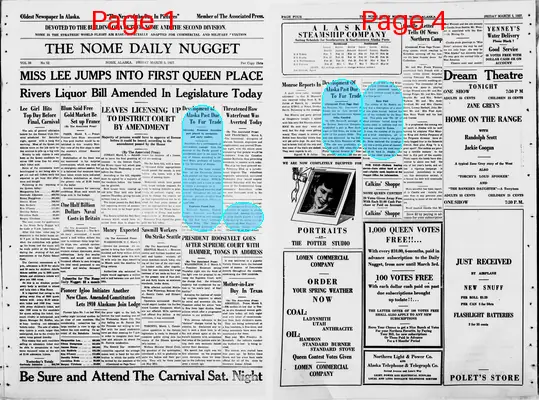
The Nome Daily Nugget
Nome, Nome County, Alaska
What is this article about?
Dr. Cecil Robe, University of Alaska history professor, lectures on explorers' search for passages to the Pacific that led to fur discoveries in Alaska. Russians expanded via fur trade, founding Sitka in 1799; site excavated in 1935, uncovering a rare Russian ownership plate.
Merged-components note: Continuation of the 'Development of Alaska Past Due To Fur Trade' story from page one to page four.
Clippings
1 of 2
OCR Quality
Full Text
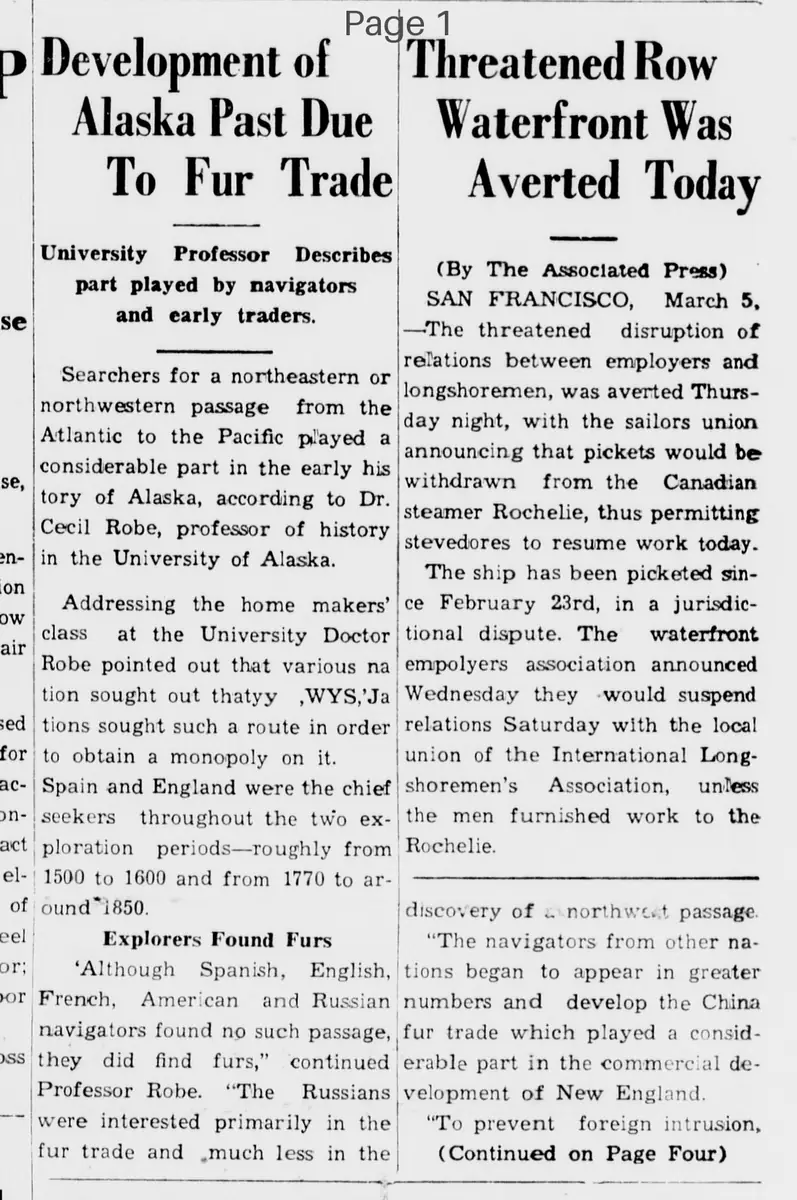
University Professor Describes part played by navigators and early traders.
Searchers for a northeastern or northwestern passage from the Atlantic to the Pacific played a considerable part in the early history of Alaska, according to Dr. Cecil Robe, professor of history in the University of Alaska.
Addressing the home makers class at the University Doctor Robe pointed out that various nations sought out that route in order to obtain a monopoly on it.
Spain and England were the chief seekers throughout the two exploration periods-roughly from 1500 to 1600 and from 1770 to around 1850.
Explorers Found Furs
'Although Spanish, English, French, American and Russian navigators found no such passage, they did find furs,' continued Professor Robe.
'The Russians were interested primarily in the fur trade and much less in the
discovery of northwest passage
The navigators from other nations began to appear in greater numbers and develop the China fur trade which played a considerable part in the commercial development of New England.
To prevent foreign intrusion,
(Continued on Page Four)
Development Of
Alaska Past Due
To Fur Trade
(Continued From Page One)
the Russians, the discoverers of Alaska and its furs, decided to expand into Southeastern Alaska.
Sitka Founded
"In 1799, Baranoff, manager of the Russian American Company, established a post at New Archangel or Old Sitka, six miles just north of the present Sitka. This post was destroyed by the Indians in the Sitka Massacre of 1802
"The site was practically untouched until 1935 when Charles Flory, regional forester for Alaska, planned and directed the excavation of the site of Old Sitka.
The several hundreds of various relics were preserved carefully and their location noted in detail on a blue print."
Rare Find
The climax of Dr. Robe's lecture was a description of a sheet of iron plate buried behind the site of the stockade by the Russians. This plate was "No. 12" of about nineteen buried along the Alaska coast to indicate that the land was owned by Russia.
A cross, the number of the plate and a brief inscription, all in bronze, were riveted to the plate.
Dr. Robe declared the investigation was a prime piece of research and the find was the most important of its kind in Alaska. Not one of the other plates has been found.
What sub-type of article is it?
What themes does it cover?
What keywords are associated?
What entities or persons were involved?
Where did it happen?
Story Details
Key Persons
Location
Alaska, Sitka
Event Date
1500 To 1600 And From 1770 To Around 1850; 1799; 1802; 1935
Story Details
Explorers from Spain, England, France, America, and Russia sought passages to the Pacific but found furs instead, sparking the fur trade. Russians expanded into southeastern Alaska, founding Old Sitka in 1799, destroyed in 1802. Site excavated in 1935, revealing relics and a buried iron plate marking Russian ownership.