Thank you for visiting SNEWPapers!
Sign up free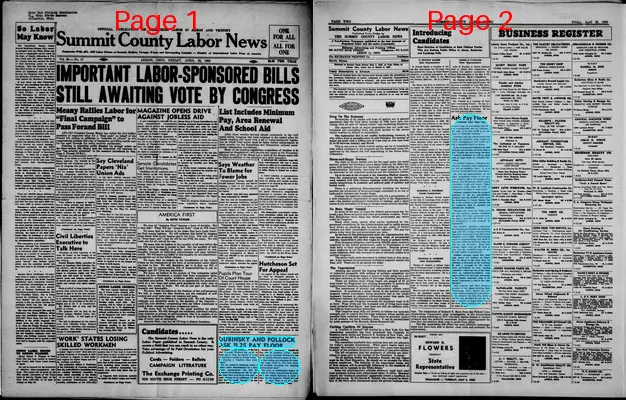
Summit County Labor News
Akron, Summit County, Ohio
What is this article about?
David Dubinsky of the Ladies' Garment Workers and William Pollock of the Textile Workers Union testify before a House Labor subcommittee in support of the Kennedy-Morse-Roosevelt bill to raise the minimum wage to $1.25 per hour and extend coverage to 7.6 million more workers, arguing it reduces welfare costs and combats unfair competition without increasing unemployment or prices significantly.
Merged-components note: Merged continuation of the story 'DUBINSKY AND POLLOCK ASK $1.25 PAY FLOOR' from page 1 to page 2.
Clippings
1 of 2
OCR Quality
Full Text
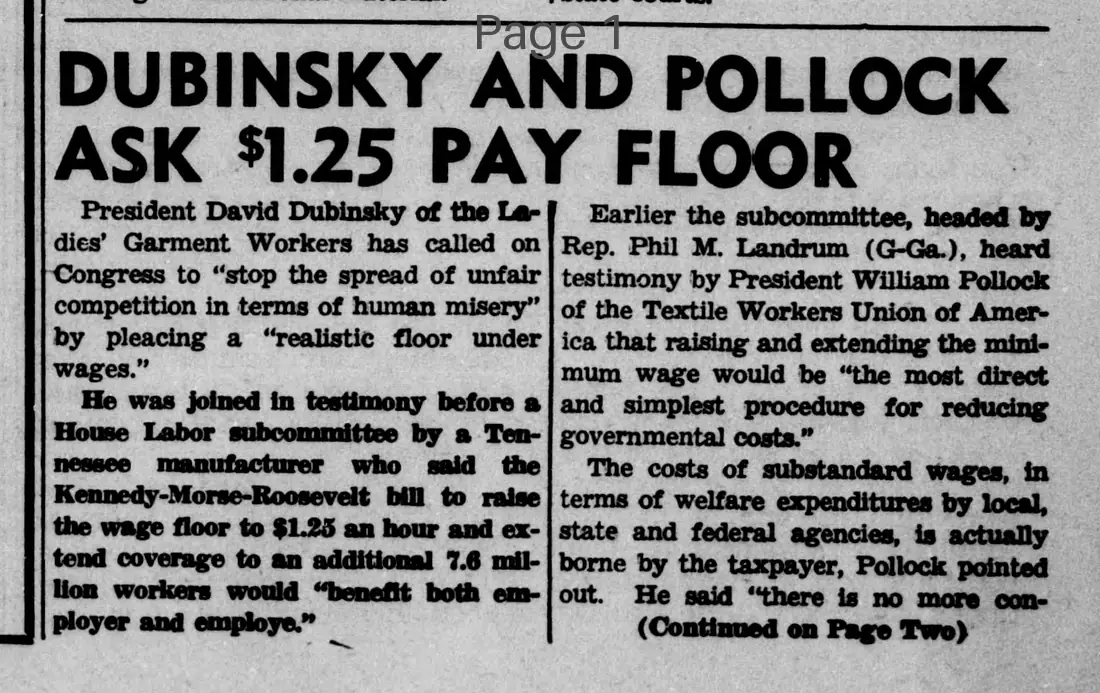
AND
POLLOCK
ASK
$1.25
PAY
FLOOR
President David Dubinsky of the Ladies' Garment Workers has called on Congress to "stop the spread of unfair competition in terms of human misery" by placing a "realistic floor under wages."
He was joined in testimony before a House Labor subcommittee by a Tennessee manufacturer who said the Kennedy-Morse-Roosevelt bill to raise the wage floor to $1.25 an hour and extend coverage to an additional 7.6 million workers would "benefit both employer and employee."
Earlier the subcommittee, headed by Rep. Phil M. Landrum (D-Ga.), heard testimony by President William Pollock of the Textile Workers Union of America that raising and extending the minimum wage would be "the most direct and simplest procedure for reducing governmental costs."
The costs of substandard wages, in terms of welfare expenditures by local, state and federal agencies, is actually borne by the taxpayer, Pollock pointed out. He said "there is no more constructive way of minimizing total welfare expenditures than by assuring a fair wage of at least $1.25 to all employees in American industry."
Dubinsky told the subcommittee that raising the minimum wage would not curtail unemployment and would have only a negligible effect on prices.
In the womens wear industry, he said, wholesale prices today are lower than in 1947 "despite the intervening advances in federal minimums as well as gains made in wage levels by collective bargaining."
To ILGWU members, Dubinsky emphasized, "minimum wage legislation is not just an academic issue. It is of practical bread-and-butter importance."
He told the subcommittee of the highly competitive nature of the garment industry, where the average shop employs only 36 workers, where capital investment is low and where unfair competition often takes the form of competition in terms of wage levels."
Dubinsky departed from his prepared testimony to tell the subcommittee members how the ILGWU arose from the sweatshops to restore human dignity to the workers in the industry and the continuing fight to establish and maintain fair standards.
"Because new firms can easily come into the industry, because employers can easily shift their operations from one shop to another, the threat of unfair competition is ever present," he emphasized.
The ILGWU president emphasized the widening gap between the minimum wage and the average manufacturing wage since enactment of the Fair Labor Standards Act in 1938. While average wages in manufacturing rose $1.66 an hour since 1938, the minimum wage has gone up only 75 cents. Since 1949, average wages went up 90 cents an hour, but the minimum wage is only 25 cents higher, he pointed out.
Dubinsky strongly urged that minimum wages for workers in Puerto Rico be raised at the same time the minimum is increased on the mainland.
He said a proposal by the Puerto Rican government to raise existing minimums--which are set on the island under an industry-by-industry wage board system--by the same percentage as the federal minimum wage is advanced represents a step in the right direction."
Both Dubinsky and Reid Murphey, president of the Signal Knitting Mills, Chattanooga, Tenn., agreed that low-priced imports presented a real problem to the industry but that this problem couldn't and shouldn't be met by trying to compete on wages with areas of the world where workers are paid 12 to 14 cents an hour.
What sub-type of article is it?
What themes does it cover?
What keywords are associated?
What entities or persons were involved?
Where did it happen?
Story Details
Key Persons
Location
House Labor Subcommittee
Story Details
Union leaders Dubinsky and Pollock testify in favor of raising the federal minimum wage to $1.25 per hour and extending coverage, highlighting benefits to workers, employers, and taxpayers while addressing unfair competition in garment and textile industries.