Thank you for visiting SNEWPapers!
Sign up free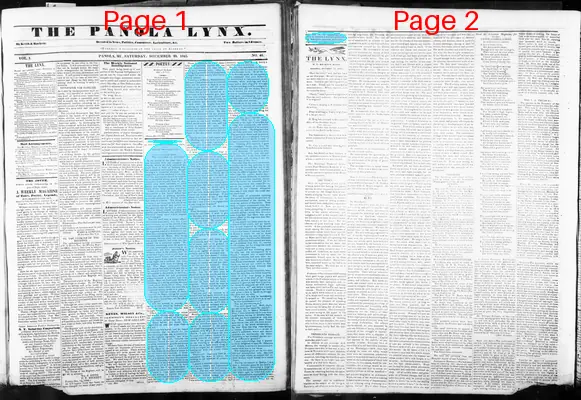
Literary
December 20, 1845
The Panola Lynx
Panola, Panola County, Mississippi
What is this article about?
In the Florida War of 183-, a lieutenant recounts how soldier Edwards falls asleep on guard, is sentenced to death, but pardoned at execution by Gen. G--. Years later, the lieutenant reunites with the now-civilian Edwards and his wife in Boston.
Merged-components note: Merged the story component on page 1 with its direct textual continuation on page 2; relabeled to 'literary' as it is a serialized tale.
Clippings
1 of 2
OCR Quality
95%
Excellent
Full Text
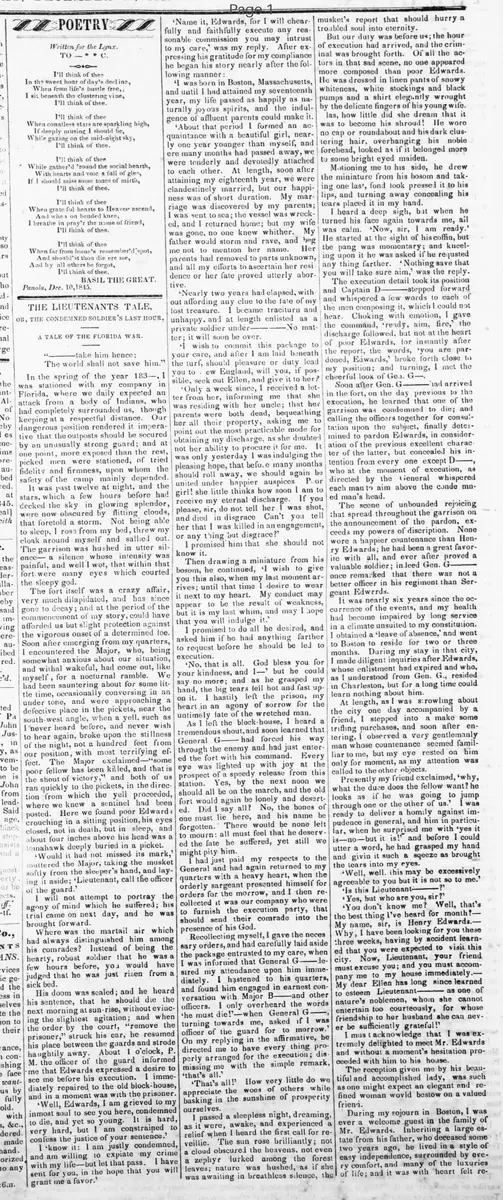
THE LIEUTENANT'S TALE
OR, THE CONDEMNED SOLDIER'S LAST HOUR,
A TALE OF THE FLORIDA WAR.
"Take him hence; The world shall not save him."
In the spring of the year 183-, I was stationed with my company in Florida, where we daily expected an attack from a body of Indians, who had completely surrounded us, though keeping at a respectful distance. Our dangerous position rendered it imperative that the outposts should be secured by an unusually strong guard; and at one point, more exposed than the rest, picked men were stationed, of tried fidelity and firmness, upon whom the safety of the camp mainly depended.
It was past twelve at night, and the stars, which a few hours before had decked the sky in glowing splendor, were now obscured by flitting clouds, that foretold a storm. Not being able to sleep, I rose from my bed, threw my cloak around myself and sallied out. The garrison was hushed in utter silence-- a silence whose intensity was painful, and well I wot, that within that fort were many eyes which courted the sleepy god.
The fort itself was a crazy affair, very much dilapidated, and has since gone to decay; and at the period of the commencement of my story, could have afforded us but slight protection against the vigorous onset of a determined foe.
Soon after emerging from my quarters, I encountered the Major, who, being somewhat anxious about our situation, and withal wakeful, had come out, like myself, for a nocturnal ramble. We had been sauntering about for some little time, occasionally conversing in an under tone, and were approaching a defective place in the pickets, near the south-west angle, when a yell, such as I never heard before, and never wish to hear again, broke upon the stillness of the night, not a hundred feet from our position, with most terrifying effect. The Major exclaimed--"some poor fellow has been killed, and that is the shout of victory," and both of us ran quickly to the pickets, in the direction from which the yell proceeded, where we knew a sentinel had been posted. Here we found poor Edwards crouching in a sitting position, his eyes closed, not in death, but in sleep, and about four inches above his head was a tomahawk deeply buried in a picket.
"Would it had not missed its mark," muttered the Major, taking the musket softly from the sleeper's hand, and laying it aside; "Lieutenant, call the officer of the guard."
I will not attempt to portray the agony of mind which he suffered; his trial came on next day, and he was brought forward.
Where was the martial air which had always distinguished him among his comrades? Instead of being the hearty, robust soldier that he was a few hours before, you would have judged that he was just risen from a sick bed.
His doom was sealed; and he heard his sentence, that he should die the next morning at sun-rise, without evincing the slightest agitation; and when the order by the court, "remove the prisoner," struck his ear, he resumed his place between the guards and strode haughtily away. About 1 o'clock, P. M. the officer of the guard informed me that Edwards expressed a desire to see me before his execution. I immediately repaired to the old block-house, and in a moment was with the prisoner.
"Well, Edwards, I am grieved to my inmost soul to see you here, condemned to die, and yet so young. It is hard, very hard, but I am constrained to confess the justice of your sentence."
"I know it: I am justly condemned, and am willing to expiate my crime with my life--but let that pass. I have sent for you, in the hope that you will grant me a favor."
"Name it, Edwards, for I will cheerfully and faithfully execute any reasonable commission you may intrust to my care," was my reply.
After expressing his gratitude for my compliance he began his story nearly after the following manner:
"I was born in Boston, Massachusetts, and until I had attained my seventeenth year, my life passed as happily as naturally joyous spirits, and the indulgence of affluent parents could make it.
"About that period I formed an acquaintance with a beautiful girl, nearly one year younger than myself, and ere many months had passed away, we were tenderly and devotedly attached to each other. At length, soon after attaining my eighteenth year, we were clandestinely married, but our happiness was of short duration. My marriage was discovered by my parents; I was sent to sea; the vessel was wrecked, and I returned home; but my wife was gone, no one knew whither.
My father would storm and rave, and beg me not to mention her name. Her parents had removed to parts unknown, and all my efforts to ascertain her residence or her fate proved utterly abortive.
"Nearly two years had elapsed, without affording any clue to the fate of my lost treasure. I became taciturn and unhappy. and at length enlisted as a private soldier under No matter; it will soon be over.
"I wish to commit this package to your care, and after I am laid beneath the turf, should pleasure or duty lead you to New England, will you, if possible, seek out Ellen, and give it to her?
"Only a week since, I received a letter from her, informing me that she was residing with her uncle; that her parents were both dead, bequeathing her all their property, asking me to point out the most practicable mode for obtaining my discharge, as she doubted not her ability to procure it for me. It was only yesterday I was indulging the pleasing hope, that before many months should roll away, we should again be united under happier auspices Poor girl! she little thinks how soon I am to receive my eternal discharge. If you please, sir, do not tell her I was shot, and died in disgrace Can't you tell her that I was killed in an engagement, or any thing but disgrace?"
I promised him that she should not know it.
Then drawing a miniature from his bosom, he continued, "I wish to give you this also, when my last moment arrives; until that time I desire to wear it next to my heart. My conduct may appear to be the result of weakness, but it is my last whim, and may I hope that you will indulge it.'"
I promised to do all he desired, and asked him if he had anything farther to request before he should be led to execution.
"No, that is all. God bless you for your kindness, and I--" but he could say no more; and as he grasped my hand, the big tears fell hot and fast upon it. I hastily left the prison, my heart in an agony of sorrow for the untimely fate of the wretched man.
As I left the block-house, I heard a tremendous shout, and soon learned that General G-- had forced his way through the enemy and had just entered the fort with his command. Every eye was lighted up with joy at the prospect of a speedy release from this station. Yes, by the next noon we should all be on the march, and the old fort would again be lonely and deserted. Did I say all? No, the bones of one must lie here, and his name be forgotten.' There would be none left to mourn: all must feel that he deserved the fate he suffered, yet still we might pity him.
I had just paid my respects to the General and had again returned to my quarters with a heavy heart, when the orderly sergeant presented himself for orders for the morrow, and I then recollected it was our company who were to furnish the execution party, that should send their comrade into the presence of his God.
Recollecting myself, I gave the necessary orders, and had carefully laid aside the package entrusted to my care, when I was informed that General G-- desired my attendance upon him immediately. I hastened to his quarters, and found him engaged in earnest conversation with Major B-- and other officers. I only overheard the words "he must die!"--when General G--, turning towards me, asked if I was officer of the guard for to-morrow.'
On my replying in the affirmative, he directed me to have every thing properly arranged for the execution; dismissing me with the simple remark, "that's all.'"
"That's all!' How very little do we appreciate the woes of others while basking in the sunshine of prosperity ourselves.
I passed a sleepless night, dreaming, as it were, awake, and experienced a relief when I heard the first call for reveille. The sun rose brilliantly; not a cloud obscured the heavens, not even a zephyr lurked among the forest leaves; nature was hushed, as if she was awaiting in breathless silence, the musket's report that should hurry a troubled soul into eternity.
But our duty was before us; the hour of execution had arrived, and the criminal was brought forth. Of all the actors in that sad scene, no one appeared more composed than poor Edwards.
He was dressed in linen pants of snowy whiteness, white stockings and black pumps and a shirt elegantly wrought by the delicate fingers of his young wife. Alas, how little did she dream that it was to become his shroud! He wore no cap or roundabout and his dark clustering hair, overhanging his noble forehead, looked as if it belonged more to some bright eyed maiden.
Motioning me to his side, he drew the miniature from his bosom and taking one last, fond look pressed it to his lips, and turning away concealing his tears placed it in my hand.
I heard a deep sigh, but when he turned his face again towards me, all was calm. "Now, sir, I am ready."
He started at the sight of his coffin, but the pang was momentary; and kneeling upon it he was asked if he requested any thing farther. "Nothing save that you will take sure aim," was the reply.
"The execution detail took its position and Captain D-- stepped forward and whispered a few words to each of the men composing it, which I could not hear. Choking with emotion, I gave the command, ready, aim, fire, the discharge followed. but not at the heart of poor Edwards, for instantly after the report, the words, 'you are pardoned, Edwards,' broke forth close to my position; and turning, I met the cheerful look of Gen. G--.
Soon after Gen. G-- had arrived in the fort, on the day previous to the execution, he learned that one of the garrison was condemned to die; and calling the officers together for consultation upon the subject, finally determined to pardon Edwards, in consideration of the previous excellent character of the latter, but concealed his intention from every one except D--, who at the moment of execution, as directed by the General whispered each man to aim above the condemned man's head.
The scene of unbounded rejoicing that spread throughout the garrison on the announcement of the pardon, exceeds my powers of description. None wore a happier countenance than Henry Edwards; he had been a great favorite with all, and ever after proved a valuable soldier: indeed Gen. G-- once remarked that there was not a better officer in his regiment than Sergeant Edwards.
It was nearly six years since the occurrence of the events, and my health had become impaired by long service in a climate unsuited to my constitution. I obtained a 'leave of absence,' and went to Boston to reside for two or three months. During my stay in that city, I made diligent inquiries after Edwards, whose enlistment had expired and who, as I understood from Gen. G., resided in Charleston, but for a long time could learn nothing about him.
At length, as I was strolling about the city one day accompanied by a friend, I stepped into a store to make some trifling purchases, and soon after entering, I observed a very gentlemanly man whose countenance seemed familiar to me, but my eye rested on him only for a moment, as my attention was called to the other objects.
Presently my friend exclaimed, 'why, what the duce does the fellow want? he looks as if he was going to jump through one or the other of us.' I was ready to deliver a homily against impertinence in general, and him in particular, when he surprised me with 'yes it is--no--but it is!' and before I could utter a word, he had grasped my hand and given it such a squeeze as brought the tears into my eyes.
"Well, well. this may be excessively agreeable to you but it is not so to me.'
'Is this Lieutenant--?'
'Yes, but who are you, sir?'
'You don't know me? Well, that's the best thing I've heard for months-- My name, sir, is Henry Edwards.'
'Why, I have been looking for you these three weeks, having by accident learned that you were expected to visit this city. Now, Lieutenant, your friend must excuse you; and you must accompany me to my house immediately.-- My dear Ellen has long since learned to esteem Lieutenant-- as one of nature's noblemen, whom she cannot entertain too courteously, for whose friendship to her husband she can never be sufficiently grateful!'
I must acknowledge that I was extremely delighted to meet Mr. Edwards and without a moment's hesitation proceeded with him to his house.
The reception given me by his beautiful and accomplished lady, was such as one might expect an elegant and refined woman would bestow on a valued friend.
During my sojourn in Boston, I was ever a welcome guest in the family of Mr. Edwards. Inheriting a large estate from his father, who deceased some two years ago, he lived in a style of easy independence, surrounded by every comfort, and many of the luxuries of life; and it was with heartfelt regret that I bade adieu to such agreeable friends. It was with great regret that on the expiration of my leave of absence, I was obliged to leave his hospitable mansion and rejoin my regiment in the regions of the wild west.
OR, THE CONDEMNED SOLDIER'S LAST HOUR,
A TALE OF THE FLORIDA WAR.
"Take him hence; The world shall not save him."
In the spring of the year 183-, I was stationed with my company in Florida, where we daily expected an attack from a body of Indians, who had completely surrounded us, though keeping at a respectful distance. Our dangerous position rendered it imperative that the outposts should be secured by an unusually strong guard; and at one point, more exposed than the rest, picked men were stationed, of tried fidelity and firmness, upon whom the safety of the camp mainly depended.
It was past twelve at night, and the stars, which a few hours before had decked the sky in glowing splendor, were now obscured by flitting clouds, that foretold a storm. Not being able to sleep, I rose from my bed, threw my cloak around myself and sallied out. The garrison was hushed in utter silence-- a silence whose intensity was painful, and well I wot, that within that fort were many eyes which courted the sleepy god.
The fort itself was a crazy affair, very much dilapidated, and has since gone to decay; and at the period of the commencement of my story, could have afforded us but slight protection against the vigorous onset of a determined foe.
Soon after emerging from my quarters, I encountered the Major, who, being somewhat anxious about our situation, and withal wakeful, had come out, like myself, for a nocturnal ramble. We had been sauntering about for some little time, occasionally conversing in an under tone, and were approaching a defective place in the pickets, near the south-west angle, when a yell, such as I never heard before, and never wish to hear again, broke upon the stillness of the night, not a hundred feet from our position, with most terrifying effect. The Major exclaimed--"some poor fellow has been killed, and that is the shout of victory," and both of us ran quickly to the pickets, in the direction from which the yell proceeded, where we knew a sentinel had been posted. Here we found poor Edwards crouching in a sitting position, his eyes closed, not in death, but in sleep, and about four inches above his head was a tomahawk deeply buried in a picket.
"Would it had not missed its mark," muttered the Major, taking the musket softly from the sleeper's hand, and laying it aside; "Lieutenant, call the officer of the guard."
I will not attempt to portray the agony of mind which he suffered; his trial came on next day, and he was brought forward.
Where was the martial air which had always distinguished him among his comrades? Instead of being the hearty, robust soldier that he was a few hours before, you would have judged that he was just risen from a sick bed.
His doom was sealed; and he heard his sentence, that he should die the next morning at sun-rise, without evincing the slightest agitation; and when the order by the court, "remove the prisoner," struck his ear, he resumed his place between the guards and strode haughtily away. About 1 o'clock, P. M. the officer of the guard informed me that Edwards expressed a desire to see me before his execution. I immediately repaired to the old block-house, and in a moment was with the prisoner.
"Well, Edwards, I am grieved to my inmost soul to see you here, condemned to die, and yet so young. It is hard, very hard, but I am constrained to confess the justice of your sentence."
"I know it: I am justly condemned, and am willing to expiate my crime with my life--but let that pass. I have sent for you, in the hope that you will grant me a favor."
"Name it, Edwards, for I will cheerfully and faithfully execute any reasonable commission you may intrust to my care," was my reply.
After expressing his gratitude for my compliance he began his story nearly after the following manner:
"I was born in Boston, Massachusetts, and until I had attained my seventeenth year, my life passed as happily as naturally joyous spirits, and the indulgence of affluent parents could make it.
"About that period I formed an acquaintance with a beautiful girl, nearly one year younger than myself, and ere many months had passed away, we were tenderly and devotedly attached to each other. At length, soon after attaining my eighteenth year, we were clandestinely married, but our happiness was of short duration. My marriage was discovered by my parents; I was sent to sea; the vessel was wrecked, and I returned home; but my wife was gone, no one knew whither.
My father would storm and rave, and beg me not to mention her name. Her parents had removed to parts unknown, and all my efforts to ascertain her residence or her fate proved utterly abortive.
"Nearly two years had elapsed, without affording any clue to the fate of my lost treasure. I became taciturn and unhappy. and at length enlisted as a private soldier under No matter; it will soon be over.
"I wish to commit this package to your care, and after I am laid beneath the turf, should pleasure or duty lead you to New England, will you, if possible, seek out Ellen, and give it to her?
"Only a week since, I received a letter from her, informing me that she was residing with her uncle; that her parents were both dead, bequeathing her all their property, asking me to point out the most practicable mode for obtaining my discharge, as she doubted not her ability to procure it for me. It was only yesterday I was indulging the pleasing hope, that before many months should roll away, we should again be united under happier auspices Poor girl! she little thinks how soon I am to receive my eternal discharge. If you please, sir, do not tell her I was shot, and died in disgrace Can't you tell her that I was killed in an engagement, or any thing but disgrace?"
I promised him that she should not know it.
Then drawing a miniature from his bosom, he continued, "I wish to give you this also, when my last moment arrives; until that time I desire to wear it next to my heart. My conduct may appear to be the result of weakness, but it is my last whim, and may I hope that you will indulge it.'"
I promised to do all he desired, and asked him if he had anything farther to request before he should be led to execution.
"No, that is all. God bless you for your kindness, and I--" but he could say no more; and as he grasped my hand, the big tears fell hot and fast upon it. I hastily left the prison, my heart in an agony of sorrow for the untimely fate of the wretched man.
As I left the block-house, I heard a tremendous shout, and soon learned that General G-- had forced his way through the enemy and had just entered the fort with his command. Every eye was lighted up with joy at the prospect of a speedy release from this station. Yes, by the next noon we should all be on the march, and the old fort would again be lonely and deserted. Did I say all? No, the bones of one must lie here, and his name be forgotten.' There would be none left to mourn: all must feel that he deserved the fate he suffered, yet still we might pity him.
I had just paid my respects to the General and had again returned to my quarters with a heavy heart, when the orderly sergeant presented himself for orders for the morrow, and I then recollected it was our company who were to furnish the execution party, that should send their comrade into the presence of his God.
Recollecting myself, I gave the necessary orders, and had carefully laid aside the package entrusted to my care, when I was informed that General G-- desired my attendance upon him immediately. I hastened to his quarters, and found him engaged in earnest conversation with Major B-- and other officers. I only overheard the words "he must die!"--when General G--, turning towards me, asked if I was officer of the guard for to-morrow.'
On my replying in the affirmative, he directed me to have every thing properly arranged for the execution; dismissing me with the simple remark, "that's all.'"
"That's all!' How very little do we appreciate the woes of others while basking in the sunshine of prosperity ourselves.
I passed a sleepless night, dreaming, as it were, awake, and experienced a relief when I heard the first call for reveille. The sun rose brilliantly; not a cloud obscured the heavens, not even a zephyr lurked among the forest leaves; nature was hushed, as if she was awaiting in breathless silence, the musket's report that should hurry a troubled soul into eternity.
But our duty was before us; the hour of execution had arrived, and the criminal was brought forth. Of all the actors in that sad scene, no one appeared more composed than poor Edwards.
He was dressed in linen pants of snowy whiteness, white stockings and black pumps and a shirt elegantly wrought by the delicate fingers of his young wife. Alas, how little did she dream that it was to become his shroud! He wore no cap or roundabout and his dark clustering hair, overhanging his noble forehead, looked as if it belonged more to some bright eyed maiden.
Motioning me to his side, he drew the miniature from his bosom and taking one last, fond look pressed it to his lips, and turning away concealing his tears placed it in my hand.
I heard a deep sigh, but when he turned his face again towards me, all was calm. "Now, sir, I am ready."
He started at the sight of his coffin, but the pang was momentary; and kneeling upon it he was asked if he requested any thing farther. "Nothing save that you will take sure aim," was the reply.
"The execution detail took its position and Captain D-- stepped forward and whispered a few words to each of the men composing it, which I could not hear. Choking with emotion, I gave the command, ready, aim, fire, the discharge followed. but not at the heart of poor Edwards, for instantly after the report, the words, 'you are pardoned, Edwards,' broke forth close to my position; and turning, I met the cheerful look of Gen. G--.
Soon after Gen. G-- had arrived in the fort, on the day previous to the execution, he learned that one of the garrison was condemned to die; and calling the officers together for consultation upon the subject, finally determined to pardon Edwards, in consideration of the previous excellent character of the latter, but concealed his intention from every one except D--, who at the moment of execution, as directed by the General whispered each man to aim above the condemned man's head.
The scene of unbounded rejoicing that spread throughout the garrison on the announcement of the pardon, exceeds my powers of description. None wore a happier countenance than Henry Edwards; he had been a great favorite with all, and ever after proved a valuable soldier: indeed Gen. G-- once remarked that there was not a better officer in his regiment than Sergeant Edwards.
It was nearly six years since the occurrence of the events, and my health had become impaired by long service in a climate unsuited to my constitution. I obtained a 'leave of absence,' and went to Boston to reside for two or three months. During my stay in that city, I made diligent inquiries after Edwards, whose enlistment had expired and who, as I understood from Gen. G., resided in Charleston, but for a long time could learn nothing about him.
At length, as I was strolling about the city one day accompanied by a friend, I stepped into a store to make some trifling purchases, and soon after entering, I observed a very gentlemanly man whose countenance seemed familiar to me, but my eye rested on him only for a moment, as my attention was called to the other objects.
Presently my friend exclaimed, 'why, what the duce does the fellow want? he looks as if he was going to jump through one or the other of us.' I was ready to deliver a homily against impertinence in general, and him in particular, when he surprised me with 'yes it is--no--but it is!' and before I could utter a word, he had grasped my hand and given it such a squeeze as brought the tears into my eyes.
"Well, well. this may be excessively agreeable to you but it is not so to me.'
'Is this Lieutenant--?'
'Yes, but who are you, sir?'
'You don't know me? Well, that's the best thing I've heard for months-- My name, sir, is Henry Edwards.'
'Why, I have been looking for you these three weeks, having by accident learned that you were expected to visit this city. Now, Lieutenant, your friend must excuse you; and you must accompany me to my house immediately.-- My dear Ellen has long since learned to esteem Lieutenant-- as one of nature's noblemen, whom she cannot entertain too courteously, for whose friendship to her husband she can never be sufficiently grateful!'
I must acknowledge that I was extremely delighted to meet Mr. Edwards and without a moment's hesitation proceeded with him to his house.
The reception given me by his beautiful and accomplished lady, was such as one might expect an elegant and refined woman would bestow on a valued friend.
During my sojourn in Boston, I was ever a welcome guest in the family of Mr. Edwards. Inheriting a large estate from his father, who deceased some two years ago, he lived in a style of easy independence, surrounded by every comfort, and many of the luxuries of life; and it was with heartfelt regret that I bade adieu to such agreeable friends. It was with great regret that on the expiration of my leave of absence, I was obliged to leave his hospitable mansion and rejoin my regiment in the regions of the wild west.
What sub-type of article is it?
Prose Fiction
What themes does it cover?
War Peace
Moral Virtue
What keywords are associated?
Florida War
Condemned Soldier
Sleeping Sentinel
Military Pardon
Soldier Reunion
Literary Details
Title
The Lieutenant's Tale Or, The Condemned Soldier's Last Hour, A Tale Of The Florida War.
Subject
A Tale Of The Florida War.
Key Lines
"Take Him Hence; The World Shall Not Save Him."
"I Know It: I Am Justly Condemned, And Am Willing To Expiate My Crime With My Life But Let That Pass."
"Only A Week Since, I Received A Letter From Her... Poor Girl! She Little Thinks How Soon I Am To Receive My Eternal Discharge."
"Nothing Save That You Will Take Sure Aim,"
'You Are Pardoned, Edwards,'