Thank you for visiting SNEWPapers!
Sign up free
The Southern Press
Washington, District Of Columbia
What is this article about?
The Alabama Southern Rights Convention in Montgomery (March 4-5, 1852) adopted resolutions defending slavery, states' rights, and Southern interests against abolitionism; formed a central committee led by W. L. Yancey; planned future party conventions.
Clipping
OCR Quality
Full Text
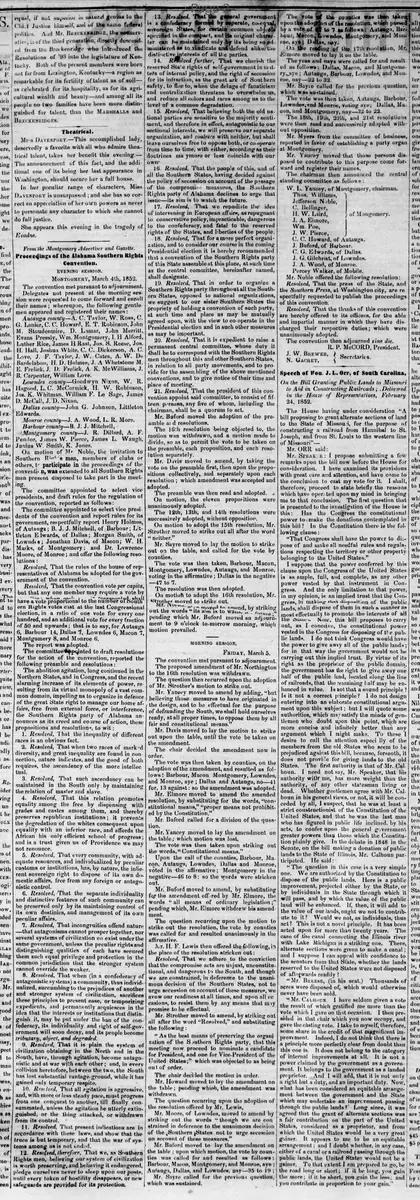
Proceedings of the Alabama Southern Rights Convention.
EVENING SESSION.
Montgomery, March 4th, 1852
The convention met pursuant to adjournment. Delegates not present at the morning session were requested to come forward and enrol their names; whereupon, the following gentlemen appeared and registered their names:
Autauga county—A. C. Taylor, W. Ross, C. G. Lanier. C. C. Howard, E. T. Robinson, John M. Stoudenmire, D. Lamar. John Merritt. Evans Pressly, Wm. Montgomery, I. H Alford, Luther Rice, James H Rast, Jos. S. Reese, Jos. H. Hall, Joshua White, C. C. Dickerson, A. C. Love, J. F. Taylor, J. W. Cates, A. W. De Bardelabon, H. D. Holmes, J. A Whetstone M. E. Frelick, J. D. Frelick, A. K. MeWilliams, J. B. Carpenter, William Love.
Lowndes county—Goodwyn Nixon, W. R Hagood, L. C. MeCormick, H. W. Robinson, Jas. K. Whitman. William F. Le Sage, James D. MeCall, J. D. Nixon.
Dallas county—John G. Johnson, Littleton Edwards.
Monroe county—J. A. Wood, L. R. More.
Barbour county—B. J. J. Mitchell,
Montgomery county—J. R. Dillard, A. F Pondor, James W. Pierce, James L. Waugh Junius W. Smith, K. Jones.
On motion of Mr Noble, the invitation to Southern Rights men, members of clubs or others, to participate in the proceedings of the convention, was extended to all Southern Rights men present disposed to take part in the meeting.
The committee appointed to select vice presidents, and draft rules for the regulation of the convention, reported as follows:
The committee appointed to select vice presidents of the convention and report rules for its government, respectfully report Henry Holmes of Autauga; B. J. J. Mitchell, of Barbour; Littleton Edwards, of Dallas; Morgan Smith, of Lowndes; Jonathan Davis, of Macon; W. H. Marks, of Montgomery; and Dr. Lawrence Moore, of Monroe; and offer the following resolutions:
Resolved, That the rules of the house of representatives of Alabama be adopted for the government of the convention.
Resolved, That the convention vote per capita, but that any one member may require a vote by counties, or by vote proportional to the number of Southern Rights votes cast at the last Congressional election, in a ratio of one vote for every one hundred, and an additional vote for every fraction of 50 and upwards; that is to say, for Autauga 6, Barbour 14, Dallas 7, Lowndes 6, Macon 7, Montgomery 8, and Monroe 6.
The report was adopted.
The committees appointed to draft resolutions for the action of the convention, reported the following preamble and resolutions:
The abolition agitation, long continued in the Northern States, and in Congress, and the recent alarming increase of its elements of power, resulting from its virtual monopoly of a vast common domain, impelling us to organize in defence of the great State right to manage our home affairs, free from external force, or interference. the Southern Rights party of Alabama announces as its creed and course of action, these propositions and resolutions, to wit :
1. Resolved, That the inequality of different races is an obvious fact.
2. Resolved, That when two races of marked diversity, and great inequality are found in connection, nature indicates, and the good of both requires, the ascendency of the more intellectual.
3. Resolved, That such ascendency can be maintained in the South only by maintaining the relation of master and slave.
4. Resolved, That this relation promotes equality among the free by dispensing with grades and castes among them, and thereby preserves republican institutions; it prevents the degradation of the whites consequent upon equality with an inferior race, and affords the African his only efficient school of progress; and is a trust given us of Providence we may not renounce.
5. Resolved, That every community, with adequate resources, and individualized by peculiar customs or institutions, has, by nature, the inherent sovereign right to dispose of its own domestic affairs, free from any foreign or antagonistic control.
6. Resolved, That the separate individuality and distinctive features of such community can be preserved only by its maintaining control of its own destinies, and management of its own peculiar affairs.
7. Resolved, That incongruities offend nature -that antagonisms cannot prosper together, nor several systems of civilization co exist under the same government, unless the peculiar rights and distinguishing qualities of each have secured to them such equal privilege and protection in the common jurisdiction that the stronger system cannot override the weaker.
8. Resolved, That when (in a confederacy of antagonistic systems) a community, thus individualized, succumbing to the prejudices of another and stronger system of civilization, sacrifices these principles to present ease, or temporizing expedients, and permanently acquiesces in the idea that the interests or institutions that distinguish it, may be put under the ban of the confederacy, its individuality and right of self-government will soon decay, and its people become tributary, abject, and degraded.
9. Resolved, That it is plain the system of civilization obtaining in the North and in the South, have, through agitation, become antagonistic and at war with each other; and, in every collision heretofore, between the two, the South has lost substantial vantage-ground, while it has gained only temporary respite.
10. Resolved, That all agitation is aggressive. and, with more or less steady pace, must progress from one conquest to another, till finally consummated, unless the agitation be utterly extinguished, or the thing attacked, or withdrawn from its control.
11. Resolved, That present indications are in accordance with these laws, and show that the truce is but temporary, and that the war of systems among us is not ended.
12. Resolved, therefore, That we, as Southern Rights men, believing our system of civilization is worth preserving, and believing it endangered. pledge ourselves never to sleep upon our posts, until every token of hostility disappears, or new safeguards are provided for its protection.
13. Resolved, That the general government in a confederacy formed by separate, co-equal sovereign States, for certain common objects specified in the compact, and is original character can be maintained only by its being so administered as to vindicate and defend alike the distinctive interests of all the parties.
14. Resolved further, That we cherish the reserved State rights of self-government in matters of internal policy, and the right of secession for its infraction, as the great ark of Southern safety, to flee to, when the deluge of fanaticism and centralization threatens to overwhelm us, and reduce all colors and races among us to the level of a common degradation.
15. Resolved, That believing both the old national parties are sensitive to the majority sentiment, and therefore in effect, antagonistic to our sectional interests, we will preserve our separate organization, and coalesce with neither, but shall leave ourselves free to oppose both, or co-operate from time to time, with either, according as their doctrines may more or less coincide with our own.
16. Resolved, That the people of this, and of all the Southern States, having decided against the policy of secession on account of the passage of the compromise measures, the Southern Rights party of Alabama declines to urge that issue-its aim is to watch the future.
17. Resolved, That we repudiate the idea of intervening in European affairs, as repugnant to conservative policy, impracticable, dangerous to the confederacy, and fatal to the reserved rights of the States, and liberties of the people.
18. Resolved, That for a more perfect organization, and to consider our course in the coming Presidential election it is hereby recommended that a convention of the Southern Rights party of this State assemble at this place, at such time as the central committee, hereinafter named. shall designate.
19. Resolved, That in order to organize a Southern Rights party throughout all the Southern States, opposed to national organizations, we suggest to our sister Southern States the propriety of holding a convention of such party, at such time and place as may be mutually agreed upon, with the view to co-operate in the Presidential election and in such other measures as may be important.
20. Resolved, That it is expedient to raise a permanent central committee, whose duty it shall be to correspond with the Southern Rights men throughout this and other Southern States, in relation to all party movements, and to provide for the assembling of the above mentioned conventions, and to give notice of their time and place of meeting.
21. Resolved, That the president of this convention appoint said committee, to consist of fifteen persons, any five of whom, including the chairman, shall be a quorum to act.
Mr. Buford moved the adoption of the preamble and resolutions.
The 16th resolution being objected to, the motion was withdrawn, and a motion made to divide, so as to permit the vote to be taken on the preamble, each proposition, and each resolution separately.
Mr. Davis moved to amend, by taking the vote on the preamble first, then upon the propositions collectively, and separately upon each resolution: which amendment was accepted and adopted.
The preamble was then read and adopted.
On motion, the eleven propositions were unanimously adopted.
The 12th, 13th, and 14th resolutions were successively adopted, without opposition.
On motion to adopt the 15th resolution, Mr Strother moved to strike out all after the word "neither."
Mr. Sayre moved to lay the motion to strike out on the table, and called for the vote by counties.
The vote was then taken, Barbour, Macon, Montgomery, Lowndes, Autauga, and Monroe, voting in the affirmative; Dallas in the negative -47 to 7.
The resolution was then adopted.
On motion to adopt the 16th resolution, Mr. Strother moved to strike out.
Mr. Northington moved to amend, by striking out the words "its aim is to watch the future?"
pending which Mr. Buford moved an adjournment to 9 o'clock to-morrow morning, which motion prevailed.
MORNING SESSION.
FRIDAY, March 5.
The convention met pursuant to adjournment
The proposed amendment of Mr. Northington to the 16th resolution was withdrawn.
The question then recurred upon the adoption of Mr. Strother's motion to strike out.
Mr. Yancey moved to amend by adding, "but believing those measures to have originated in the design, and to be effectual for the purpose of defrauding the South, we shall hold ourselves ready, at all proper times, to oppose them by all fair and constitutional means."
Mr. Davis moved to lay the motion to strike out upon the table, until the vote be taken on the amendment.
The chair decided the amendment now in order.
The vote was then taken by counties, on the adoption of the amendment, and resulted as follows: Barbour, Macon Montgomery, Lowndes, and Monroe, aye; Dallas and Autauga, no--41 for, 13 against: so the amendment was adopted.
Mr. Elmore moved to amend the amended resolution, by substituting for the words, "constitutional means," "proper means not prohibited by the Constitution."
Mr. Buford called for a division of the question.
Mr. Yancey moved to lay the amendment on the table; which motion was lost.
The vote was then taken upon striking out the words,"Constitutional means.
Upon the call of the counties, Barbour, Macon, Autauga, Lowndes, Dallas and Monroe, voted in the affirmative; Montgomery in the negative-46 to 8: so the words were stricken out.
Mr. Buford moved to amend, by substituting for the amendment offered by Mr. Elmore, the words "all means of ordinary legislation;"
pending which, Mr. Elmore withdrew his amendment.
The question recurring upon the motion to strike out the resolution, the vote by counties was called for and resulted unanimously in the affirmative.
Mr. H. F. Lewis then offered the following, in the place of the resolution stricken out:
Resolved, That we adhere to the conviction that the compromise acts are unjust, unconstitutional, and dangerous to the South, and though we are constrained, in deference to the unanimous decision of the Southern States, not to urge secession on account of these measures, we avow our readiness at all times, and upon all occasions, to resist them by any means that may promise to be effectual,
Mr. Strother moved to amend, by striking out all after the word "Resolved," and substituting the following:
"As the best means of preserving the organization of the Southern Rights party, that this meeting now proceed to nominate a candidate for President, and one for Vice-President of the United States;" which was objected to as being out of order.
The chair decided the motion in order.
Mr. Howard moved to lay the amendment on the table; pending which, the amendment was withdrawn.
The question recurring upon the adoption of the resolution offered by Mr. Lewis,
Mr. Moore, of Lowndes, moved to amend by striking out the words "though we are constrained in deference to the unanimous decision of the Southern States not to urge secession on account of these measures."
Mr. Buford moved to lay the amendment on the table ; upon which motion, the vote by counties was called for and resulted as follows:
Barbour, Macon, Montgomery, and Monroe, aye; Autauga, Dallas, and Lowndes, nay-35 to 19
Mr. Sayre called for the previous question, which was sustained.
The vote of the counties was then taken upon the adoption of the resolution, which passed by a vote of 47 to 7 as follows: Autauga, Barbour, Macon, Lowndes, Montgomery, and Monroe, aye; Dallas, nay.
On the reading of the 17th resolution, Mr. Elmore moved to lay it on the table.
The yeas and nays were called for and resulted as follows: Dallas, Macon, and Montgomery,aye; Autauga, Barbour, Lowndes, and Monroe, nay-22 to 32.
Mr. Sayre called for the previous question, which was sustained.
The vote was then taken, Autauga, Barbour, Lowndes, and Monroe, voting aye; Dallas, Macon, and Montgomery, nay--32 to 22.
The 18th, 19th, 20th, and 21st resolutions were then read and successively adopted without opposition.
Mr. Myers from the committee of business, reported in favor of establishing a party organ at Montgomery.
Mr. Yancey moved that those persons disposed to contribute to this purpose come forward and register their names.
The chairman then announced the central standing committee as follows :
W. L. Yancey, of Montgomery, chairman.
Thos. Williams,
Jefferson Noble,
C. Bellinger,
H. W. Laird, of Montgomery.
J. A. Elmore,
Wm. Poe,
J. W. Pierce,
C. C. Howard, of Autauga.
J. Buford, of Barbour.
C. G. Edwards. of Dallas,
J. G. Gilchrist, of Lowndes.
J. A. Wood, of Monroe.
Percey Walker, of Mobile.
Mr. Noble offered the following resolution:
Resolved, That the press of the State, and the Southern Press, at Washington city, are respectfully requested to publish the proceedings of this convention.
Resolved, That the thanks of this convention are hereby offered to its officers, for the able and impartial manner in which they have discharged their respective duties; which were unanimously adopted.
The convention then adjourned sine die.
R. P. McCORD. President.
J. W. Brewer,
N. Gachet,
Secretaries.
What sub-type of article is it?
What keywords are associated?
What entities or persons were involved?
Where did it happen?
Domestic News Details
Primary Location
Montgomery, Alabama
Event Date
March 4 5, 1852
Key Persons
Outcome
the convention adopted a preamble and most resolutions affirming southern rights, states' rights, and the institution of slavery; formed a central committee of 15 members chaired by w. l. yancey; recommended future conventions; adjourned sine die.
Event Details
The Alabama Southern Rights Convention met in Montgomery on March 4 evening and March 5 morning, 1852. Delegates from counties including Autauga, Lowndes, Dallas, Monroe, Barbour, and Montgomery registered. Vice presidents were selected, and rules adopted based on Alabama House of Representatives procedures with voting by counties proportional to Southern Rights votes. A preamble and 21 resolutions were debated and largely adopted, addressing racial inequality, slavery's necessity, states' rights, opposition to abolitionism, rejection of national parties, and plans for party organization and future conventions. Amendments were made, particularly to the 16th resolution on compromise measures. A central standing committee was appointed, and thanks extended to officers.