Thank you for visiting SNEWPapers!
Sign up free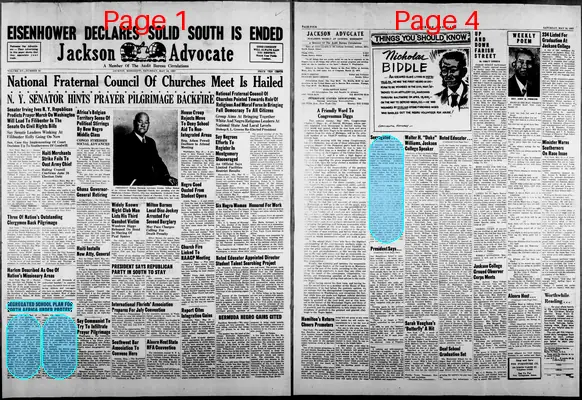
Jackson Advocate
Jackson, Hinds County, Mississippi
What is this article about?
In Cape Town, South Africa, on May 7, 1957, professors, students, and university officials protested the government's plan to racially segregate universities, removing nonwhite students to separate colleges by January 1, 1958. The policy faces strong opposition domestically and internationally, including from British universities and press, but the government persists amid fears of white racial dilution.
Merged-components note: Merged across pages for continuation of the South Africa segregated school plan story.
Clippings
1 of 2
OCR Quality
Full Text
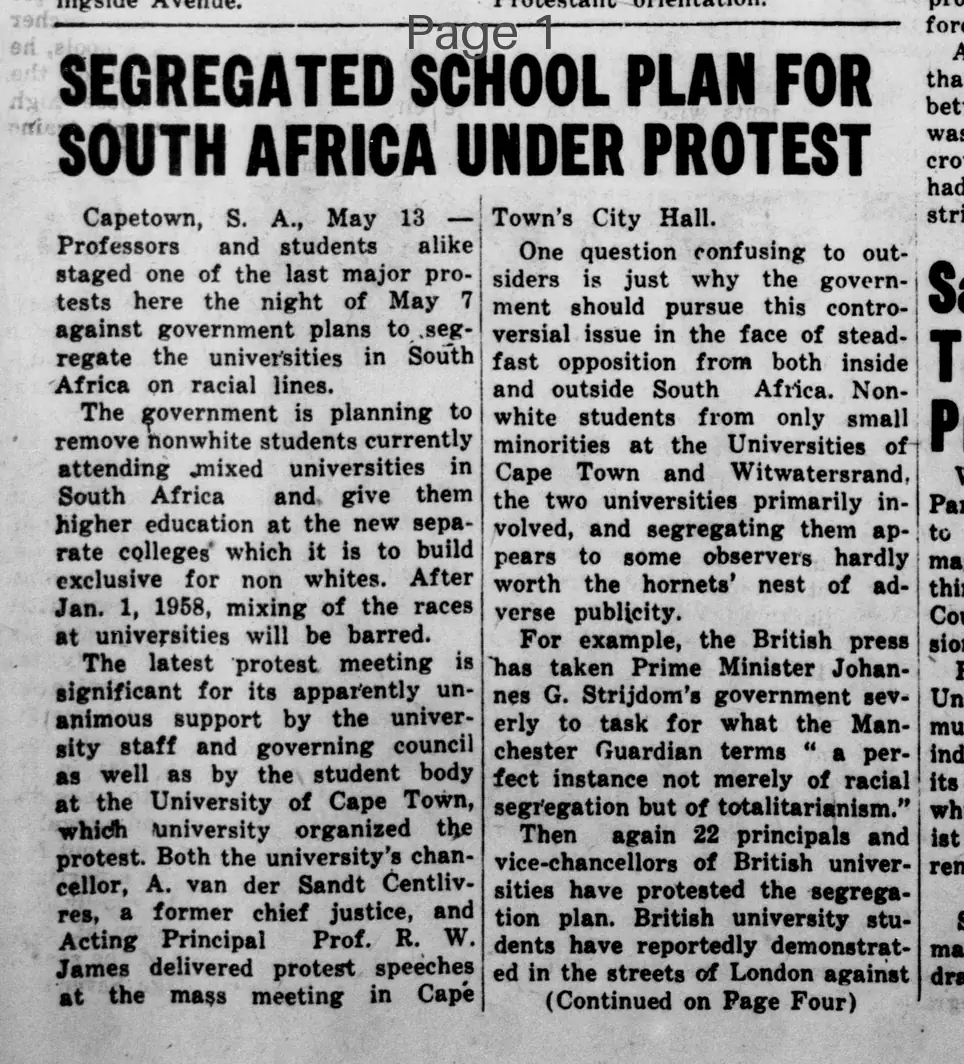
Capetown, S. A., May 13 - Professors and students alike staged one of the last major protests here the night of May 7 against government plans to segregate the universities in South Africa on racial lines.
The government is planning to remove nonwhite students currently attending mixed universities in South Africa and give them higher education at the new separate colleges which it is to build exclusive for non whites. After Jan. 1, 1958, mixing of the races at universities will be barred.
The latest protest meeting is significant for its apparently unanimous support by the university staff and governing council as well as by the student body at the University of Cape Town, which university organized the protest. Both the university's chancellor, A. van der Sandt Centlivres, a former chief justice, and Acting Principal Prof. R. W. James delivered protest speeches at the mass meeting in Cape Town's City Hall.
One question confusing to outsiders is just why the government should pursue this controversial issue in the face of steadfast opposition from both inside and outside South Africa. Non-white students from only small minorities at the Universities of Cape Town and Witwatersrand, the two universities primarily involved, and segregating them appears to some observers hardly worth the hornets' nest of adverse publicity.
For example, the British press has taken Prime Minister Johannes G. Strijdom's government severely to task for what the Manchester Guardian terms a perfect instance not merely of racial segregation but of totalitarianism."
Then again 22 principals and vice-chancellors of British universities have protested the segregation plan. British university students have reportedly demonstrated in the streets of London against
(Continued on Page Four)
Segregated
(Continued from Page One)
the measure, and South African consulates and embassies in various countries have reportedly received protests.
But the South African Government has hardened itself to overseas criticism and has accustomed itself to swimming stubbornly against the world trend in racial relations.
Students currently at the mixed universities claim their interracial contact makes for better racial understanding when they have left the university. The government, however, fears the nonwhites one day may swamp the white universities.
Universities State Views
Its attitude is made clear by Mr. Strijdom in a recent speech:
"South Africa cannot allow universities to spread doctrines that are perilous to the life or future of the white race They cannot follow a course which is completely in conflict with the general way of life of the nation and which will, therefore, undermine the nation's character and tradition."
The mixed universities themselves, however, do not share Mr. Strijdom's apprehension. They have stated their cases officially as being that the government plan to bar nonwhites from their universities is interference with university autonomy, that academic segregation on racial grounds is against their principles, and that the facilities to be given non-whites cannot equal those they now enjoy and thus will be separate but unequal.
What sub-type of article is it?
What keywords are associated?
What entities or persons were involved?
Where did it happen?
Foreign News Details
Primary Location
Cape Town, South Africa
Event Date
Night Of May 7, 1957
Key Persons
Outcome
government plans to bar racial mixing at universities after jan. 1, 1958, despite unanimous protest from university of cape town staff, council, and students, and international criticism from british press, universities, and demonstrations.
Event Details
Professors, students, and officials at the University of Cape Town protested government plans to segregate universities racially by removing nonwhite students to separate colleges. Chancellor A. van der Sandt Centlivres and Acting Principal Prof. R. W. James spoke at the mass meeting in City Hall. The policy faces opposition for interfering with university autonomy and creating unequal facilities, while Prime Minister Strijdom defends it to protect white racial interests. International protests include British media criticism and demonstrations.