Thank you for visiting SNEWPapers!
Sign up free
Letter to Editor
May 9, 1766
The New Hampshire Gazette And Historical Chronicle
Portsmouth, Greenland, Rockingham County, New Hampshire
What is this article about?
A letter to the New-Hampshire Gazette urges equitable taxation proportional to ability, criticizes unequal assessments burdening the poor, tradesmen, and widows, and calls for public spirit among the wealthy while defending selectmen's efforts.
Clipping
OCR Quality
95%
Excellent
Full Text
To the Publishers of the New-Hampshire Gazette.
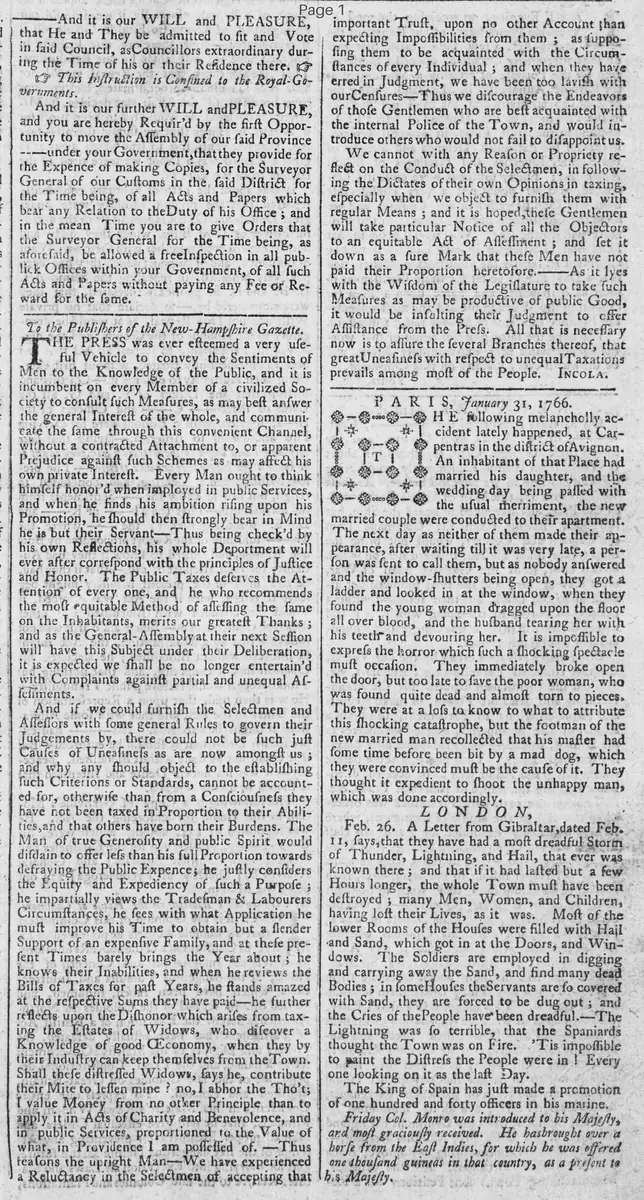
THE PRESS was ever esteemed a very useful Vehicle to convey the Sentiments of Men to the Knowledge of the Public, and it is incumbent on every Member of a civilized Society to consult such Measures, as may best answer the general Interest of the whole, and communicate the same through this convenient Channel, without a contracted Attachment to, or apparent Prejudice against such Schemes as may affect his own private Interest. Every Man ought to think himself honored when employed in public Services, and when he finds his ambition rising upon his Promotion, he should then strongly bear in Mind he is but their Servant--Thus being check'd by his own Reflections, his whole Deportment will ever after correspond with the principles of Justice and Honor. The Public Taxes deserves the Attention of every one, and he who recommends the most equitable Method of assessing the same on the Inhabitants, merits our greatest Thanks: and as the General-Assembly at their next Session will have this Subject under their Deliberation, it is expected we shall be no longer entertain'd with Complaints against partial and unequal Assessments.
And if we could furnish the Selectmen and Assessors with some general Rules to govern their Judgements by, there could not be such just Causes of Uneasiness as are now amongst us: and why any should object to the establishing such Criterions or Standards, cannot be accounted for, otherwise than from a Consciousness they have not been taxed in Proportion to their Abilities, and that others have born their Burdens. The Man of true Generosity and public Spirit would disdain to offer less than his full Proportion towards defraying the Public Expense; he justly considers the Equity and Expediency of such a Purpose; he impartially views the Tradesman & Labourers Circumstances, he sees with what Application he must improve his Time to obtain but a slender Support of an expensive Family, and at these present Times barely brings the Year about; he knows their Inabilities, and when he reviews the Bills of Taxes for past Years, he stands amazed at the respective Sums they have paid--he further reflects upon the Dishonor which arises from taxing the Estates of Widows, who discover a Knowledge of good OEconomy, when they by their Industry can keep themselves from the Town. Shall these distressed Widows, says he, contribute their Mite to lessen mine? no, I abhor the Tho't; I value Money from no other Principle than to apply it in Acts of Charity and Benevolence, and in public Services proportioned to the Value of what, in Providence I am possessed of. --Thus reasons the upright Man-- We have experienced a Reluctancy in the Selectmen of accepting that important Trust, upon no other Account than expecting Impossibilities from them; as supposing them to be acquainted with the Circum- stances of every Individual; and when they have erred in Judgment, we have been too lavish with our Censures-Thus we discourage the Endeavors of those Gentlemen who are best acquainted with the internal Police of the Town, and would in- troduce others who would not fail to disappoint us. We cannot with any Reason or Propriety re- flect on the Conduct of the Selectmen, in follow- ing the Dictates of their own Opinions in taxing. especially when we object to furnish them with regular Means: and it is hoped, these Gentlemen will take particular Notice of all the Objectors to an equitable Act of Assessment; and set it down as a sure Mark that these Men have not paid their Proportion heretofore.- -As it lies with the Wisdom of the Legislature to take such Measures as may be productive of public Good, it would be insulting their Judgment to offer Assistance from the Press. All that is necessary now is to assure the several Branches thereof, that great Uneasiness with respect to unequal Taxations prevails among most of the People. Incola.
THE PRESS was ever esteemed a very useful Vehicle to convey the Sentiments of Men to the Knowledge of the Public, and it is incumbent on every Member of a civilized Society to consult such Measures, as may best answer the general Interest of the whole, and communicate the same through this convenient Channel, without a contracted Attachment to, or apparent Prejudice against such Schemes as may affect his own private Interest. Every Man ought to think himself honored when employed in public Services, and when he finds his ambition rising upon his Promotion, he should then strongly bear in Mind he is but their Servant--Thus being check'd by his own Reflections, his whole Deportment will ever after correspond with the principles of Justice and Honor. The Public Taxes deserves the Attention of every one, and he who recommends the most equitable Method of assessing the same on the Inhabitants, merits our greatest Thanks: and as the General-Assembly at their next Session will have this Subject under their Deliberation, it is expected we shall be no longer entertain'd with Complaints against partial and unequal Assessments.
And if we could furnish the Selectmen and Assessors with some general Rules to govern their Judgements by, there could not be such just Causes of Uneasiness as are now amongst us: and why any should object to the establishing such Criterions or Standards, cannot be accounted for, otherwise than from a Consciousness they have not been taxed in Proportion to their Abilities, and that others have born their Burdens. The Man of true Generosity and public Spirit would disdain to offer less than his full Proportion towards defraying the Public Expense; he justly considers the Equity and Expediency of such a Purpose; he impartially views the Tradesman & Labourers Circumstances, he sees with what Application he must improve his Time to obtain but a slender Support of an expensive Family, and at these present Times barely brings the Year about; he knows their Inabilities, and when he reviews the Bills of Taxes for past Years, he stands amazed at the respective Sums they have paid--he further reflects upon the Dishonor which arises from taxing the Estates of Widows, who discover a Knowledge of good OEconomy, when they by their Industry can keep themselves from the Town. Shall these distressed Widows, says he, contribute their Mite to lessen mine? no, I abhor the Tho't; I value Money from no other Principle than to apply it in Acts of Charity and Benevolence, and in public Services proportioned to the Value of what, in Providence I am possessed of. --Thus reasons the upright Man-- We have experienced a Reluctancy in the Selectmen of accepting that important Trust, upon no other Account than expecting Impossibilities from them; as supposing them to be acquainted with the Circum- stances of every Individual; and when they have erred in Judgment, we have been too lavish with our Censures-Thus we discourage the Endeavors of those Gentlemen who are best acquainted with the internal Police of the Town, and would in- troduce others who would not fail to disappoint us. We cannot with any Reason or Propriety re- flect on the Conduct of the Selectmen, in follow- ing the Dictates of their own Opinions in taxing. especially when we object to furnish them with regular Means: and it is hoped, these Gentlemen will take particular Notice of all the Objectors to an equitable Act of Assessment; and set it down as a sure Mark that these Men have not paid their Proportion heretofore.- -As it lies with the Wisdom of the Legislature to take such Measures as may be productive of public Good, it would be insulting their Judgment to offer Assistance from the Press. All that is necessary now is to assure the several Branches thereof, that great Uneasiness with respect to unequal Taxations prevails among most of the People. Incola.
What sub-type of article is it?
Persuasive
Ethical Moral
Political
What themes does it cover?
Taxation
Economic Policy
Morality
What keywords are associated?
Equitable Taxation
Unequal Assessments
Public Spirit
Selectmen
Widows Taxes
Proportional Burdens
What entities or persons were involved?
Incola.
To The Publishers Of The New Hampshire Gazette.
Letter to Editor Details
Author
Incola.
Recipient
To The Publishers Of The New Hampshire Gazette.
Main Argument
advocates for equitable and proportional taxation based on ability to pay, criticizes unequal assessments that burden the poor, tradesmen, and widows, and defends the selectmen's role while urging public spirit among the wealthy.
Notable Details
References To Taxing Widows' Estates As Dishonorable
Emphasis On Public Spirit And Charity
Critique Of Objectors To Fair Assessment Rules As Those Underpaying