Thank you for visiting SNEWPapers!
Sign up free
Editorial
April 1, 1869
Yorkville Enquirer
York, York County, South Carolina
What is this article about?
Horace Greeley advises Southern planters post-Civil War to abandon cotton dependency, restore soil fertility through rotation and livestock, and focus on producing necessities for sustainable prosperity, criticizing monoculture's role in wartime failure.
Clipping
OCR Quality
98%
Excellent
Full Text
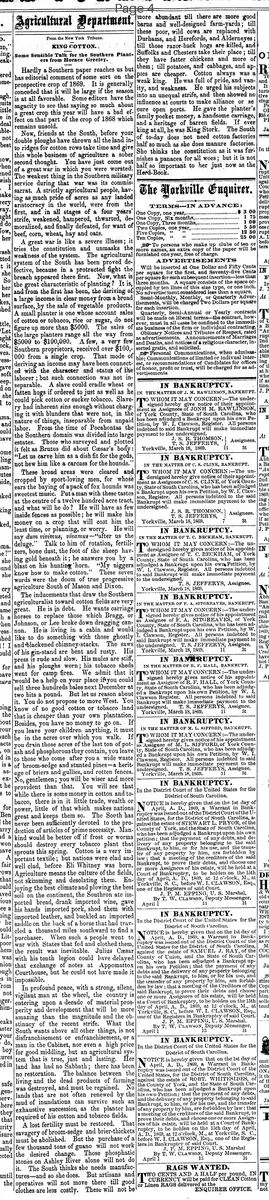
Agricultural Department.
From the New York Tribune.
KING COTTON.
Some Sensible Talk for the Southern Planters from Horace Greeley.
Hardly a Southern paper reaches us but has editorial comment of some sort on the prospective crop of 1869. It is generally conceded that it will be large if the season is at all favorable. Some editors have the sagacity to see that saying so much about a great crop this year will have a bad effect on that part of the crop of 1868 which remains unsold.
Now, friends at the South, before your double ploughs have thrown all the land into ridges for cotton rows take time and give this whole business of agriculture a sober second thought. You have just come out of a great war in which you were worsted. The weakest thing in the Southern military service during that war was its commissariat. A strictly agricultural people, having as much pride of acres as any landed aristocracy in the world, were from the first, and in all stages of a four years' strife, weakened, hampered, thwarted, demoralized, and finally defeated, for want of beef, corn, wheat, hay and oats.
A great war is like a severe illness; it tries the constitution and unmasks the weakness of the system. The agricultural system of the South has been proved defective, because in a protracted fight the breach appeared there first. Now, what is the great characteristic of planting? It is, and from the first has been, the deriving of a large income in clear money from a broad surface, by the sale of vegetable products. A small planter is one whose account sales of cotton or tobacco, rice or sugar, do not figure up more than $5000. The sales of the large planters range all the way from $5000 to $100,000. A few, a very few Southern proprietors, received over $100,000 from a single crop. That mode of deriving an income may have been connected with the character and status of the laborer; but such connection was not inseparable. A slave could cradle wheat or fatten hogs if ordered to just as well as he could pick cotton or sucker tobacco. Slavery had inherent sins enough without charging it with blunders that were not, in the nature of things, inseparable from unpaid labor. From the time of Pocahontas the Southern domain was divided into large estates. Those who surveyed and plotted it felt as Brutus did about Caesar's body: "Let us carve him as a dish fit for the gods, not hew him like a carcass for the hounds."
These broad areas were cleared and cropped by sport-loving men, for whose ears the baying of a pack of fox hounds was sweetest music. Put a man with these tastes at the centre of a twelve hundred acre tract, and what will he do? He will have as few inside fences as possible; he will make his money on a crop that will cost him the least time, or planning, or worry. He will say dum vivimus, vivamus—"after us the deluge." Talk to him of rotation, fertilizers, bone dust, the foot of the sheep having gold beneath it; he answers you by a blast on his hunting horn. "My niggers know how to make cotton." These seven words were the doom of true progressive agriculture South of Mason and Dixon.
The inducements that draw the Southern agriculturalist toward cotton fields are very great. He is in debt. He wants carriage horses to replace those which Bragg, or Johnson, or Lee broke down dragging cannon. He is living in a cabin and would like to do something with those ghostly and blackened chimney-stacks. The saws of his gin-stand are bent and rusty. His press is rude and slow. His mules are stiff, and his ploughs worn; his tobacco sheds went for camp fires. We admit that it would be a help on your place if you could sell three hundred bales next December at two bits a pound. But let us reason about it. You do not propose to move West. You know of no good cotton or tobacco land that is cheaper than your own plantation. Besides, you have no money to go on. If you leave your children anything, it must be in the acres over which you walk. If you drain those acres of the last ton of potash and phosphorous they contain, you leave to those who come after you a wide waste of broom-sedge and stunted pines—a heritage of briers and gullies, and rotten fences.
No, gentlemen; you will be wiser and more provident than that. You will see that while there is some money in cotton and tobacco, there is in it little trade, wealth or power, little of that which makes nations great and keeps them so. The South has never been sufficiently devoted to the production of articles of prime necessity. Mankind would be better off if frost or worms should destroy every tobacco plant that sprouts this spring. Cotton is a very important textile; but nations were clad and well clad, before Eli Whitney was born. Agriculture means the culture of the fields, not skimming and desolating them. Enjoying the best climate and plowing the best soil on the continent, the Southron ate imported bread, drank imported wine, gave his hands imported pork, shod them with imported leather, and buckled an imported saddle on the back of a horse that had traveled a thousand miles southward to find a purchaser. When such a people went to war with States that fed and clothed them, the result was inevitable. Julius Caesar with his tenth legion could have delayed that exchange of notes at Appomattox Courthouse, but he could not have made it impossible.
In profound peace, with a strong, silent, vigilant man at the wheel, the country is entering upon a decade of material prosperity and development that will be more amazing than the magnitude and the obstinacy of the recent strife. What the South wants above all other things, is not disfranchisement or enfranchisement, or a man in the Cabinet, nor even a high price for good middling, but an agricultural system that is true, just and lasting. Her land has had no Sabbath; there has been no restoration. The balance between the living and the dead products of farming was destroyed, and must be regained. No lands that are not often renewed by the mud of inundations can survive such an exhaustive succession as the planter has required of his cotton and tobacco fields. A lost fertility must be restored. That savagery of broom-sedge and brier-thickets must be abolished. But the purchase of a few thousand tons of guano will not work the desired change. Those phosphatic stones on Ashley River alone will not do it. The South thinks she needs manufactures—and so she does. But artisans and operatives will not move there till good land has been subdued and made productive, and the comforts of life are more abundant till there are more good barns and well-designed farm-yards: till these poor, wild cows are replaced with Durhams, and Herefords, and Alderneys; till those razor-back hogs are killed, and Suffolks and Chesters take their place; till they have fatter chickens and more of them; till potatoes, and cabbages, and apples are cheaper. Cotton always was a weak king. He was full of pride, and vanity, and weakness. He urged his subjects into an unequal strife, and then showed no influence at courts to make alliance or secure open ports. He gave the planter's family pocket money, a handsome carriage, and a heritage of barren fields. If ever king at all, he was King Stork. The South of to-day does not need cotton factories half so much as she does manure factories. She thinks the constitution as it was furnishes a panacea for all woes; but it is not half so important to her just now as the Herd-Book.
From the New York Tribune.
KING COTTON.
Some Sensible Talk for the Southern Planters from Horace Greeley.
Hardly a Southern paper reaches us but has editorial comment of some sort on the prospective crop of 1869. It is generally conceded that it will be large if the season is at all favorable. Some editors have the sagacity to see that saying so much about a great crop this year will have a bad effect on that part of the crop of 1868 which remains unsold.
Now, friends at the South, before your double ploughs have thrown all the land into ridges for cotton rows take time and give this whole business of agriculture a sober second thought. You have just come out of a great war in which you were worsted. The weakest thing in the Southern military service during that war was its commissariat. A strictly agricultural people, having as much pride of acres as any landed aristocracy in the world, were from the first, and in all stages of a four years' strife, weakened, hampered, thwarted, demoralized, and finally defeated, for want of beef, corn, wheat, hay and oats.
A great war is like a severe illness; it tries the constitution and unmasks the weakness of the system. The agricultural system of the South has been proved defective, because in a protracted fight the breach appeared there first. Now, what is the great characteristic of planting? It is, and from the first has been, the deriving of a large income in clear money from a broad surface, by the sale of vegetable products. A small planter is one whose account sales of cotton or tobacco, rice or sugar, do not figure up more than $5000. The sales of the large planters range all the way from $5000 to $100,000. A few, a very few Southern proprietors, received over $100,000 from a single crop. That mode of deriving an income may have been connected with the character and status of the laborer; but such connection was not inseparable. A slave could cradle wheat or fatten hogs if ordered to just as well as he could pick cotton or sucker tobacco. Slavery had inherent sins enough without charging it with blunders that were not, in the nature of things, inseparable from unpaid labor. From the time of Pocahontas the Southern domain was divided into large estates. Those who surveyed and plotted it felt as Brutus did about Caesar's body: "Let us carve him as a dish fit for the gods, not hew him like a carcass for the hounds."
These broad areas were cleared and cropped by sport-loving men, for whose ears the baying of a pack of fox hounds was sweetest music. Put a man with these tastes at the centre of a twelve hundred acre tract, and what will he do? He will have as few inside fences as possible; he will make his money on a crop that will cost him the least time, or planning, or worry. He will say dum vivimus, vivamus—"after us the deluge." Talk to him of rotation, fertilizers, bone dust, the foot of the sheep having gold beneath it; he answers you by a blast on his hunting horn. "My niggers know how to make cotton." These seven words were the doom of true progressive agriculture South of Mason and Dixon.
The inducements that draw the Southern agriculturalist toward cotton fields are very great. He is in debt. He wants carriage horses to replace those which Bragg, or Johnson, or Lee broke down dragging cannon. He is living in a cabin and would like to do something with those ghostly and blackened chimney-stacks. The saws of his gin-stand are bent and rusty. His press is rude and slow. His mules are stiff, and his ploughs worn; his tobacco sheds went for camp fires. We admit that it would be a help on your place if you could sell three hundred bales next December at two bits a pound. But let us reason about it. You do not propose to move West. You know of no good cotton or tobacco land that is cheaper than your own plantation. Besides, you have no money to go on. If you leave your children anything, it must be in the acres over which you walk. If you drain those acres of the last ton of potash and phosphorous they contain, you leave to those who come after you a wide waste of broom-sedge and stunted pines—a heritage of briers and gullies, and rotten fences.
No, gentlemen; you will be wiser and more provident than that. You will see that while there is some money in cotton and tobacco, there is in it little trade, wealth or power, little of that which makes nations great and keeps them so. The South has never been sufficiently devoted to the production of articles of prime necessity. Mankind would be better off if frost or worms should destroy every tobacco plant that sprouts this spring. Cotton is a very important textile; but nations were clad and well clad, before Eli Whitney was born. Agriculture means the culture of the fields, not skimming and desolating them. Enjoying the best climate and plowing the best soil on the continent, the Southron ate imported bread, drank imported wine, gave his hands imported pork, shod them with imported leather, and buckled an imported saddle on the back of a horse that had traveled a thousand miles southward to find a purchaser. When such a people went to war with States that fed and clothed them, the result was inevitable. Julius Caesar with his tenth legion could have delayed that exchange of notes at Appomattox Courthouse, but he could not have made it impossible.
In profound peace, with a strong, silent, vigilant man at the wheel, the country is entering upon a decade of material prosperity and development that will be more amazing than the magnitude and the obstinacy of the recent strife. What the South wants above all other things, is not disfranchisement or enfranchisement, or a man in the Cabinet, nor even a high price for good middling, but an agricultural system that is true, just and lasting. Her land has had no Sabbath; there has been no restoration. The balance between the living and the dead products of farming was destroyed, and must be regained. No lands that are not often renewed by the mud of inundations can survive such an exhaustive succession as the planter has required of his cotton and tobacco fields. A lost fertility must be restored. That savagery of broom-sedge and brier-thickets must be abolished. But the purchase of a few thousand tons of guano will not work the desired change. Those phosphatic stones on Ashley River alone will not do it. The South thinks she needs manufactures—and so she does. But artisans and operatives will not move there till good land has been subdued and made productive, and the comforts of life are more abundant till there are more good barns and well-designed farm-yards: till these poor, wild cows are replaced with Durhams, and Herefords, and Alderneys; till those razor-back hogs are killed, and Suffolks and Chesters take their place; till they have fatter chickens and more of them; till potatoes, and cabbages, and apples are cheaper. Cotton always was a weak king. He was full of pride, and vanity, and weakness. He urged his subjects into an unequal strife, and then showed no influence at courts to make alliance or secure open ports. He gave the planter's family pocket money, a handsome carriage, and a heritage of barren fields. If ever king at all, he was King Stork. The South of to-day does not need cotton factories half so much as she does manure factories. She thinks the constitution as it was furnishes a panacea for all woes; but it is not half so important to her just now as the Herd-Book.
What sub-type of article is it?
Agriculture
Economic Policy
What keywords are associated?
Southern Agriculture
Cotton Monoculture
Soil Exhaustion
Crop Diversification
Post Civil War Recovery
What entities or persons were involved?
Horace Greeley
Southern Planters
King Cotton
Editorial Details
Primary Topic
Advice To Southern Planters On Sustainable Agriculture Beyond Cotton Monoculture
Stance / Tone
Advisory And Critical Of Cotton Dependency
Key Figures
Horace Greeley
Southern Planters
King Cotton
Key Arguments
Southern Agriculture's Defects Contributed To Civil War Defeat Due To Poor Commissariat
Cotton Planting Exhausts Soil, Leaving Barren Land For Future Generations
Advocate Crop Rotation, Fertilizers, And Livestock Over Monoculture
South Needs Production Of Necessities Like Food And Feed, Not Just Cash Crops
Post War Prosperity Requires Restoring Land Fertility And Diversifying Farming