Thank you for visiting SNEWPapers!
Sign up free
Gazette Of The United States, & Philadelphia Daily Advertiser
Philadelphia, Philadelphia County, Pennsylvania
What is this article about?
On June 13, 1799, Massachusetts Lieutenant Governor Moses Gill delivered a speech to the legislature mourning the recent death of Governor Increase Sumner, emphasizing unity, education, religion, and support for the federal government. The House responded on June 14, echoing these sentiments and praising Sumner's character.
Merged-components note: Continuation of the domestic news article reporting the Lieutenant Governor's speech to the legislature and the house response; original second component mislabeled as editorial.
Clippings
1 of 2
OCR Quality
Full Text
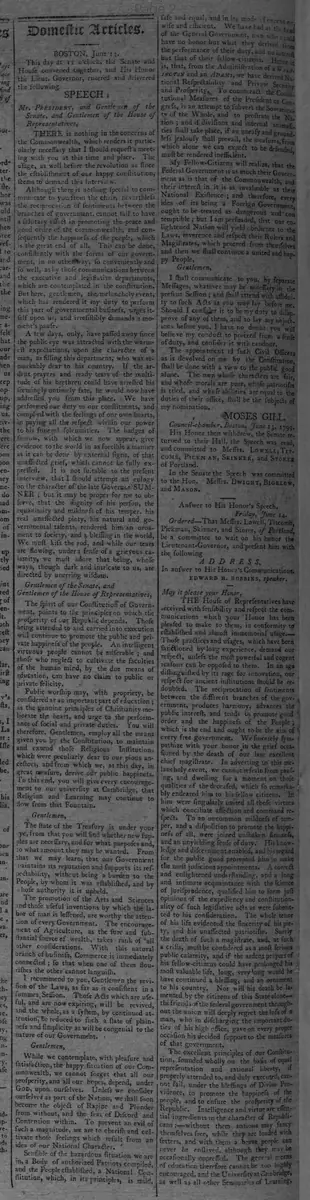
BOSTON, June 13.
This day at 1 o'clock, the Senate and House convened together, and His Honor the Lieut. Governor, entered and delivered the following
SPEECH:
Mr. PRESIDENT, and Gentlemen of the Senate, and Gentlemen of the House of Representatives,
THERE is nothing in the concerns of the Commonwealth, which renders it particularly necessary that I should request a meeting with you at this time and place. The usage, as well before the revolution as since the establishment of our happy constitution, seems to demand this interview.
Although there is nothing special to communicate to you from the chair, nevertheless the reciprocation of sentiments between the branches of government, cannot fail to have a salutary effect in promoting the peace and good order of the commonwealth, and consequently the happiness of the people, which is the great end of all. This can be done, consistently with the forms of our government, in no other way, so conveniently and so well, as by those communications between the executive and legislative departments, which are contemplated in the constitution.
But here, gentlemen, the melancholy event, which has rendered it my duty to perform this part of governmental business, urges itself upon us, and irresistibly demands a moment's pause.
A few days, only, have passed away since the public eye was attracted with the warmest expectations, upon the character of a man, as filling this department, who was remarkably dear to his country. If the ardent prayers and ready tears of the multitude of his brethren could have arrested his seemingly untimely fate, he would now have addressed you from this place. We have performed our duty to our constituents, and complied with the feelings of our own hearts, in paying all the respect within our power to his funeral solemnities. The badges of sorrow, with which we now appear, give evidence to the world in as forcible a manner as it can be done by external signs, of that unaffected grief, which cannot be fully expressed. It is not suitable to the present interview, that I should attempt an eulogy on the character of the late Governor SUMNER; but it may be proper for me to observe, that the dignity of his person, the equanimity and mildness of his temper, his real unaffected piety, his natural and governmental talents, rendered him an ornament to society, and a blessing in the world,
We must kiss the rod, and while our tears are flowing, under a sense of a grievous calamity, we must adore that being, whose ways, though dark and intricate to us, are directed by unerring wisdom.
Gentlemen of the Senate, and Gentlemen of the House of Representatives,
The spirit of our Constitution of Government, points to the principles on which the prosperity of our Republic depends. Those being attended to and carried into execution will continue to promote the public and private happiness of the people. An intelligent virtuous people cannot be miserable; and those who neglect to cultivate the faculties of the human mind, by the due means of education, can have no claim to public or private felicity.
Public worship may, with propriety, be considered as an important part of education; as the genuine principles of Christianity meliorate the heart, and urge to the performance of social and private duties. You will therefore, Gentlemen, employ all the means given you by the Constitution, to maintain and extend those Religious Institutions which were peculiarly dear to our pious ancestors, and from which we, at this day, in great measure, derive our public happiness.
To this end, you will give every encouragement to our university at Cambridge, that Religion and Learning may continue to flow from that Fountain.
Gentlemen,
The state of the Treasury is under your eye, from that you will find whether new supplies are necessary, and for what purposes and, to what amount they may be wanted. From that we may learn, that our Government maintains its reputation and supports its respectability, without being a burden to the People, by whom it was established, and by whose authority it is upheld.
The promotion of the Arts and Sciences and those useful inventions by which the labor of man is lessened, are worthy the attention of every Government. The encouragement of Agriculture, as the sure and substantial source of wealth, takes rank of all other considerations. With this natural branch of business, Commerce is immediately connected; so that when one of them flourishes the other cannot languish.
I recommend to you, Gentlemen the revision of the Laws, as far as is consistent in a summer Session. Those Acts which are useful, and are now expiring, will be revived, and the whole, as a system, by continued attention, be reduced to such a state of plainness and simplicity as will be congenial to the nature of our Government.
Gentlemen,
While we contemplate, with pleasure and satisfaction, the happy situation of our Commonwealth, we cannot forget that all our prosperity, and all our hopes, depend, under God, upon ourselves. Unless we consider ourselves as part of the Nation, we shall soon become the object of Rapine and Plunder from without, and the fear of Discord and Contention within. To prevent an evil of such a magnitude, we are to cherish and cultivate those feelings which result from an idea of our National Character.
Sensible of the hazardous situation we are in, a Body of authorized Patriots assembled, and the People established, a National Constitution, which, in its principles, is mild, safe and equal, and in its mode of execution, wise and efficient. We have had at the head of the General Government, men who could have no honor but what they derived from the performance of their duty, and no interest but that of their fellow-citizens. Hence it is, that, from the Administration of a WASHINGTON and an ADAMS, we have derived National Respectability and Private Security and Prosperity. To counteract the Constitutional Measures of the President or Congress, is an attempt to subvert the Sovereignty of the Whole, and to prostrate the Nation; and if divisions and internal animosities shall take place, if an uneasy and groundless jealousy shall prevail, the measures, from which alone we can expect to be defended, must be rendered inefficient.
My Fellow-Citizens will realize, that the Federal Government is as much their Government as is that of the Commonwealth, and their interest in it is as invaluable as their National Existence; and therefore, every idea of its being a Foreign Government, ought to be treated as dangerous and contemptible; but I am persuaded, that our enlightened Nation will yield obedience to the Laws, reverence and respect their Rulers and Magistrates, which proceed from themselves and then we shall continue a united and happy People,
Gentlemen,
I shall communicate to you, by separate Messages, whatever may be necessary in the present Session; and shall attend with assiduity to such Acts as you may lay before me. Should I consider it to be my duty to disapprove of any of them, and to lay my objections before you, I have no doubt you will believe my conduct to proceed from a sense of duty, and consider it with candour.
The appointment of such Civil Officers as is devolved on me by the Constitution, shall be done with a view to the public good alone. The men whose characters are fair and whose morals are pure, whose patriotism is tried, and whose abilities are equal to the duties of their office, shall be the subjects of my nomination,
MOSES GILL.
Council-chamber, Boston, June 13, 1799.
His Honor then withdrew, the Senate returned to their Hall, the Speech was read, and committed to Messrs. LOWELL, TITCOMB, PICKMAN, SKINNER, and STORER of Portland.
In the Senate the Speech was committed to the Hon. Messrs. DWIGHT, BIGELOW, and MASON.
Answer to His Honor's Speech.
Friday, June 14.
Ordered—That Messrs. Lowell, Titcomb, Pickman, Skinner, and Storer, of Portland, be a committee to wait on his honor the Lieutenant-Governor, and present him with the following
ADDRESS,
In answer to His Honor's Communications.
EDWARD H. ROBBINS, Speaker.
May it please your Honor,
THE House of Representatives have received with sensibility and respect the communications which your Honor has been pleased to make to them, in conformity to established and almost immemorial usage.—Those practices and usages, which have been sanctioned by long experience, demand our respect, unless the most powerful and cogent reasons can be opposed to them. In an age distinguished by its rage for innovation, our respect for ancient institutions should be redoubled. The reciprocation of sentiments between the different branches of the government, produces harmony, advances the public interest, and tends to promote good order and the happiness of the People; which is the end and ought to be the aim of every free government. We sincerely sympathize with your honor in the grief occasioned by the death of our late excellent chief magistrate. In adverting to this melancholy event, we cannot refrain from pausing, and dwelling for a moment on those qualities of the deceased, which so remarkably endeared him to his fellow citizens. In him were singularly united all those virtues which conciliate affection and command respect. To an uncommon mildness of temper, and a disposition to promote the happiness of all, were joined unshaken firmness, and an unyielding sense of duty. His knowledge and discernment enabled, and his regard for the public good prompted him to make the most judicious appointments, A correct and enlightened understanding, and a long and intimate acquaintance with the science of jurisprudence, qualified him to form just opinions of the expediency and constitutionality of such legislative acts as were submitted to his consideration. The whole tenor of his life evidenced the sincerity of his piety, and his unaffected patriotism. Surely the death of such a magistrate, and, at such a crisis, must be considered as a most serious public calamity, and if the ardent prayers of his fellow-citizens could have prolonged his most valuable life, long, very long would he have continued a blessing, and an ornament to his country. Nor will his death be lamented by the citizens of this State alone—the friends of the federal government throughout the union will deeply regret the loss of a man, who in discharging the important duties of his high office, gave on every proper occasion his decided support to the measures of that government.
The excellent principles of our Constitution, founded wholly on the basis of equal representation and rational liberty, if properly attended to, and duly executed, cannot fail, under the blessings of Divine Providence, to promote the happiness of the people, and to ensure the prosperity of the Republic. Intelligence and virtue are essential ingredients in the character of Republicans;—without them nations may fancy themselves free, while they are loaded with fetters, and with them a brave people can never be enslaved, although they may be occasionally oppressed. The general means of education therefore cannot be too highly encouraged, and the University at Cambridge, as well as all other Seminaries of Learning.
merit our fervent regard, not only from the solemn injunctions of the Constitution, but from the important and distinguished benefits which have flowed from those literary fountains. The Christian Religion is the grand basis of public and private virtue. While we lament the introduction of modern philosophy, the spreading of atheistical principles, and the consequent decline of religious worship, we fully accord with your honor, that it is our incumbent duty to support, maintain and extend those public institutions of Religion, so dear to our pious ancestors, and which we justly estimate, as the foundation of our national glory and public happiness.
The state of the Treasury is grateful to our feelings, and honorable to the financial policy of our predecessors. The promotion of the arts and sciences which adorn and improve, and the encouragement of agriculture and commerce, which enrich a nation, are certainly important objects of legislation. To revise and to adapt our laws to the present improved state of our country, will continue to be the subject of our attention.
While we contemplate with pleasure, the tranquil and happy situation of this Commonwealth, we cannot forget that our future prosperity in a great measure depends, under God, upon our own exertions. Our Federal Constitution was the result of a common sense of public danger, and of a general conviction of the total insufficiency of our old confederation. In its formation it was the work of the whole American people—In its execution it has been upheld by their virtue, and supported by their affection. In its principles, it was therefore naturally mild, safe and equal. In its administration, it has been uniformly wise, patriotic and efficient. If there have been any deluded citizens who have looked upon the Federal Government with a jealous and with a jaundiced eye,—if they have regarded as a foreign power the common guardian of our national rights, their numbers must at this moment be too inconsiderable to be dangerous. We regret that any past humiliating events in our country, should have rendered such remarks necessary, but we are happy in the full conviction, that the American people are fast returning to a just sense of their national character.
Without spirit Nations, like individuals, will be trampled upon.—Without a just and becoming sense of National Character, we fully agree with your Honor, that we should soon become tributaries, as we have long been the objects of the rapine and lawless plunder of a Foreign Nation. Internally we must cultivate a spirit of obedience, and cheerful support to the Laws, and to those who administer them; for no axiom in politics is better founded than the one advanced by your Honor, that to counteract or calumniate the measures of the Federal or State Constituted Authorities, is a direct and alarming blow, aimed at the Sovereignty of the People themselves.
Any communications which may be made from the Chair, will merit our respect, and shall receive our serious and deliberate consideration.
The assurance which your Honor has been pleased to make, that in such appointments as shall unavoidably devolve upon you, in the course of the present year, you will have a view only to the public good, merits our highest approbation. If fair characters, pure morals, tried patriotism, and competent abilities, shall be the only recommendations to office, the Magistrates of Massachusetts, will in truth, 'become a terror to evil doers, and a praise and encouragement to such as do well.'
What sub-type of article is it?
What keywords are associated?
What entities or persons were involved?
Where did it happen?
Domestic News Details
Primary Location
Boston
Event Date
June 13 14, 1799
Key Persons
Outcome
death of governor sumner; legislative mourning and continuation of government proceedings with emphasis on unity and federal support.
Event Details
Lieutenant Governor Moses Gill delivered a speech to the Massachusetts Senate and House on June 13, 1799, mourning Governor Sumner's death, promoting education, religion, agriculture, law revision, and national unity. The House responded with an address on June 14, praising Sumner and endorsing the speech's principles.