Thank you for visiting SNEWPapers!
Sign up free
Norfolk Gazette And Publick Ledger
Norfolk, Virginia
What is this article about?
Official dispatch from Maj.-Gen. Sir David Baird details British capture of Cape of Good Hope in January 1806. Troops landed despite surf challenges, defeated Dutch at Blawberg on Jan. 8, leading to Cape Town's capitulation on Jan. 10. Minimal British losses compared to over 700 Dutch casualties.
Clipping
OCR Quality
Full Text
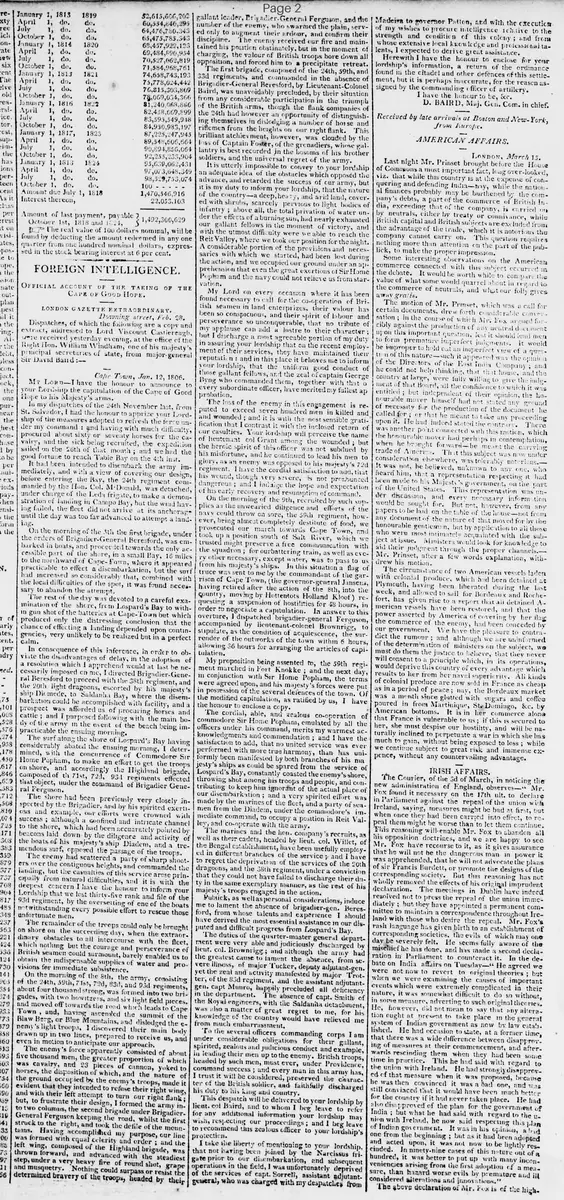
OFFICIAL ACCOUNT OF THE TAKING OF THE CAPE OF GOOD HOPE.
LONDON GAZETTE EXTRAORDINARY.
Downing street, Feb. 28.
Dispatches, of which the following are a copy and extract, addressed to Lord Viscount Castlereagh, were received yesterday evening, at the office of the Right Hon. William Windham, one of his majesty's principal secretaries of state, from major-general Sir David Baird:--
Cape Town, Jan. 12, 1806.
My Lord--I have the honour to announce to your Lordship the capitulation of the Cape of Good Hope to his Majesty's arms.
In my dispatches of the 24th November last, from St. Salvador, I had the honour to apprise your Lordship of the measures adopted to refresh the force under my command: and having with much difficulty, procured about sixty or seventy horses for the cavalry, and the sick being recruited, the expedition sailed on the 26th of that month; and we had the good fortune to reach Table Bay on the 4th inst.
It had been intended to disembark the army immediately, and with a view of covering our design, before entering the Bay, the 24th regiment commanded by the Hon. Col. MacDonald, was detached, under charge of the Leda frigate, to make a demonstration of landing in Campo Bay, but the wind having failed, the fleet did not arrive at its anchorage until the day was too far advanced to attempt a landing.
On the morning of the 5th the first brigade, under the orders of Brigadier-General Beresford, was embarked in boats, and proceeded towards the only accessible part of the shore, in a small Bay, 16 miles to the northward of Cape Town, where it appeared practicable to effect a disembarkation, but the surf had increased so considerably that, combined with the local difficulties of the spot, it was found necessary to abandon the attempt.
The rest of the day was devoted to a careful examination of the shore, from Lospard's Bay to within gun shot of the batteries at Cape-Town but which produced only the distressing conclusion that the chance of effecting a landing depended upon contingencies, very unlikely to be realized but in a perfect calm.
In consequence of this inference, in order to obviate the disadvantages of delay, in the adoption of a resolution which I apprehend would at last be necessarily imposed on me, I directed Brigadier-General Beresford to proceed with the 38th regiment, and the 20th light dragoons, escorted by his majesty's ship Diomede, to Saldanha Bay, where the disembarkation could be accomplished with facility, and a prospect was afforded us of procuring horses and cattle; and I proposed following with the main body of the army in the event of the beach being impracticable the ensuing morning.
The surf along the shore of Lospard's Bay having considerably abated the ensuing morning, I determined, with the concurrence of Commodore Sir Home Popham, to make an effort to get the troops on shore, and accordingly the Highland brigade, composed of the 71st, 72d, 93d regiments effected that object, under the command of Brigadier General Ferguson.
The shore had been previously very closely inspected by the Brigadier, and by his spirited exertions and example, our efforts were crowned with success: although a confined and intricate channel to the shore, which had been accurately pointed by beacons laid down by the diligence and activity of the boats of his majesty's ship Diadem, and a tremendous surf, opposed the passage of the troops.
The enemy had scattered a party of sharp shooters over the contiguous heights, and commanded the landing, but the casualties of this service arose principally from natural difficulties, and it is with the deepest concern I have the honour to inform your Lordship that we lost thirty-five rank and file of the 93d regiment, by the oversetting of one of the boats notwithstanding every possible effort to rescue those unfortunate men.
The remainder of the troops could only be brought on shore on the succeeding day, when the extraordinary obstacles to all intercourse with the fleet, which nothing but the courage and perseverance of British seamen could surmount, barely enabled us to obtain the indispensable supplies of water and provisions for immediate subsistence.
On the morning of the 8th, the army, consisting of the 24th, 59th, 71st, 72d, 83d, and 93d regiments, about four thousand strong, was formed into two brigades, with two howitzers, and six light field pieces, and moved off towards the road which leads to Cape Town, and, having ascended the summit of the Blaw Berg, or Blue Mountains, and dislodged the enemy's light troops, I discovered their main body drawn up in two lines, prepared to receive us, and even in motion to anticipate our approach.
The enemy's force apparently consisted of about five thousand men, the greater proportion of which was cavalry, and 23 pieces of cannon, yoked to horses, the disposition of which, and the nature of the ground occupied by the enemy's troops, made it evident that they intended to refuse their right wing, and with their left attempt to turn our right flank; but, to frustrate their design, I formed the army into two columns, the second brigade under Brigadier General Ferguson keeping the road, whilst the first struck to the right, and took the defile of the mountains. Having accomplished my purpose, our line was formed with equal celerity and order: and the left wing, composed of the Highland brigade, was thrown forward, and advanced with the steadiest step, under a very heavy fire of round shot, grape and musquetry. Nothing could surpass or resist the determined bravery of the troops, headed by their gallant leader, Brigadier-General Ferguson. and the number of the enemy, who swarmed the plain, served only to augment their ardour, and confirm their discipline. The enemy received our fire and maintained his position obstinately, but in the moment of charging, the valour of British troops bore down all opposition, and forced him to a precipitate retreat.
The first brigade, composed of the 24th, 59th, and 83d regiments, and commanded in the absence of Brigadier-General Beresford, by Lieutenant-Colonel Baird, was unavoidably precluded, by their situation from any considerable participation in the triumph of the British arms, though the flank companies of the 24th had however an opportunity of distinguishing themselves in dislodging a number of horse and riflemen from the heights on our right flank. This brilliant achievement, however, was clouded by the loss of Captain Foster, of the grenadiers, whose gallantry is best recorded in the bosoms of his brother soldiers, and the universal regret of the army.
It is utterly impossible to convey to your lordship an adequate idea of the obstacles which opposed the advance, and retarded the success of our army, but it is my duty to inform your lordship, that the nature of the country-a deep, heavy, and arid land, covered with shrubs, scarcely pervious to light bodies of infantry : above all, the total privation of water under the effects of a burning sun, had nearly exhausted our gallant fellows in the moment of victory, and with the utmost difficulty were we able to reach the Reit Valley, where we took our position for the night.
A considerable portion of the provisions and necessaries with which we started, had been lost during the action, and we occupied our ground under an apprehension that even the great exertions of Sir Home Popham and the navy could not relieve us from starvation.
My Lord on every occasion where it has been found necessary to call for the co-operation of British seamen in land enterprizes, their valour has been so conspicuous, and their spirit of labour and perseverance so unconquerable, that no tribute of my applause can add a lustre to their character; but I discharge a most agreeable portion of my duty in assuring your lordship that on the recent employment of their services, they have maintained their reputation: and in this place it behoves me to inform your lordship, that the uniform good conduct of those gallant fellows, and the zeal of captain George Byng who commanded them, together with that of every subordinate officer, have merited my fullest approbation.
The loss of the enemy in this engagement is reported to exceed seven hundred men in killed and wounded ; and it is with the most sensible gratification that I contrast it with the inclosed return of our casualties. Your lordship will perceive the name of lieutenant col. Grant among the wounded; but the heroic spirit of this officer was not subdued by his misfortune, and he continued to lead his men to glory, as long as any enemy was opposed to his majesty's 72d regiment. I have the cordial satisfaction to add, that his wound, though very severe, is not pronounced dangerous ; and I indulge the hope and expectation of his early recovery and resumption of command.
On the morning of the 9th, recruited by such supplies as the unwearied diligence and efforts of the navy could throw on shore, the 59th regiment, however, being almost completely destitute of food, we prosecuted our march towards Cape Town, and took up a position south of Salt River, which we trusted might preserve a free communication with the squadron ; for our battering train, as well as every other necessary, except water, was to pass to us from his majesty's ships. In this situation a flag of truce was sent to me by the commandant of the garrison of Cape Town, (the governor-general Jansens, having retired after the action of the 8th, into the country, moving by Hottentots Holland Kloof) requesting a suspension of hostilities for 48 hours, in order to negotiate a capitulation. In answer to this overture, I dispatched brigadier-general Ferguson, accompanied by lieutenant-colonel Brownrigg, to stipulate, as the condition of acquiescence, the surrender of the outworks of the town within 6 hours, allowing 36 hours for arranging the articles of capitulation.
My proposition being assented to, the 59th regiment marched in Fort Knokke ; and the next day, in conjunction with Sir Home Popham, the terms were agreed upon, and his majesty's forces were put in possession of the several defences of the town. Of the modified capitulation, as ratified by us, I have the honour to enclose a copy.
The cordial, able, and zealous co-operation of commodore Sir Home Popham, emulated by all the officers under his command, merits my warmest acknowledgments and commendation ; and I have the satisfaction to add, that no united service was ever performed with more true harmony, than has uniformly been manifested by both branches of his majesty's service. The ships as could be spared from the service of Lospard's Bay, constantly coasted the enemy's shore, throwing shot among his troops and people, and contributing to keep him ignorant of the actual place of our disembarkation; and a very spirited effort was made by the marines of the fleet, and a party of seamen from the Diadem, under the commodore's immediate command, to occupy a position in Reit Valley, and co-operate with the army.
The marines and the hon. company's recruits, as well as their cadets, headed by lieut. col. Willett, of the Bengal establishment, have been usefully employed in different branches of the service; and I have to regret the deprivation of the services of the 20th dragoons, and the 38th regiment, under a conviction that they could not have failed to discharge their duty in the same exemplary manner, as the rest of his majesty's troops engaged in the action.
Publick, as well as personal considerations, induce me to lament the absence of brigadier-gen. Beresford, from whose talents and experience I should have derived the most essential assistance in our disputed and difficult progress from Lospard's Bay.
The duties of the quarter-master general department were very able and judiciously discharged by lieut. col. Brownrigg; and although the army had the greatest cause to lament the absence, from severe illness, of major Tucker, deputy adjutant-gen. yet the zeal and activity manifested by major Trotter, of the 83d regiment, and the assistant adjutant-gen. capt. Munro, happily precluded all deficiency in the department. The absence of capt. Smith of the Royal engineers, with the Saldanha detachment, was also a matter of great regret to me, for his knowledge of the country would have relieved me from much embarrassment.
To the several officers commanding corps I am under considerable obligations for their gallant, spirited, zealous and judicious conduct and example, in leading their men up to the enemy. British troops, headed by such men, must ever, under Providence, command success ; and every man in this army has, I trust it will be considered, preserved the character of the British soldier, and faithfully discharged his duty to his king and country.
This despatch will be delivered to your lordship by lieut. col. Baird, and to whom I beg leave to refer for any additional information your lordship may wish, respecting our proceedings; and I beg leave to recommend this zealous officer to your lordship's protection.
I take the liberty of mentioning to your lordship, that not having been joined by the Narcissus frigate prior to our disembarkation, and subsequent operations in the field, I was unfortunately deprived of the services of capt. Sorell, assistant adjutant-general, who was charged with my despatches from Madeira to governor Patton, and with the execution of my wishes to procure intelligence relative to the strength and condition of this colony ; and from whose extensive local knowledge and professional talents, I expected to derive great assistance.
Herewith I have the honour to enclose for your lordship's information, a return of the ordnance found in the citadel and other defences of this settlement, but it is perhaps inaccurate, for the reason as signed by the commanding officer of artillery.
I have the honour to be, &c.
D. BAIRD, Maj. Gen. Com. in chief.
What sub-type of article is it?
What keywords are associated?
What entities or persons were involved?
Where did it happen?
Foreign News Details
Primary Location
Cape Of Good Hope
Event Date
January 1806
Key Persons
Outcome
british casualties: 35 rank and file drowned, some wounded including lt. col. grant; enemy: over 700 killed and wounded. capitulation of cape town to british forces.
Event Details
British expedition under Maj.-Gen. Sir David Baird and Commodore Sir Home Popham landed troops near Cape Town after initial disembarkation challenges. Highland brigade landed on January 7. On January 8, army advanced, defeated Dutch forces at Blawberg, forcing retreat. Truce led to surrender of Cape Town on January 10, with British taking possession.