Thank you for visiting SNEWPapers!
Sign up free
The Louisiana Democrat
Alexandria, Rapides County, Louisiana
What is this article about?
In 1868, Columbus, Georgia citizens arrested by military authorities for the assassination of George W. Ashburn detail their warrantless arrests, brutal confinement in Fort Pulaski and Atlanta, suborned evidence, and blame Gen. Meade for politically motivated mistreatment, culminating in their release.
Merged-components note: Merged continuation of the article on the Columbus (Ga.) Prisoners across columns on page 1.
Clipping
OCR Quality
Full Text
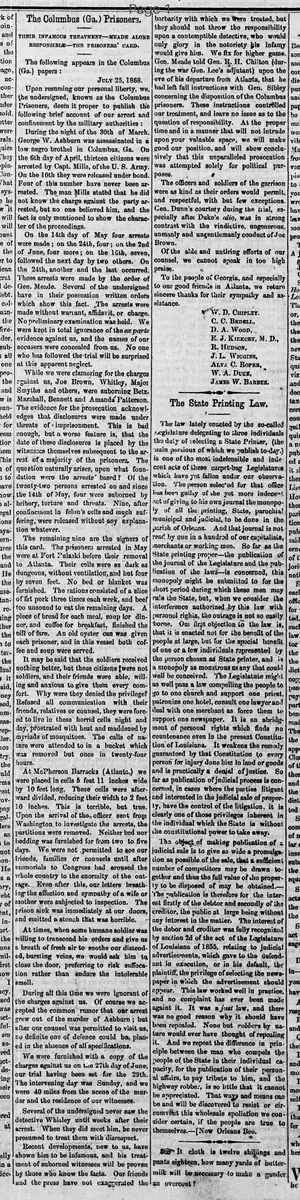
THEIR INFAMOUS TREATMENT-MEADE ALONE RESPONSIBLE-THE PRISONERS CARD.
The following appears in the Columbus (Ga.) papers :
July 25, 1868.
Upon resuming our personal liberty, we, the undersigned, known as the Columbus Prisoners, deem it proper to publish the following brief account of our arrest and confinement by the military authorities :
During the night of the 30th of March, George W. Ashburn was assassinated in a low negro brothel in Columbus, Ga. On the 6th day of April, thirteen citizens were arrested by Capt. Mills, of the U. S. Army. On the 10th they were released under bond. Four of this number have never been arrested. The man Mills stated that he did not know the charge against the party arrested, but no one believed him, and the fact is only mentioned to show the character of the proceedings.
On the 14th day of May four arrests were made; on the 24th, four; on the 2nd of June, four more; on the 16th, seven, followed the next day by two others. On the 24th, another and the last occurred. These arrests were made by the order of Gen. Meade. Several of the undersigned have in their possession written orders which show this fact. The arrests were made without warrant, affidavit, or charge. No preliminary examination was held. We were kept in total ignorance of the ex parte evidence against us, and the names of our accusers were concealed from us. No one who has followed the trial will be surprised at this apparent neglect.
While we were clamoring for the charges against us, Joe Brown, Whitley, Major Smythe and others, were suborning Betz, Marshall, Bennett and Amanda Patterson. The evidence for the prosecution acknowledges that disclosures were made under threats of imprisonment. This is bad enough, but a worse feature is, that the date of these disclosures is placed by the witnesses themselves subsequent to the arrest of a majority of the prisoners The question naturally arises, upon what foundation were the arrests based? Of the twenty-two persons arrested on and since the 14th of May, four were suborned by bribery, torture and threats. Nine, after confinement in felon's cells and much suffering, were released without any explanation whatever.
The remaining nine are the signers of this card. The prisoners arrested in May were at Fort Pulaski before their removal to Atlanta. Their cells were as dark as dungeons, without ventilation, and but four by seven feet. No bed or blanket was furnished. The rations consisted of a slice of fat pork three times each week, and beef too unsound to eat the remaining days. A piece of bread for each meal, soup for dinner, and coffee for breakfast, finished the bill of fare. An old oyster can was given each prisoner, and in this vessel both coffee and soup were served.
It may be said that the soldiers received nothing better, but these citizens were not soldiers, and their friends were able, willing and anxious to give them every comfort. Why were they denied the privilege? Refused all communication with their friends, relatives or counsel, they were forced to live in these horrid cells night and day, prostrated with heat and maddened by myriads of mosquitoes. The calls of nature were attended to in a bucket which was removed but once in twenty-four hours.
At McPherson Barracks (Atlanta,) we were placed in cells 5 feet 11 inches wide by 10 feet long. These cells were afterward divided, reducing their width to 2 feet 10 inches. This is terrible, but true. Upon the arrival of the officer sent from Washington to investigate the arrests, the partitions were removed. Neither bed nor bedding was furnished for from two to five days. We were not permitted to see our friends, families or counsels until after memorials to Congress had aroused the whole country to the enormity of the outrage. Even after this, our letters breathing the affection and sympathy of wife or mother were subjected to inspection. The prison sink was immediately at our doors, and emitted a stench that was horrible. At times, when some humane soldier was willing to transcend his orders and give us a breath of fresh air to soothe our distended, bursting veins, we would ask him to close the door, preferring to risk suffocation rather than endure the intolerable smell.
During all this time we were ignorant of the charges against us. Of course we accepted the common rumor that our arrest grew out of the murder of Ashburn; but after our counsel was permitted to visit us, no definite one of defence could be planned in the absence of all specifications.
We were furnished with a copy of the charges against us on the 27th day of June, our trial having been set for the 29th. The intervening day was Sunday, and we were 40 miles from the scene of the murder and the residence of our witnesses.
Several of the undersigned never saw the detective Whitley until weeks after their arrest. When they did meet him, he never presumed to treat them with disrespect. Recent developments, new to us, have shown him to be infamous, and his treatment of suborned witnesses will be proven by those who know the acts. Our friends and the press have not exaggerated the
barbarity with which we were treated, but they should not throw the responsibility upon a contemptible detective, who would only glory in the notoriety his infamy would give him. We fix for higher game.
Gen. Meade told Gen. R. H. Chilton (during the war Gen. Lee's adjutant) upon the eve of his departure from Atlanta, that he had left full instructions with Gen. Sibley concerning the disposition of the Columbus prisoners. These instructions controlled our treatment, and leave no issue as to the question of responsibility. At the proper time and in a manner that will not intrude upon your valuable space, we will make good our position, and will show conclusively that this unparalleled prosecution was attempted solely for political purposes.
The officers and soldiers of the garrison were as kind as their orders would permit, and respectful, with but few exceptions. Gen. Dunn's courtesy during the trial, especially after Duke's alibi, was in strong contrast with the vindictive, ungenerous, unmanly and ungentlemanly conduct of Joe Brown.
Of the able and untiring efforts of our counsel, we cannot speak in too high praise.
To the people of Georgia, and especially to our good friends in Atlanta, we return sincere thanks for their sympathy and assistance.
W. D. CHIPLEY.
C. C. BEDELL,
D. A. WOOD,
E. J. KIRKSEY, M. D.,
R. HUDSON,
J. L. WIGGINS,
Alva C. ROPER,
W. A. DUKE,
JAMES W. BARBER.
What sub-type of article is it?
What themes does it cover?
What keywords are associated?
What entities or persons were involved?
Where did it happen?
Story Details
Key Persons
Location
Columbus, Ga.; Fort Pulaski; Mcpherson Barracks, Atlanta
Event Date
March 30, 1868 To July 25, 1868
Story Details
Citizens arrested without charges for Ashburn's assassination endure brutal prison conditions ordered by Gen. Meade; suborned witnesses and political motives revealed; nine prisoners released after public outcry and trial.