Thank you for visiting SNEWPapers!
Sign up free
Virginia Argus
Richmond, Virginia
What is this article about?
Memoirs of the Prince of Peace (Manuel Godoy) detail the destruction of Spain's ancient council, the disastrous war and treaty with France ceding territories and providing military support, Godoy's elevation to titles and dominions by Charles IV, his cruel imprisonment of statesman Jovellanos, whimsical royal marriage, papal protections, and scandalous conduct during the war against Portugal, alongside his notorious private debaucheries.
Clipping
OCR Quality
Full Text
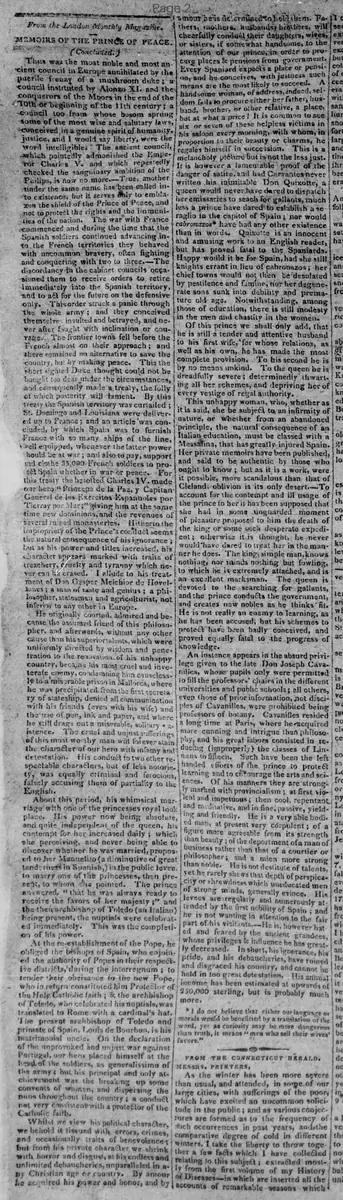
MEMOIRS OF THE PRINCE OF PEACE
Concluded.
This was the most noble and most ancient council in Europe annihilated by the puerile frenzy of a mushroom duke; a council instituted by Alonzo XI. and the conquerors of the Moors in the end of the 15th or beginning of the 16th century; a council too from whose bosom sprung some of the most wise and salutary laws, conceived in a genuine spirit of humanity, justice, and I would say liberty, were the word intelligible. The ancient council, which pointedly admonished the Emperor Charles V. and which repeatedly checked the sanguinary ambition of the Philips, is now no more. True, another under the same name has been called into existence, but it serves only to emblazon the shield of the Prince of Peace, and not to protect the rights and the immunities of the nation. The war with France commenced and during the time that the Spanish soldiers continued advancing into the French territories they behaved with uncommon bravery, often fighting and conquering with two to three. The discordancy in the cabinet councils occasioned them to receive orders to retire immediately into the Spanish territory, and to act for the future on the defensive only. This order struck a panic through the whole army; and they conceived themselves insulted and betrayed, and never after fought with inclination or courage. The frontier towns fell before the French almost on their approach; and there remained no alternative to save the country, but by making peace. This the short-sighted Duke thought could not be bought too dear under the circumstances, and consequently made a treaty, the folly of which posterity will lament. By this treaty the Spanish territory was curtailed; St. Domingo and Louisiana were delivered up to France; and an article was concluded, by which Spain was to furnish France with so many ships of the line, well equipped, whenever the latter power should be at war; and also to pay, support and clothe 35,000 French soldiers to protect Spain whether in war or peace. For this treaty the besotted Charles IV. made our hero "Principe de la Paz, y Capitan General de los Exercitos Espanoles por Tierra y por Mar;" giving him at the same time new dominions, and the revenues of several ruined monasteries. Hitherto the impropriety of the Prince's conduct seems the natural consequence of his ignorance; but as his power and titles increased, his character appears marked with traits of treachery, cruelty and tyranny which never can be erased. I allude to his treatment of Don Gasper Melchior de Jovellanos; a man of taste and genius; a philosopher, statesman and agriculturist, not inferior to any other in Europe. He originally courted, admired and became the assumed friend of this philosopher, and afterwards, without any other cause than his superior talents, which were uniformly directed by wisdom and penetration to the renovation of his unhappy country, became his most cruel and inveterate enemy, condemning him causelessly to a miserable prison in Mallorca, where he was precipitated from the first secretary of state-ship, denied all communication with his friends (even with his wife) and the use of pen, ink and paper, and where he still drags out a miserable, solitary existence. The cruel and unjust sufferings of this most worthy man will forever stain the character of our hero with infamy and detestation. His conduct to two other respectable characters, but of less notoriety, was equally criminal and ferocious, falsely accusing them of partiality to the English. About this period, his whimsical marriage with one of the princesses royal took place. His power now being absolute, and quite independent of the queen, his contempt of her increased daily; which she perceiving, and never being able to discover whether he was married, proposed to her Manuelito (a diminutive of great tenderness in Spanish,) in the public levee, to marry one of the princesses, then present, to whom she pointed. The prince answered, "that he was always ready to receive the favors of her majesty;" and the then archbishop of Toledo (an Italian) being present, the nuptials were celebrated immediately. This was the completion of his power. At the re-establishment of the Pope, he obliged the bishops of Spain, who enjoined the authority of Popes in their respective districts, during the interregnum, to tender their obeisance to the new Pope, who in return constituted him Protector of the Holy Catholic faith; & the archbishop of Toledo, who celebrated his nuptials, was translated to Rome with a cardinal's hat. The present archbishop of Toledo and primate of Spain, Louis de Bourbon, is his matrimonial uncle. On the declaration of the unprovoked and unjust war against Portugal, our hero placed himself at the head of the soldiers, as generalissimo of the army; but his principal and only achievement was the breaking open some convents of women, and dispersing the nuns throughout the country; a conduct not very consistent with a protector of the Catholic faith. Whilst we view his political character we behold it tissue with errors, crimes, and occasionally traits of benevolence; but from his private character we shrink with horror and disgust, at his endless and unlimited debaucheries, unparalleled in any Christian age or country. By amour he acquired his power and honor, and by
What sub-type of article is it?
What keywords are associated?
What entities or persons were involved?
Where did it happen?
Foreign News Details
Primary Location
Spain
Key Persons
Outcome
annihilation of ancient council; treaty with france ceding st. domingo and louisiana, providing ships and support for 35,000 french soldiers; godoy elevated to principe de la paz and capitan general; jovellanos imprisoned in mallorca; godoy's marriage to a princess royal; papal protections granted; convents broken open during war against portugal.
Event Details
The Prince of Peace annihilated Spain's ancient noble council. Spanish forces initially advanced bravely against France but were ordered to retreat defensively, leading to panic and defeats. A disadvantageous treaty was signed, ceding territories and committing military aid to France. Godoy received titles and revenues from Charles IV. He betrayed and imprisoned statesman Jovellanos in Mallorca without cause. Godoy married a princess royal in a whimsical ceremony proposed by the queen. He enforced papal obeisance among Spanish bishops and was made Protector of the Catholic faith. During the war against Portugal, as generalissimo, he dispersed nuns from convents. His character is marked by political errors, crimes, treachery, cruelty, and unlimited debaucheries.