Thank you for visiting SNEWPapers!
Sign up free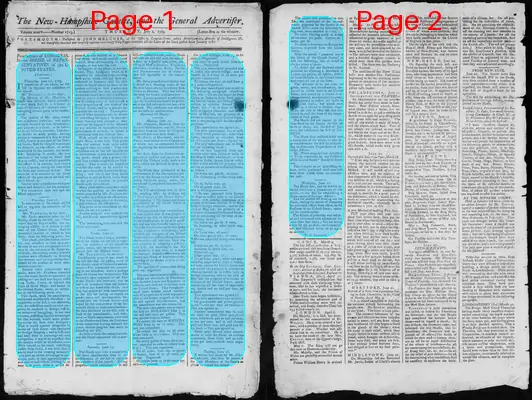
The New Hampshire Gazette And General Advertiser
Portsmouth, Rockingham County, New Hampshire
What is this article about?
Proceedings of the U.S. House of Representatives from June 10-17, 1789, debating and amending the bill to regulate impost collection, including clauses on surveyors, manifests, port restrictions for foreign vessels, duties on various goods, and Senate amendments. Other minor resolutions proposed.
Merged-components note: This is a direct continuation of the congressional proceedings story across pages 1 and 2, ending with 'To be Continued.' The label is changed from 'domestic_news' for the second part to 'story' to match the narrative article style.
Clippings
1 of 2
OCR Quality
Full Text
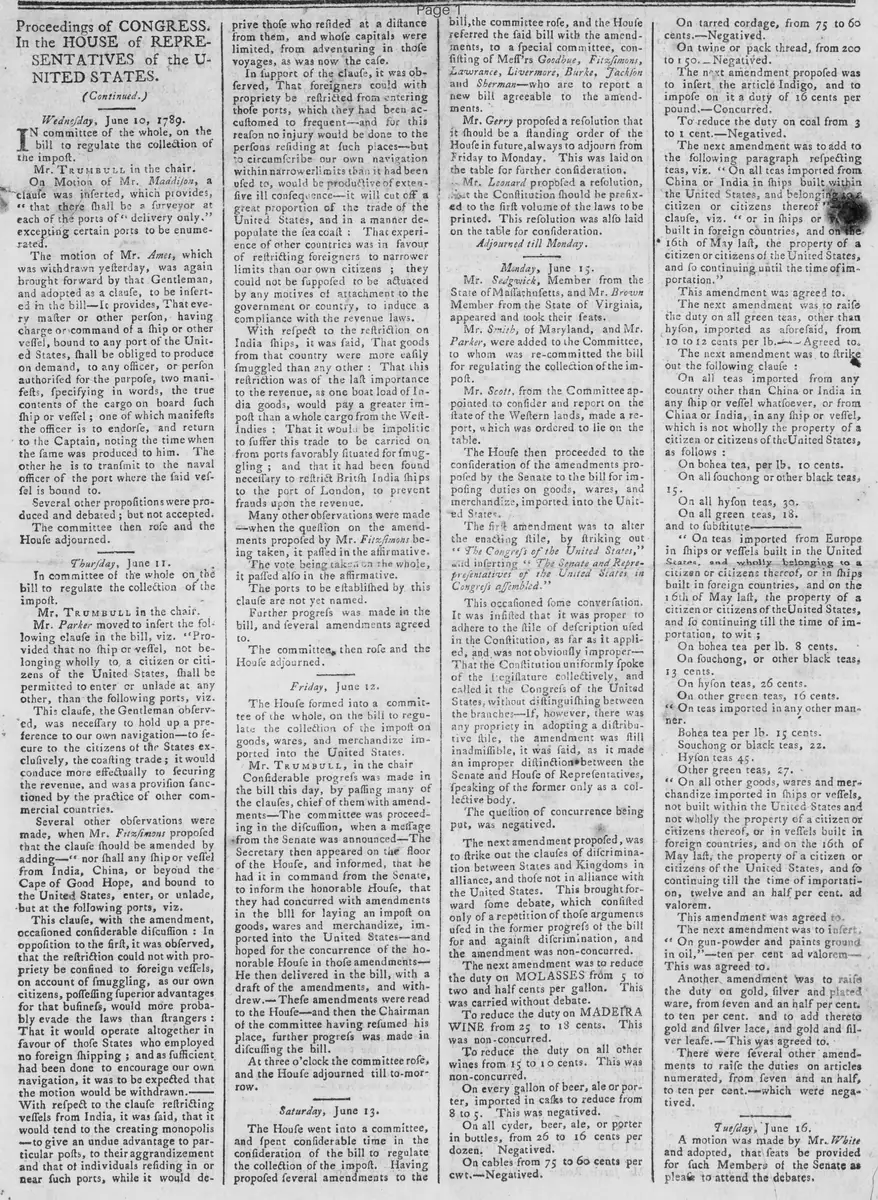
In the HOUSE of REPRESENTATIVES of the UNITED STATES.
(Continued.)
Wednesday, June 10, 1789.
In committee of the whole, on the bill to regulate the collection of the impost.
Mr. TRUMBULL in the chair.
On motion of Mr. Madison, a clause was inserted, which provides, "that there shall be a surveyor at each of the ports of delivery only," excepting certain ports to be enumerated.
The motion of Mr. Ames, which was withdrawn yesterday, was again brought forward by that Gentleman, and adopted as a clause, to be inserted in the bill. It provides, that every master or other person, having charge or command of a ship or other vessel, bound to any port of the United States, shall be obliged to produce on demand, to any officer, or person authorized for the purpose, two manifests, specifying in words, the true contents of the cargo on board such ship or vessel: one of which manifests the officer is to endorse, and return to the Captain, noting the time when the same was produced to him. The other he is to transmit to the naval officer of the port where the said vessel is bound to.
Several other propositions were produced and debated; but not accepted.
The committee then rose and the House adjourned.
Thursday, June 11.
In committee of the whole on the bill to regulate the collection of the impost.
Mr. TRUMBULL in the chair.
Mr. Parker moved to insert the following clause in the bill, viz. "Provided that no ship or vessel, not belonging wholly to a citizen or citizens of the United States, shall be permitted to enter or unlade at any other, than the following ports, viz."
This clause, the Gentleman observed, was necessary to hold up a preference to our own navigation--to secure to the citizens of the States exclusively, the coasting trade; it would conduce more effectually to securing the revenue, and was a provision sanctioned by the practice of other commercial countries.
Several other observations were made, when Mr. Fitzsimons proposed that the clause should be amended by adding--"nor shall any ship or vessel from India, China, or beyond the Cape of Good Hope, and bound to the United States, enter, or unlade, but at the following ports, viz."
This clause, with the amendment, occasioned considerable discussion: In opposition to the first, it was observed, that the restriction could not with propriety be confined to foreign vessels, on account of smuggling, as our own citizens, possessing superior advantages for that business, would more probably evade the laws than strangers: That it would operate altogether in favour of those States who employed no foreign shipping; and as sufficient had been done to encourage our own navigation, it was to be expected that the motion would be withdrawn.
With respect to the clause restricting vessels from India, it was said, that it would tend to the creating monopolies--to give an undue advantage to particular ports, to their aggrandizement and that of individuals residing in or near such ports, while it would deprive those who resided at a distance from them, and whose capitals were limited, from adventuring in those voyages, as was now the case.
In support of the clause, it was observed, that foreigners could with propriety be restricted from entering those ports, which they had been accustomed to frequent--and for this reason no injury would be done to the persons residing at such places--but to circumscribe our own navigation within narrower limits than it had been used to, would be productive of extensive ill consequence--it will cut off a great proportion of the trade of the United States, and in a manner depopulate the sea coast: That experience of other countries was in favour of restricting foreigners to narrower limits than our own citizens; they could not be supposed to be actuated by any motives of attachment to the government or country, to induce a compliance with the revenue laws.
With respect to the restriction on India ships, it was said, that goods from that country were more easily smuggled than any other: That this restriction was of the last importance to the revenue, as one boat load of India goods, would pay a greater impost than a whole cargo from the West-Indies: That it would be impolitic to suffer this trade to be carried on from ports favorably situated for smuggling; and that it had been found necessary to restrict British India ships to the port of London, to prevent frauds upon the revenue.
Many other observations were made when the question on the amendments proposed by Mr. Fitzsimons being taken, it passed in the affirmative.
The vote being taken on the whole, it passed also in the affirmative.
The ports to be established by this clause are not yet named.
Further progress was made in the bill, and several amendments agreed to.
The committee then rose and the House adjourned.
Friday, June 12.
The House formed into a committee of the whole, on the bill to regulate the collection of the impost on goods, wares, and merchandize imported into the United States.
Mr. TRUMBULL, in the chair.
Considerable progress was made in the bill this day, by passing many of the clauses, chief of them with amendments--The committee was proceeding in the discussion, when a message from the Senate was announced--The Secretary then appeared on the floor of the House, and informed, that he had it in command from the Senate, to inform the honorable House, that they had concurred with amendments in the bill for laying an impost on goods, wares and merchandize, imported into the United States--and hoped for the concurrence of the honorable House in those amendments--He then delivered in the bill, with a draft of the amendments, and withdrew.--These amendments were read to the House --and then the Chairman of the committee having resumed his place, further progress was made in discussing the bill.
At three o'clock the committee rose, and the House adjourned till to-morrow.
Saturday, June 13.
The House went into a committee, and spent considerable time in the consideration of the bill to regulate the collection of the impost. Having proposed several amendments to the bill, the committee rose, and the House referred the said bill with the amendments, to a special committee, consisting of Messrs. Goodhue, Fitzsimons, Lawrence, Livermore, Burke, Jackson and Sherman--who are to report a new bill agreeable to the amendments.
Mr. Gerry proposed a resolution that it should be a standing order of the House in future, always to adjourn from Friday to Monday. This was laid on the table for further consideration.
Mr. Leonard proposed a resolution, that the Constitution should be prefixed to the first volume of the laws to be printed. This resolution was also laid on the table for consideration.
Adjourned till Monday.
Monday, June 15.
Mr. Sedgwick, Member from the State of Massachusetts, and Mr. Brown Member from the State of Virginia, appeared and took their seats.
Mr. Smith, of Maryland, and Mr. Parker, were added to the Committee, to whom was re-committed the bill for regulating the collection of the impost.
Mr. Scott, from the Committee appointed to consider and report on the state of the Western lands, made a report, which was ordered to lie on the table.
The House then proceeded to the consideration of the amendments proposed by the Senate to the bill for imposing duties on goods, wares, and merchandize, imported into the United States.
The first amendment was to alter the enacting style, by striking out "The Congress of the United States," and inserting "The Senate and Representatives of the United States in Congress assembled."
This occasioned some conversation.
It was insisted that it was proper to adhere to the style of description used in the Constitution, as far as it applied, and was not obviously improper--That the Constitution uniformly spoke of the Legislature collectively, and called it the Congress of the United States, without distinguishing between the branches--If, however, there was any propriety in adopting a distributive title, the amendment was still inadmissible, it was said, as it made an improper distinction between the Senate and House of Representatives, speaking of the former only as a collective body.
The question of concurrence being put, was negatived.
The next amendment proposed, was to strike out the clauses of discrimination between States and Kingdoms in alliance, and those not in alliance with the United States. This brought forward some debate, which consisted only of a repetition of those arguments used in the former progress of the bill for and against discrimination, and the amendment was non-concurred.
The next amendment was to reduce the duty on MOLASSES from 5 to two and half cents per gallon.
This was carried without debate.
To reduce the duty on MADEIRA WINE from 25 to 18 cents. This was non-concurred.
To reduce the duty on all other wines from 15 to 10 cents. This was non-concurred.
On every gallon of beer, ale or porter, imported in casks to reduce from 8 to 5. This was negatived.
On all cyder, beer, ale, or porter in bottles, from 26 to 16 cents per dozen. Negatived.
On cables from 75 to 60 cents per cwt. Negatived.
On tarred cordage, from 75 to 60 cents. Negatived.
On twine or pack thread, from 2 to 1 50. Negatived.
The next amendment proposed was to insert the article Indigo, and to impose on it a duty of 16 cents per pound. Concurred.
To reduce the duty on coal from 3 to 1 cent. Negatived.
The next amendment was to add to the following paragraph respecting teas, viz. "On all teas imported from China or India in ships built within the United States, and belonging to a citizen or citizens thereof" clause, viz. "or in ships or built in foreign countries, and on the 16th of May last, the property of a citizen or citizens of the United States, and so continuing until the time of importation."
This amendment was agreed to.
The next amendment was to raise the duty on all green teas, other than hy son, imported as aforesaid, from 10 to 12 cents per lb. Agreed to.
The next amendment was to strike out the following clause:
On all teas imported from any country other than China or India in any ship or vessel whatsoever, or from China or India, in any ship or vessel, which is not wholly the property of a citizen or citizens of the United States, as follows:
On bohea tea, per lb. 10 cents.
On all souchong or other black teas, 15.
On all hy son teas, 30.
On all green teas, 18.
and to substitute--
"On teas imported from Europe in ships or vessels built in the United States, and wholly belonging to a citizen or citizens thereof, or in ships built in foreign countries, and on the 16th of May last, the property of a citizen or citizens of the United States, and so continuing till the time of importation, to wit;
On bohea tea per lb. 8 cents.
On souchong, or other black teas, 13 cents.
On hy son teas, 26 cents.
On other green teas, 16 cents.
"On teas imported in any other manner.
Bohea tea per lb. 15 cents.
Souchong or black teas, 22.
Hy son teas 45.
Other green teas, 27.
"On all other goods, wares and merchandize imported in ships or vessels, not built within the United States and not wholly the property of a citizen or citizens thereof, or in vessels built in foreign countries, and on the 16th of May last, the property of a citizen or citizens of the United States, and so continuing till the time of importation, twelve and an half per cent. ad valorem.
This amendment was agreed to.
The next amendment was to insert, "On gun-powder and paints ground in oil," ten per cent ad valorem--This was agreed to.
Another amendment was to raise the duty on gold, silver and plated ware, from seven and an half per cent. to ten per cent. and to add thereto gold and silver lace, and gold and silver leaf. This was agreed to.
There were several other amendments to raise the duties on articles enumerated, from seven and an half. to ten per cent.--which were negatived.
Tuesday, June 16.
A motion was made by Mr. White and adopted, that seats be provided for such Members of the Senate as please to attend the debates.
The House then proceeded to consider the remainder of the amendments proposed by the Senate to the Impost Bill---when the following being read, were acceded to---viz.
To insert Playing cards at a duty of ten cents per pack. Cotton, at 3 cents, per lb,
To allow a drawback on Brandy and Geneva, exported from the United States.
After the words "exported out of the limits of the United States" to add the following, viz. as settled by the late treaty of peace.
To strike out the sentence which provided for allowing a drawback of 5 cents per gallon, on Spirits, distilled from Molasses in the United States and exported out of the same.
The discount of 10 per cent. on goods, wares, and merchandize, imported in vessels built in the United States, and owned by a citizen or citizens thereof, was extended to goods, imported in vessels not built in United States, but which were owned by a citizen or citizens thereof, on the 16th of May last, and continued so until the time of the importation of such goods,
The House did not concur in the time fixed by the Senate for this act to be in force, viz. the first of July next, but substituted the first of AUGUST.
The House then resolved itself into a committee of the whole, to take into consideration the Bill for establishing an Executive Department of Foreign Affairs.
Mr. White proposed that this clause "To be removable by the President of the United States" should be struck out.
This brought on an interesting debate, which continued until near half after three o'clock when the committee rose.
Wednesday, June 17.
The House met, and on motion resolved itself into a Committee of the whole, on the Bill for establishing a Department of Foreign Affairs :
And the motion for striking out the clause, vesting the power of removing the principal officer from office, in the President of the United States, recurred for consideration.
The debate of yesterday was resumed and continued with animation for more than four hours ; but not being ready for the question, the Committee rose and obtained leave to sit again to-morrow.
To be Continued.
What sub-type of article is it?
What keywords are associated?
What entities or persons were involved?
Where did it happen?
Story Details
Key Persons
Location
House Of Representatives Of The United States
Event Date
June 10 17, 1789
Story Details
The House debates and amends the impost collection bill over several days, inserting clauses on surveyors, cargo manifests, port restrictions for foreign and distant-trade vessels to prevent smuggling and favor U.S. navigation. Considers Senate amendments on duties for molasses, wines, teas, indigo, and other goods, concurring on some reductions and additions. Minor resolutions on adjournments, printing laws, and Western lands report. Begins debate on Foreign Affairs Department bill regarding presidential removal power.