Thank you for visiting SNEWPapers!
Sign up free
The New York Journal, And Daily Patriotic Register
New York, New York County, New York
What is this article about?
Edmund Randolph's letter to Virginia's House of Delegates explains his refusal to sign the proposed U.S. Constitution, critiques the Articles of Confederation's weaknesses in defense, commerce, and interstate relations, and advocates for a stronger federal government with direct taxation and coercive powers. Dated October 10, 1787, from Richmond.
Merged-components note: Continuation of Edmund Randolph's letter explaining his position on the Federal Constitution, spanning pages 2 and 3.
Clippings
1 of 2
OCR Quality
Full Text
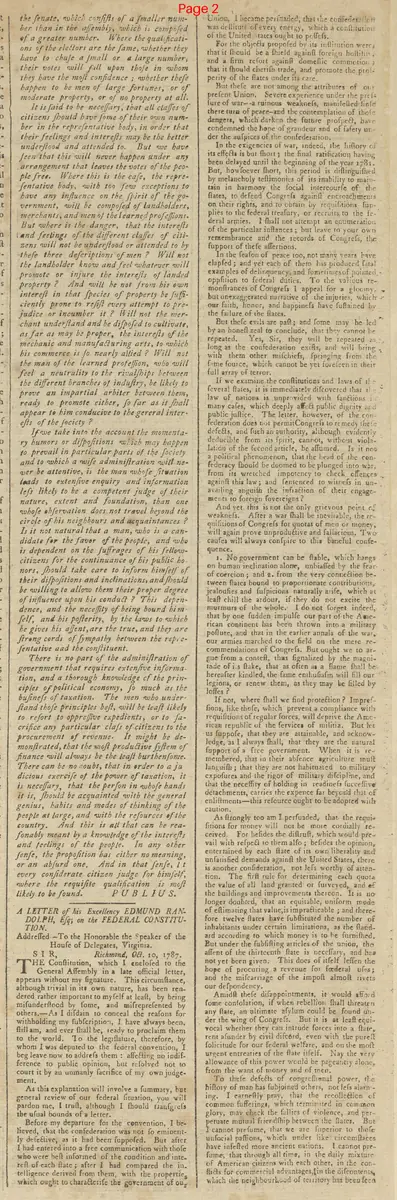
Addressed To the Honorable the Speaker of the House of Delegates, Virginia.
SIR,
Richmond, Oct. 10, 1787.
The Constitution appears without my signature. This circumstance, although trivial in its own nature, has been rendered rather important to myself at least, by being misunderstood by some, and misrepresented by others.—As I disdain to conceal the reasons for withholding my subscription, I have always been, still am, and ever shall be, ready to proclaim them to the world. To the legislature, therefore, by whom I was deputed to the federal convention, I beg leave now to address them: affecting no indifference to public opinion, but resolved not to court it by an unmanly sacrifice of my own judgment.
As this explanation will involve a summary, but general review of our federal situation, you will pardon me, I trust, although I should transgress the usual bounds of a letter.
Before my departure for the convention, I believed, that the confederation was not so eminently defective, as it had been supposed. But after I had entered into a free communication with those who were best informed of the condition and interest of each state; after I had compared the intelligence derived from them, with the properties which ought to characterize the government of our Union, I became persuaded, that the confederation was destitute of every energy, which a constitution of the United States ought to possess.
For the objects proposed by its institution were, that it should be a shield against foreign hostilities, and a firm resort against domestic commotion. That it should cherish trade, and promote the prosperity of the states under its care. But these are not among the attributes of our present Union. Severe experience under the pressure of war—a ruinous weakness, manifested in those turns of peace—and the contemplation of those dangers, which darken the future prospect, have condemned the hope of grandeur and of safety under the auspices of the confederation.
In the exigencies of war, indeed, the history of its effects is but short; the final ratification having been delayed until the beginning of the year 1781. But, however short, this period is distinguished by melancholy testimonies of its inability to maintain in harmony the social intercourse of the states, to defend Congress against encroachments on their rights, and to obtain by requisitions supplies to the federal treasury, or recruits, to the federal armies. I shall not attempt an enumeration of the particular instances; but leave to your own remembrance and the records of Congress, the support of these assertions.
In the season of peace too, not many years have elapsed; and yet each of them has produced fatal examples of delinquency, and sometimes of pointed opposition to federal duties. To the various remonstrances of Congress I appeal for a gloomy, but unexaggerated narrative of the injuries, which our faith, honor, and happiness have sustained by the failure of the states.
But these evils are past: and some may be led by an honest zeal to conclude, that they cannot be repeated. Yes, Sir, they will be repeated as long as the confederation exists, and will bring with them other mischiefs, springing from the same source, which cannot be yet foreseen in their full array of terror.
If we examine the constitutions and laws of the several states, it is immediately discovered that the law of nations is unprovided with sanctions in many cases, which deeply affect public dignity and public justice. The letter, however, of the confederation does not permit Congress to remedy these defects, and such an authority, although evidently deducible from its spirit, cannot, without violation of the second article, be assumed. Is it not a political phenomenon, that the head of the confederacy should be doomed to be plunged into war, from its wretched impotency to check offences against this law; and sentenced to witness in unavailing anguish the infraction of their engagements to foreign sovereigns?
And yet this is not the only grievous point of weakness. After a war shall be inevitable, the requisitions of Congress for quotas of men or money, will again prove unproductive and fallacious. Two causes will always conspire to this baneful consequence.
1. No government can be stable, which hangs on human inclination alone, unbiased by the fear of coercion: and 2. from the very connection between states bound to proportionate contributions, jealousies and suspicions naturally arise, which at least chill the ardour, if they do not excite the murmurs of the whole. I do not forget indeed, that by one sudden impulse our part of the American continent has been thrown into a military posture, and that in the earlier annals of the war, our armies marched to the field on the mere recommendations of Congress. But ought we to argue from a contest, thus signalized by the magnitude of its stake, that as often as a flame shall be hereafter kindled, the same enthusiasm will fill our legions, or renew them, as they may be filled by losses?
If not, where shall we find protection? Impressions, like those, which prevent a compliance with requisitions of regular forces, will deprive the American republic of the services of militia. But let us suppose, that they are attainable, and acknowledge, as I always shall, that they are the natural support of a free government. When it is remembered, that in their absence agriculture must languish; that they are not habituated to military exposures and the rigor of military discipline, and that the necessity of holding in readiness successive detachments, carries the expence far beyond that of enlistments—this resource ought to be adopted with caution.
As strongly too am I persuaded, that the requisitions for money will not be more cordially received. For besides the distrust, which would prevail with respect to them also; besides the opinion, entertained by each state of its own liberality and unsatisfied demands against the United States, there is another consideration, not less worthy of attention. The first rule for determining each quota the value of all land granted or surveyed, and of the buildings and improvements thereon. It is no longer doubted, that an equitable, uniform mode of estimating that value, is impracticable; and therefore twelve states have substituted the number of inhabitants under certain limitations, as the standard according to which money is to be furnished. But under the subsisting articles of the union, the assent of the thirteenth state is necessary, and has not yet been given. This does of itself lessen the hope of procuring a revenue or federal uses; and the miscarriage of the impost almost rivets our despondency.
Amidst these disappointments, it would afford some consolation, if when rebellion shall threaten any state, an ultimate asylum could be found under the wing of Congress. But it is at least equivocal whether they can intrude forces into a state, rent asunder by civil discord, even with the purest solicitude for our federal welfare, and on the most urgent entreaties of the state itself. Nay the very allowance of this power would be pageantry alone, from the want of money and of men.
To these defects of congressional power, the history of man has subjoined others, not less alarming. I earnestly pray, that the recollection of common sufferings, which terminated in common glory, may check the sallies of violence, and perpetuate mutual friendship between the states. But I cannot presume, that we are superior to those unsocial passions, which under like circumstances have infested more ancient nations. I cannot presume, that through all time, in the daily mixture of American citizens with each other, in the conflicts for commercial advantages, in the discontents, which the neighbourhood of territory has been seen to engender in other quarters of the globe, and in the efforts of faction and intrigue—thirteen distinct communities under no effective superintending control (as the United States confessedly now are, notwithstanding the bold terms of the confederation) will avoid a hatred to each other deep and deadly.
In the prosecution of this enquiry we shall find the general prosperity to decline under a system thus unnerved. No sooner is the merchant prepared for foreign ports, with the treasures which this new world kindly offers to his acceptance, than it is announced to him, that they are shut against American shipping, or opened under oppressive regulations. He urges Congress to a counter-policy, and is answered only by a condolence on the general misfortune. He is immediately struck with the conviction, that until exclusion shall be opposed to exclusion, and restriction to restriction, the American flag will be disgraced. For who can conceive, that thirteen legislatures, viewing commerce under different regulations, and fancying themselves discharged from every obligation to concede the smallest of their commercial advantages for the benefit of the whole, will be wrought into a concert of action in defiance of every prejudice? Nor is this all: Let the great improvements be recounted, which have enriched and illustrated Europe: Let it be noted, how few those are, which will be absolutely denied to the United States, comprehending within their boundaries the choicest blessings of climate, soil and navigable waters; then let the most sanguine patriot banish, if he can, the mortifying belief, that all these must sleep, until they shall be roused by the vigor of a national government.
I have not exemplified the preceding remarks by minute details; because they are evidently fortified by truth, and the consciousness of United America. I shall therefore no longer deplore the unfitness of the confederation to secure our peace; but proceed, with a truly unaffected distrust of my own opinions, to examine what order of powers the government of the United States ought to enjoy? How they ought to be defended against encroachment? Whether they can be interwoven in the confederation, without an alteration of its very essence, or must be lodged in new hands? Shewing at the same time the convulsions, which seem to await us, from a dissolution of the union or partial confederacies.
To mark the kind and degree of authority, which ought to be confided to the government of the United States, is no more than to reverse the description, which I have already given, of the defects of the confederation.
From thence it will follow, that the operations of peace and war will be clogged without regular advances of money, and that these will be low indeed, if dependent on application alone. For what better name do requisitions deserve, which may be evaded or opposed, without the fear of coercion? But although coercion is an indispensable ingredient, it ought not to be directed against a state, as a state; it being impossible to attempt it except by blockading the trade of the delinquent, or carrying war into its bowels. Even if these violent schemes were eligible, in other respects both of them might perhaps be defeated by the contingencies of the public chest; would be tardy in their complete effect, as the expense of the land and naval equipments must be first reimbursed; and might drive the proscribed state into the desperate resolve of inviting foreign alliances. Against each of them lie separate unconquerable objections. A blockade is not equally applicable to all the states, they being differently circumstanced in commerce and in ports; nay, an excommunication from the privileges of the union would be vain, because every regulation or prohibition may be easily eluded under the rights of American citizenship, or of foreign nations. But how shall we speak of the intrusion of troops? Shall we arm citizens against citizens, and habituate them to shed kindred blood? Shall we risk the inflicting of wounds, which will generate a rancor never to be subdued? Would there be no room to fear, that an army accustomed to fight, for the establishment of authority, would salute an Emperor of their own? Let us not bring these things into jeopardy. Let us rather substitute the same process by which individuals are compelled to contribute to the government of their own states. Instead of making requisitions to the legislatures, it would appear more proper, that taxes should be imposed by the federal head, under due modifications and guards; that the collectors should demand from the citizens their respective quotas, and be supported as in the collection of ordinary taxes.
It follows too, that, as the general government will be responsible to foreign nations, it ought to be able to annul any offensive measure, or enforce any public right. Perhaps among the topics on which they may be aggrieved or complain, the commercial intercourse, and the manner in which contracts are discharged, may constitute the principal articles of clamor.
It follows too, that the general government ought to be the supreme arbiter, of adjusting every contention among the states. In all their connections therefore with each other, and particularly in commerce, which will probably create the greatest discord, it ought to hold the reins.
It follows too, that the general government ought to protect each state against domestic as well as external violence.
And lastly it follows, that through the general government alone can we ever assume the rank, to which we are entitled by our resources & situation.
Should the people of America surrender those powers, they can be paramount to the Constitutions, and ordinary acts of Legislation, only by being delegated by them. I do not pretend to affirm, but I venture to believe, that if the Confederation had been solemnly questioned in opposition to our Constitution, or even to one of our laws, posterior to it, it must have given way. For never did it obtain with us a higher ratification, than a resolution of Assembly in the usual form.
This will be one security against encroachment. But another not less effectual is, to exclude the individual states from any agency in the national Government, as far as it may be safe, and their interposition may not be absolutely necessary.
But now, Sir, permit me to declare, that in my humble judgment, the powers by which alone the blessings of a general government can be accomplished, cannot be interwoven in the confederation without a change in its very essence, or, in other words, that the confederation must be thrown aside. This is almost demonstrable, from the inefficacy of requisitions, and from the necessity of converting them into acts of authority. My suffrage, as a citizen, is also for additional powers. But to whom shall we commit these acts of authority, these additional powers? To Congress? —When I formerly lamented the defects in the jurisdiction of Congress, I had no view to indicate any other opinion, than that the federal head ought not to be so circumscribed. For free as I am at all times to profess my reverence for that body, and the individuals who compose it, I am yet equally free, to make known my aversion to repose such a trust, in a tribunal so constituted. My objections are not the visions of theory, but the result of my own observations in America, and of the experience of others abroad. 1. The legislative and executive are concentred in the same persons. This, where real power exists, must eventuate in tyranny. 2. The representation of the states bears no proportion to their importance. This is an unreasonable subjection of the will of the majority to that of the minority. 3. The mode of election, and the liability to be recalled, may too often render the delegates, rather partisans of their own states, than representatives of the Union. 4. Cabal and intrigue must consequently gain an ascendancy in a course of years. 5. A single house of legislation, will sometimes be precipitate, perhaps passionate. 6. As long as even states are required for the smallest, and nine for the greatest votes, may not foreign influence at some future day insinuate itself, so as to interrupt every active exertion? 7. To crown the whole, it is scarcely within the verge of possibility; that so numerous an assembly should acquire that secrecy, dispatch, and vigor, which are the test of excellence in the executive department.
[To be concluded on Friday next.]
What sub-type of article is it?
What keywords are associated?
What entities or persons were involved?
Editorial Details
Primary Topic
Critique Of Articles Of Confederation And Advocacy For Stronger Federal Government
Stance / Tone
Critical Of Confederation, Supportive Of New Constitution With Reservations On Signing
Key Figures
Key Arguments