Thank you for visiting SNEWPapers!
Sign up free
Literary
December 29, 1810
The Enquirer
Richmond, Henrico County, Virginia
What is this article about?
In 'The Old Bachelor' No. III, the narrator consults his family via letters on publishing moral essays to refine American manners and stimulate literature. Nephew Galen cautions against backlash and limited impact, citing Addison's Spectator. Alfred supports it, arguing for its novelty and potential good. Niece Rosalie, bribed by Alfred, votes in favor, leading the narrator to proceed.
Merged-components note: Continuation of 'THE OLD BACHELOR. No. III.' across pages.
Clippings
1 of 2
OCR Quality
92%
Excellent
Full Text
RICHMOND. DECEMBER 29, 1810.
FOR THE ENQUIRER.
THE OLD BACHELOR.
No. III.
Pectus a plano, opus alea
Tractas, et in medio versus
Suppositos, cineris doloso.
HOR. LIB. I. OD. 1.
The task is full of peril and you tread
On fire, with faithless ashes, overspread.
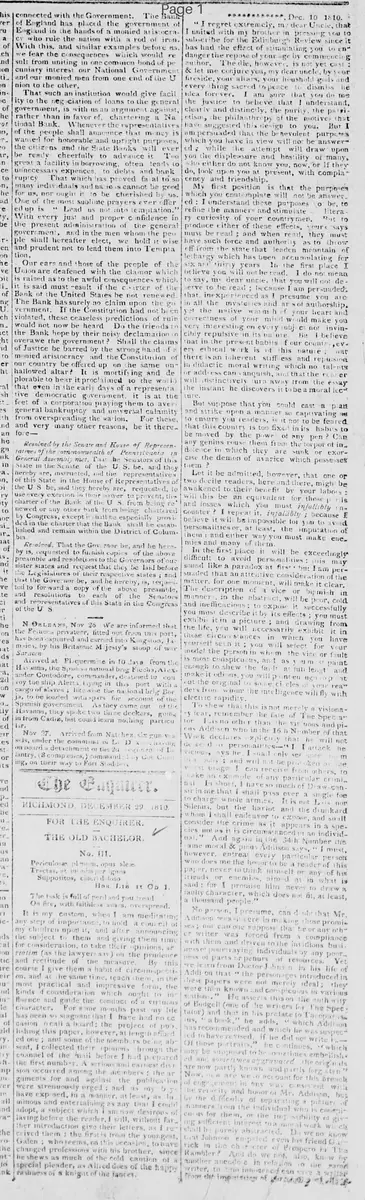
It is my custom, when I am meditating any step of importance, to hold a council of my children upon it, and after announcing the subject to them and giving them time for consideration, to take their opinions, seriatim (as the lawyer says) on the prudence and rectitude of the measure. By this course I give them a habit of circumspection, and at the same time, teach them, in the most practical and impressive form, the kinds of consideration which ought to influence and guide the conduct of a virtuous character. For five months past my life has been so stagnant that I have had no occasion to call a board: the project of publishing this paper, however, at length afforded one; and some of the members being absent, I collected their opinion, through the channel of the mail before I had prepared the first number. A serious and earnest discussion occurred among them: the arguments for and against the publication were strenuously urged; and as my secretary has exposed, in a manner, at least, as luminous and entertaining as any that I could adopt, a subject which I am now desirous of having before the reader, I will, without further introduction give their letters, as I received them: the first is from the youngest, Galen; who seems, on this occasion, to have changed professions with his brother, since he shews as much of the cold caution of a special pleader, as Alfred does of the happy rashness of a knight of the lancet.
************. Dec. 10, 1810.
"I regret extremely, my dear Uncle, that I united with my brother in pressing you to subscribe for the Edinburgh Review since it has had the effect of stimulating you to endanger the repose of your age by commencing author. The die, however, is not yet cast: & let me conjure you, my dear uncle, by your fireside, your altars, your household gods and every thing sacred to you, to dismiss the idea forever. I am sure that you do me the justice to believe that I understand, clearly and distinctly, the purity, the patriotism, the philanthropy of the motives that have suggested this design to you. But I am persuaded that the benevolent purposes which you have in view will not be answered; while the attempt will draw upon you the displeasure and hostility of many, who either do not know you now, or if they do, look upon you at present, with complacency and friendship.
My first position is that the purposes which you contemplate will not be answered: I understand these purposes to be, to refine the manners and stimulate literary curiosity of your countrymen. But to produce either of these effects, your essays must be read; and when read, they must have such force and authority as to throw off from the state that leaden mountain of lethargy which has been accumulating for sixty and thirty years. In the first place I believe you will not be read. I do not mean to say, my dear uncle, that you will not deserve to be read; because I am persuaded, that, inexperienced as I presume you are in all the mysteries and art of authorship, yet the native warmth of your heart and correctness of your mind would make you very interesting on every subject not invincibly repulsive in its nature. But I believe that in the present habits of our country, every ethical work is of this nature; nor is there an inherent stiffness and repulsion in didactic moral writing which no talents or address can vanquish, and that the reader will instinctively turn away from the essay the instant he discovers it to be a moral lecture.
But suppose that you could cast a plan and strike upon a manner so captivating as to ensure you readers, is it not to be feared that this country is too fixed in its habits to be moved by the power of any pen? Can any genius rouse them from the torpor of indolence in which they are sunk or exorcise the demon of avarice which possesses them?
Let it be admitted, however, that one or two docile readers, here and there, might be awakened to their benefit by your labors: will this be an equivalent for those pains and losses which you must infallibly encounter? I repeat it, infallibly; because I believe it will be impossible for you to avoid personalities or, at least, the imputation of them: and either way you must make enemies and many of them.
In the first place it will be exceedingly difficult to avoid personalities: this may sound like a paradox at first: but I am persuaded that an attentive consideration of the matter, for one moment, will make it clear. The description of a vice or blemish in manner, in the abstract, will be prolix, cold and inefficacious; to expose it successfully you must describe it by its effects; you must exhibit it in a picture; and drawing from the life, you will necessarily exhibit it in those circumstances in which you have yourself seen it; you will select for your model the person in whom the vice or fault is most conspicuous, and as you must paint strong enough to shew the fault at full length and make it odious, you will put it up in such a way as to cut the original to some circles of his friends from whom the intelligence will fly with electric rapidity.
To shew that this is not merely a visionary fear, remember the fate of the Spectator. It is no other than the virtuous and pious Addison who in the 16th Number of that work declares explicitly that he will not descend to personalities—"If I attack the vicious, I shall do it in the abstract; as I shall make use of the names of particular persons, or of any one in particular, I shall endeavor to expose the vice or folly of the species, not as it is circumstanced in an individual. In short, I have so much of my Don Quixote in me that I shall pass over a single foe to charge whole armies. It is not Lisander nor Silenus, but the harlot and the drunkard whom I shall endeavor to expose, and shall consider their crime as it appears in a species not as it is circumstanced in an individual." And again in the 34th Number the same moral & pious Addison says, "I must, however, entreat every particular person who does me the honor to be a reader of this paper, never to think himself, or any of his friends or enemies, aimed at in what is said: for I promise him never to draw a faulty character which does not fit, at least, a thousand people." Or those portraits," he continues, "which may be supposed to be sometimes embellished and sometimes aggravated the originals are now partly known and partly forgotten."
No person, I presume, can doubt that Mr. Addison was sincere in making those promises; nor can one suppose that he or any other writer was forced from a compliance with them and driven to the invidious business of portraying individuals by any poverty of parts or penury of resources. Yet we learn from Doctor Johnson in his life of Addison that "the personages introduced in these papers were not merely ideal; they were then known and conspicuous in various stations." He asserts this on the authority of Budgell (one of the writers to The Spectator) and that in his preface to Theofrastus, "a book," he adds, "which Addison has recommended and which he was suspected to have revised, if he did not write it."— "Or those portraits," be continues, "which may be supposed to be sometimes embellished and sometimes aggravated the originals are now partly known and partly forgotten."
Now, how are we to account for this breach of engagement in any way consistent with the veracity and honor of Mr. Addison, but by the difficulty of separating a picture of manners from the individual who is conspicuous for them, or the utter inability of giving sufficient interest to a moral work which shall be purely abstracted. Do we not know that Johnson engaged even his friend Garrick in the character of Prospero in the Rambler? And do we not, also, know by another anecdote in relation to the same writer, in one case a whole club of gentlemen in the country who had determined to revenge themselves on him by violence, for an imaginary attack at a time when he did not even know of their existence?—Yes, believe me, my dear uncle, that although it were possible for you to avoid the design of personalities, there will not be wanting curious and malicious persons enough, who will apply your remarks and appropriate your pictures to individuals, and thus excite against you a host of enemies. Alas! it is not your retirement nor your age that can save you. Alas! I imagine that I can already see the sunshine and halcyon peace that now surrounds you, and illumines your face with smiles, exchanged for darkness, clouds and tempest. I implore you, my beloved uncle, and were I with you, I would implore you on my bended knees to dismiss the baleful project from your mind forever, and so confirm your own happiness, as well as that of your dutiful and affectionate nephew.
GALEN. *********.
************. December 12, 1810.
I am delighted, my dear uncle, with the scheme which your letter discloses; and feel a new obligation to the writers of the Edinburgh Review, for having caused it. I am persuaded that a course of moral and literary essays, executed in such a style as to draw & fix upon them the public attention, would do great good in this country, & great honor to their author. As to the idea which you suggest, that the world is perhaps already full enough of such works, and that the topics are all exhausted, I am sure you urged it, merely to try my judgment or to give me the triumph of refuting it.
For as to Casa's Book of manners, and Castiglione's Courtier in Italy, Bruyere's manners of the age, in France, or the Tatler, Spectator, Guardian, &c. in England—what have they to do with American manners? What instruction does a lady in this country gain by being told that a girl with a hoop petticoat, whom the Spectator saw fall, in the streets of London, looked for all the world like a bell without a clapper; or that another who fell down stairs with a head dress, four stories high, resembled an Egyptian pyramid set upon its apex? Every country and every age has its peculiar manners, and therefore, no portrait of one, can serve for another; on the contrary, a picture of manners "living as they rise" in any country, will always be new, original and captivating.
In matters of literature there is, indeed, more unity and durability; but then the topics which it presents are so various, and indeed infinite, that there is no danger of finding subjects enough to which a writer of genius can give novelty and grace. And even on the same subject different men have such different modes of thinking, that I believe such a mind as Goldsmith's, for instance, could have walked directly over the track of the Spectator, touching his very notes and subjects, without any danger of tiring his reader. You will say that you are no Goldsmith; to which I answer that to counterbalance this advantage you have a new country; a vast field covered with a heavy harvest, which no sickle has ever yet touched.
As to your doubt whether such a work would produce any effect on the inveterate habits of this country, why should we think so humbly of ourselves and so ill of others? I presume that the people of England in the reign of Queen Anne, were at least as luxurious, as vicious and inveterate in their habits as the people of this country: and yet we are told by Addison, that the Spectator had a perceptible influence upon the conversation of that time, and taught the frolic and the gay to unite merriment with decency. You will say that you are not an Addison or a Steele: never mind, my dear uncle, I will help you: so that you see there is no danger of my failing in my profession by my modesty.
But you apprehend that you may inflict pain where you mean only to give pleasure, and make enemies of those whom it is your wish and intention to serve. If I could believe this, I should certainly oppose the measure, totis viribus: but why is such a consequence necessary? I take it for granted, that you do not propose to write lampoons and satires upon individuals: but strictures upon the manners of the age—the reader who feels that your remarks are just and apply to himself, will certainly feel pain from that consciousness; so also does the patient whose leg a surgeon amputates to save his life; and so also does the sinner who trembles under the voice, and shrinks from the probe of a penetrating & eloquent preacher—but what then? Shall the surgeon throw away his instruments, & the preacher seal up his lips, & so, to avoid present pain, let the patient die and the sinner go to hell? No, sir—inflict the salutary pain of a moment—it is a cheap price for an eternity of happiness.
As to your creating enemies without any intention to do so, let the benevolence of your intention be manifest on the face of your works, and there is no danger of your making enemies of any but the vicious, the malicious and the mean, whose enmity is honor. What do you care for such people? You depend upon them for nothing: and their displeasure will be infinitely overbalanced by the applause and esteem of the wise and good. Go on, my dear uncle, I conjure you: and that God, whom you adore, will not fail to follow with his blessing, a work which he must approve.
Tendering to you and our beloved Rosalie the compliments of the approaching season, I am, my dear uncle, your affectionate nephew.
ALFRED.
After I had read these letters to Rosalie, I called for her opinion; whereupon, I perceived immediately an arch smile playing around her lips, and dimpling her sweet cheek. "In the first place, uncle, said she, I must be frank enough to tell you, that I have been bribed to vote in a particular way." "Bribed by whom?" "Why, that sly rogue, Alfred, apprehending that Galen and himself would differ in opinion, has written me a promise that, if I would vote with him, he would make me a present of a new edition of The British Classics, and give me six kisses into the bargain, when he comes home in the spring. It was right that you should know this fact, in order that my opinion may stand for no more than it deserves. After this confession, I must confess farther, that my brother Galen's letter has alarmed me exceedingly, and brought to my mind the fable of the bear, who, stung by a single bee, as you have been by the British leviathan, overset, in revenge, the whole hive upon his own head. Yet I do not see why a person should be restrained from a virtuous action, which may do good, by any terror of the low and wicked. I perfectly approve of the rule which directs that we should do whatever our conscience tells us to be right and leave the consequences to Heaven. The bribe apart, therefore, I vote with Alfred, so far as to advise that we make the experiment. We will watch the effects, and desist if we find Alfred's hopes likely to be frustrated, or Galen's fears to be realized."
Rosalie's vote, supported by her own and Alfred's arguments, at once determined me, and I commenced the work. How long it may continue, will depend more upon my readers than myself; upon their tractability and submission to my authority, as well as the candor and justice with which they shall treat my motives.
FOR THE ENQUIRER.
THE OLD BACHELOR.
No. III.
Pectus a plano, opus alea
Tractas, et in medio versus
Suppositos, cineris doloso.
HOR. LIB. I. OD. 1.
The task is full of peril and you tread
On fire, with faithless ashes, overspread.
It is my custom, when I am meditating any step of importance, to hold a council of my children upon it, and after announcing the subject to them and giving them time for consideration, to take their opinions, seriatim (as the lawyer says) on the prudence and rectitude of the measure. By this course I give them a habit of circumspection, and at the same time, teach them, in the most practical and impressive form, the kinds of consideration which ought to influence and guide the conduct of a virtuous character. For five months past my life has been so stagnant that I have had no occasion to call a board: the project of publishing this paper, however, at length afforded one; and some of the members being absent, I collected their opinion, through the channel of the mail before I had prepared the first number. A serious and earnest discussion occurred among them: the arguments for and against the publication were strenuously urged; and as my secretary has exposed, in a manner, at least, as luminous and entertaining as any that I could adopt, a subject which I am now desirous of having before the reader, I will, without further introduction give their letters, as I received them: the first is from the youngest, Galen; who seems, on this occasion, to have changed professions with his brother, since he shews as much of the cold caution of a special pleader, as Alfred does of the happy rashness of a knight of the lancet.
************. Dec. 10, 1810.
"I regret extremely, my dear Uncle, that I united with my brother in pressing you to subscribe for the Edinburgh Review since it has had the effect of stimulating you to endanger the repose of your age by commencing author. The die, however, is not yet cast: & let me conjure you, my dear uncle, by your fireside, your altars, your household gods and every thing sacred to you, to dismiss the idea forever. I am sure that you do me the justice to believe that I understand, clearly and distinctly, the purity, the patriotism, the philanthropy of the motives that have suggested this design to you. But I am persuaded that the benevolent purposes which you have in view will not be answered; while the attempt will draw upon you the displeasure and hostility of many, who either do not know you now, or if they do, look upon you at present, with complacency and friendship.
My first position is that the purposes which you contemplate will not be answered: I understand these purposes to be, to refine the manners and stimulate literary curiosity of your countrymen. But to produce either of these effects, your essays must be read; and when read, they must have such force and authority as to throw off from the state that leaden mountain of lethargy which has been accumulating for sixty and thirty years. In the first place I believe you will not be read. I do not mean to say, my dear uncle, that you will not deserve to be read; because I am persuaded, that, inexperienced as I presume you are in all the mysteries and art of authorship, yet the native warmth of your heart and correctness of your mind would make you very interesting on every subject not invincibly repulsive in its nature. But I believe that in the present habits of our country, every ethical work is of this nature; nor is there an inherent stiffness and repulsion in didactic moral writing which no talents or address can vanquish, and that the reader will instinctively turn away from the essay the instant he discovers it to be a moral lecture.
But suppose that you could cast a plan and strike upon a manner so captivating as to ensure you readers, is it not to be feared that this country is too fixed in its habits to be moved by the power of any pen? Can any genius rouse them from the torpor of indolence in which they are sunk or exorcise the demon of avarice which possesses them?
Let it be admitted, however, that one or two docile readers, here and there, might be awakened to their benefit by your labors: will this be an equivalent for those pains and losses which you must infallibly encounter? I repeat it, infallibly; because I believe it will be impossible for you to avoid personalities or, at least, the imputation of them: and either way you must make enemies and many of them.
In the first place it will be exceedingly difficult to avoid personalities: this may sound like a paradox at first: but I am persuaded that an attentive consideration of the matter, for one moment, will make it clear. The description of a vice or blemish in manner, in the abstract, will be prolix, cold and inefficacious; to expose it successfully you must describe it by its effects; you must exhibit it in a picture; and drawing from the life, you will necessarily exhibit it in those circumstances in which you have yourself seen it; you will select for your model the person in whom the vice or fault is most conspicuous, and as you must paint strong enough to shew the fault at full length and make it odious, you will put it up in such a way as to cut the original to some circles of his friends from whom the intelligence will fly with electric rapidity.
To shew that this is not merely a visionary fear, remember the fate of the Spectator. It is no other than the virtuous and pious Addison who in the 16th Number of that work declares explicitly that he will not descend to personalities—"If I attack the vicious, I shall do it in the abstract; as I shall make use of the names of particular persons, or of any one in particular, I shall endeavor to expose the vice or folly of the species, not as it is circumstanced in an individual. In short, I have so much of my Don Quixote in me that I shall pass over a single foe to charge whole armies. It is not Lisander nor Silenus, but the harlot and the drunkard whom I shall endeavor to expose, and shall consider their crime as it appears in a species not as it is circumstanced in an individual." And again in the 34th Number the same moral & pious Addison says, "I must, however, entreat every particular person who does me the honor to be a reader of this paper, never to think himself, or any of his friends or enemies, aimed at in what is said: for I promise him never to draw a faulty character which does not fit, at least, a thousand people." Or those portraits," he continues, "which may be supposed to be sometimes embellished and sometimes aggravated the originals are now partly known and partly forgotten."
No person, I presume, can doubt that Mr. Addison was sincere in making those promises; nor can one suppose that he or any other writer was forced from a compliance with them and driven to the invidious business of portraying individuals by any poverty of parts or penury of resources. Yet we learn from Doctor Johnson in his life of Addison that "the personages introduced in these papers were not merely ideal; they were then known and conspicuous in various stations." He asserts this on the authority of Budgell (one of the writers to The Spectator) and that in his preface to Theofrastus, "a book," he adds, "which Addison has recommended and which he was suspected to have revised, if he did not write it."— "Or those portraits," be continues, "which may be supposed to be sometimes embellished and sometimes aggravated the originals are now partly known and partly forgotten."
Now, how are we to account for this breach of engagement in any way consistent with the veracity and honor of Mr. Addison, but by the difficulty of separating a picture of manners from the individual who is conspicuous for them, or the utter inability of giving sufficient interest to a moral work which shall be purely abstracted. Do we not know that Johnson engaged even his friend Garrick in the character of Prospero in the Rambler? And do we not, also, know by another anecdote in relation to the same writer, in one case a whole club of gentlemen in the country who had determined to revenge themselves on him by violence, for an imaginary attack at a time when he did not even know of their existence?—Yes, believe me, my dear uncle, that although it were possible for you to avoid the design of personalities, there will not be wanting curious and malicious persons enough, who will apply your remarks and appropriate your pictures to individuals, and thus excite against you a host of enemies. Alas! it is not your retirement nor your age that can save you. Alas! I imagine that I can already see the sunshine and halcyon peace that now surrounds you, and illumines your face with smiles, exchanged for darkness, clouds and tempest. I implore you, my beloved uncle, and were I with you, I would implore you on my bended knees to dismiss the baleful project from your mind forever, and so confirm your own happiness, as well as that of your dutiful and affectionate nephew.
GALEN. *********.
************. December 12, 1810.
I am delighted, my dear uncle, with the scheme which your letter discloses; and feel a new obligation to the writers of the Edinburgh Review, for having caused it. I am persuaded that a course of moral and literary essays, executed in such a style as to draw & fix upon them the public attention, would do great good in this country, & great honor to their author. As to the idea which you suggest, that the world is perhaps already full enough of such works, and that the topics are all exhausted, I am sure you urged it, merely to try my judgment or to give me the triumph of refuting it.
For as to Casa's Book of manners, and Castiglione's Courtier in Italy, Bruyere's manners of the age, in France, or the Tatler, Spectator, Guardian, &c. in England—what have they to do with American manners? What instruction does a lady in this country gain by being told that a girl with a hoop petticoat, whom the Spectator saw fall, in the streets of London, looked for all the world like a bell without a clapper; or that another who fell down stairs with a head dress, four stories high, resembled an Egyptian pyramid set upon its apex? Every country and every age has its peculiar manners, and therefore, no portrait of one, can serve for another; on the contrary, a picture of manners "living as they rise" in any country, will always be new, original and captivating.
In matters of literature there is, indeed, more unity and durability; but then the topics which it presents are so various, and indeed infinite, that there is no danger of finding subjects enough to which a writer of genius can give novelty and grace. And even on the same subject different men have such different modes of thinking, that I believe such a mind as Goldsmith's, for instance, could have walked directly over the track of the Spectator, touching his very notes and subjects, without any danger of tiring his reader. You will say that you are no Goldsmith; to which I answer that to counterbalance this advantage you have a new country; a vast field covered with a heavy harvest, which no sickle has ever yet touched.
As to your doubt whether such a work would produce any effect on the inveterate habits of this country, why should we think so humbly of ourselves and so ill of others? I presume that the people of England in the reign of Queen Anne, were at least as luxurious, as vicious and inveterate in their habits as the people of this country: and yet we are told by Addison, that the Spectator had a perceptible influence upon the conversation of that time, and taught the frolic and the gay to unite merriment with decency. You will say that you are not an Addison or a Steele: never mind, my dear uncle, I will help you: so that you see there is no danger of my failing in my profession by my modesty.
But you apprehend that you may inflict pain where you mean only to give pleasure, and make enemies of those whom it is your wish and intention to serve. If I could believe this, I should certainly oppose the measure, totis viribus: but why is such a consequence necessary? I take it for granted, that you do not propose to write lampoons and satires upon individuals: but strictures upon the manners of the age—the reader who feels that your remarks are just and apply to himself, will certainly feel pain from that consciousness; so also does the patient whose leg a surgeon amputates to save his life; and so also does the sinner who trembles under the voice, and shrinks from the probe of a penetrating & eloquent preacher—but what then? Shall the surgeon throw away his instruments, & the preacher seal up his lips, & so, to avoid present pain, let the patient die and the sinner go to hell? No, sir—inflict the salutary pain of a moment—it is a cheap price for an eternity of happiness.
As to your creating enemies without any intention to do so, let the benevolence of your intention be manifest on the face of your works, and there is no danger of your making enemies of any but the vicious, the malicious and the mean, whose enmity is honor. What do you care for such people? You depend upon them for nothing: and their displeasure will be infinitely overbalanced by the applause and esteem of the wise and good. Go on, my dear uncle, I conjure you: and that God, whom you adore, will not fail to follow with his blessing, a work which he must approve.
Tendering to you and our beloved Rosalie the compliments of the approaching season, I am, my dear uncle, your affectionate nephew.
ALFRED.
After I had read these letters to Rosalie, I called for her opinion; whereupon, I perceived immediately an arch smile playing around her lips, and dimpling her sweet cheek. "In the first place, uncle, said she, I must be frank enough to tell you, that I have been bribed to vote in a particular way." "Bribed by whom?" "Why, that sly rogue, Alfred, apprehending that Galen and himself would differ in opinion, has written me a promise that, if I would vote with him, he would make me a present of a new edition of The British Classics, and give me six kisses into the bargain, when he comes home in the spring. It was right that you should know this fact, in order that my opinion may stand for no more than it deserves. After this confession, I must confess farther, that my brother Galen's letter has alarmed me exceedingly, and brought to my mind the fable of the bear, who, stung by a single bee, as you have been by the British leviathan, overset, in revenge, the whole hive upon his own head. Yet I do not see why a person should be restrained from a virtuous action, which may do good, by any terror of the low and wicked. I perfectly approve of the rule which directs that we should do whatever our conscience tells us to be right and leave the consequences to Heaven. The bribe apart, therefore, I vote with Alfred, so far as to advise that we make the experiment. We will watch the effects, and desist if we find Alfred's hopes likely to be frustrated, or Galen's fears to be realized."
Rosalie's vote, supported by her own and Alfred's arguments, at once determined me, and I commenced the work. How long it may continue, will depend more upon my readers than myself; upon their tractability and submission to my authority, as well as the candor and justice with which they shall treat my motives.
What sub-type of article is it?
Essay
Epistolary
What themes does it cover?
Moral Virtue
Social Manners
What keywords are associated?
Moral Essays
American Manners
Family Council
Authorship Risks
Literary Influence
Addison Spectator
Literary Details
Title
The Old Bachelor. No. Iii.
Subject
Debate On Publishing Moral Essays To Refine American Manners
Key Lines
The Task Is Full Of Peril And You Tread On Fire, With Faithless Ashes, Overspread.
I Am Persuaded That The Benevolent Purposes Which You Have In View Will Not Be Answered; While The Attempt Will Draw Upon You The Displeasure And Hostility Of Many...
I Am Delighted, My Dear Uncle, With The Scheme Which Your Letter Discloses; And Feel A New Obligation To The Writers Of The Edinburgh Review, For Having Caused It.
Every Country And Every Age Has Its Peculiar Manners, And Therefore, No Portrait Of One, Can Serve For Another...