Thank you for visiting SNEWPapers!
Sign up free
Editorial
April 12, 1808
Virginia Argus
Richmond, Virginia
What is this article about?
This editorial defends President Jefferson against Federalist claims that he withheld French Minister Champagny's January 1808 letter from Congress. It clarifies the timeline of its receipt and presentation, analyzes the letter's contents urging US war with Britain without threats to the US, critiques British envoy Erskine's haughty response, and suggests the embargo may soften French policy toward American commerce.
Clipping
OCR Quality
98%
Excellent
Full Text
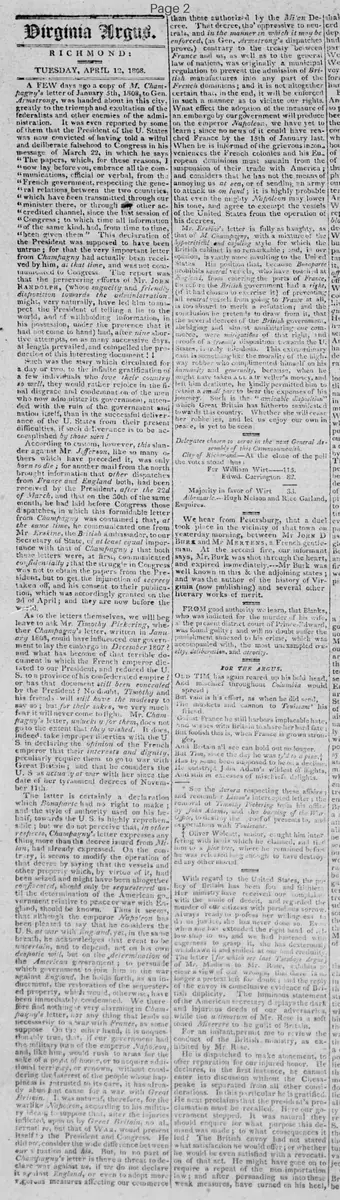
A FEW days ago a copy of M. Champagny's letter of January 5th, 1808, to Gen. Armstrong, was handed about in this city, greatly to the triumph and exultation of the federalists and other enemies of the administration. It was even reported by some of them that the President of the U. States was now convicted of having told a wilful and deliberate falsehood to Congress in his message of March 22, in which he says "The papers, which, for these reasons, I now lay before you, embrace all the communications, official or verbal, from the French government, respecting the general relations between the two countries, which have been transmitted through our minister there, or through any other accredited channel, since the last session of Congress; to which time all information of the same kind, had, from time to time, been given them."
This declaration of the President was supposed to have been untrue; for that the very important letter from Champagny had actually been received by him, at that time, and was not communicated to Congress. The report was that the persevering efforts of Mr. John Randolph, (whose sagacity and friendship towards the administration might, very naturally, have led him to suspect the President of telling a lie to the world, and of withholding information, in his possession, under the pretence that it had not come to hand) had, after nine abortive attempts, on as many successive days, at length prevailed, and compelled the production of this interesting document!! Such was the story which circulated for a day or two, to the infinite gratification of a few individuals who love their country so well, they would rather rejoice in the final disgrace and condemnation of the men who now administer its government, attended with the ruin of the government and nation itself, than in the successful deliverance of the U. States from their present difficulties, if such deliverance is to be accomplished by those men!
According to custom, however, this slander against Mr. Jefferson, like so many others which have preceded it, was only born to die; for another mail from the north brought information that other dispatches from France and England both, had been received by the President, after the 22d of March, and that on the 30th of the same month, he had laid before Congress those dispatches, in which this formidable letter from Champagny was contained; that, at the same time, he communicated one from Mr. Erskine, the British ambassador, to our Secretary of State, of at least equal importance with that of Champagny; that both these letters were, at first, communicated confidentially; that the struggle in Congress was not to obtain the papers from the President, but to get the injunction of secrecy taken off, and his consent to their publication, which was accordingly granted on the 2d of April; and they are now before the world.
As to the letters themselves, we will beg leave to ask Mr. Timothy Pickering, whether Champagny's letter, written in January 1808, could have influenced our government to lay the embargo in December 1807? and what has become of that terrible document in which the French emperor dictated to our President, and reduced the U. S. to a province of his confederated empire? or has that document still been concealed by the President? No doubt, Timothy and his friends will still have the modesty to say so; but for their sakes, we very much fear it will never come to light. Mr. Champagny's letter, unluckily for them, does not go to the extent that they wished. It does, indeed, take improper liberties with the U. S. in declaring the opinion of the French emperor that their interests and dignity, peculiarly require them to go to war with Great Britain; and that he considers the U. S. as actually at war with her since the date of her tyrannical decrees of November 11th. The latter is certainly a declaration which Bonaparte had no right to make; and the style of authority used on his behalf, towards the U. S. is highly reprehensible; but we do not perceive that, in other respects, Champagny's letter expresses any thing more than the decree issued from Milan, had already expressed. On the contrary, it seems to modify the operation of that decree by saying that the vessels and other property which, by virtue of it, had been seized and might have been altogether confiscated, should only be sequestered until the determination of the American government relative to peace or war with England, should be known. Thus it seems, that although the emperor Napoleon has been pleased to say that he considers the U. S. at war with England, yet, in the same breath, he acknowledges that event to be uncertain, and to depend, not on his own despotic will, but on the determination of the American government; to persuade which government to join him in the war against England, he holds forth, as an inducement, the restoration of the sequestered property, which would, otherwise, have been immediately condemned. We therefore find nothing so very alarming in Champagny's letter, nor any thing that leads so necessarily to a war with France, as some suppose.
On the other hand, it is unquestionably true, that, if our government had the military turn of the emperor Napoleon, and, like him, would rush to arms for the sake of a point of honor, or to acquire additional territory, or renown, without considering the interest of the people whose happiness is entrusted to its care, it has already abundant cause for a war with Great Britain. It was natural, therefore, for the warlike Napoleon, according to his military ideas to suppose that, after the injuries inflicted upon us by Great Britain, no alternative, but that of war, would present itself to the President and Congress. He did not consider the wide difference between our situation and his. But, in no part of Champagny's letter is there a threat to declare war against us, if we do not declare it against England, or even to adopt more rigorous measures affecting our commerce than those authorized by the Milan Decree. That decree, tho' oppressive to neutrals, and in the manner in which it may be enforced, (as Gen. Armstrong's dispatches prove,) contrary to the treaty between France and us, as well as to the general law of nations, was originally a municipal regulation to prevent the admission of British manufactures into any part of the French dominions; and it is not altogether certain that, in the end, it will be enforced in such a manner as to violate our rights. What effect the adoption of the measure of an embargo by our government will produce on the emperor Napoleon, we have yet to learn; since no news of it could have reached France by the 15th of January last. When he is informed of the grievous inconveniences the French colonies and his European dominions must sustain from the suspension of their trade with America; and considers that he has not the means of annoying us at sea, or of sending an army to attack us on land: it is highly probable that even the mighty Napoleon may lower his tone, and agree to exempt the vessels of the United States from the operation of his decrees.
Mr. Erskine's letter is fully as haughty, as that of M. Champagny, with a mixture of the hypocritical and cajoling style for which the British cabinet is so remarkable; and, in our opinion, is vastly more insulting to the United States. His position that, because Bonaparte prohibits neutral vessels, who have touched at England, from entering the ports of France, therefore the British government had a right, (if it had chosen to exercise it) of preventing all neutral vessels from going to France at all, is too absurd to merit a refutation: and the conclusion he pretends to draw from it, that the several decrees of the British government, abridging and almost annihilating our commerce, were mitigations of that right, and proofs of a friendly disposition towards the U. States, is truly ridiculous. This extraordinary cant is something like the morality of the highway robber who complimented himself on his humanity and generosity, because, when he might have taken all a traveller's money, and left him destitute, he kindly permitted him to retain a small part to bear the expenses of his journey. Such is the "amicable disposition" which Great Britain has hitherto manifested towards this country. Whether she will cease her robberies, and let us enjoy our own in peace, is yet to be seen.
This declaration of the President was supposed to have been untrue; for that the very important letter from Champagny had actually been received by him, at that time, and was not communicated to Congress. The report was that the persevering efforts of Mr. John Randolph, (whose sagacity and friendship towards the administration might, very naturally, have led him to suspect the President of telling a lie to the world, and of withholding information, in his possession, under the pretence that it had not come to hand) had, after nine abortive attempts, on as many successive days, at length prevailed, and compelled the production of this interesting document!! Such was the story which circulated for a day or two, to the infinite gratification of a few individuals who love their country so well, they would rather rejoice in the final disgrace and condemnation of the men who now administer its government, attended with the ruin of the government and nation itself, than in the successful deliverance of the U. States from their present difficulties, if such deliverance is to be accomplished by those men!
According to custom, however, this slander against Mr. Jefferson, like so many others which have preceded it, was only born to die; for another mail from the north brought information that other dispatches from France and England both, had been received by the President, after the 22d of March, and that on the 30th of the same month, he had laid before Congress those dispatches, in which this formidable letter from Champagny was contained; that, at the same time, he communicated one from Mr. Erskine, the British ambassador, to our Secretary of State, of at least equal importance with that of Champagny; that both these letters were, at first, communicated confidentially; that the struggle in Congress was not to obtain the papers from the President, but to get the injunction of secrecy taken off, and his consent to their publication, which was accordingly granted on the 2d of April; and they are now before the world.
As to the letters themselves, we will beg leave to ask Mr. Timothy Pickering, whether Champagny's letter, written in January 1808, could have influenced our government to lay the embargo in December 1807? and what has become of that terrible document in which the French emperor dictated to our President, and reduced the U. S. to a province of his confederated empire? or has that document still been concealed by the President? No doubt, Timothy and his friends will still have the modesty to say so; but for their sakes, we very much fear it will never come to light. Mr. Champagny's letter, unluckily for them, does not go to the extent that they wished. It does, indeed, take improper liberties with the U. S. in declaring the opinion of the French emperor that their interests and dignity, peculiarly require them to go to war with Great Britain; and that he considers the U. S. as actually at war with her since the date of her tyrannical decrees of November 11th. The latter is certainly a declaration which Bonaparte had no right to make; and the style of authority used on his behalf, towards the U. S. is highly reprehensible; but we do not perceive that, in other respects, Champagny's letter expresses any thing more than the decree issued from Milan, had already expressed. On the contrary, it seems to modify the operation of that decree by saying that the vessels and other property which, by virtue of it, had been seized and might have been altogether confiscated, should only be sequestered until the determination of the American government relative to peace or war with England, should be known. Thus it seems, that although the emperor Napoleon has been pleased to say that he considers the U. S. at war with England, yet, in the same breath, he acknowledges that event to be uncertain, and to depend, not on his own despotic will, but on the determination of the American government; to persuade which government to join him in the war against England, he holds forth, as an inducement, the restoration of the sequestered property, which would, otherwise, have been immediately condemned. We therefore find nothing so very alarming in Champagny's letter, nor any thing that leads so necessarily to a war with France, as some suppose.
On the other hand, it is unquestionably true, that, if our government had the military turn of the emperor Napoleon, and, like him, would rush to arms for the sake of a point of honor, or to acquire additional territory, or renown, without considering the interest of the people whose happiness is entrusted to its care, it has already abundant cause for a war with Great Britain. It was natural, therefore, for the warlike Napoleon, according to his military ideas to suppose that, after the injuries inflicted upon us by Great Britain, no alternative, but that of war, would present itself to the President and Congress. He did not consider the wide difference between our situation and his. But, in no part of Champagny's letter is there a threat to declare war against us, if we do not declare it against England, or even to adopt more rigorous measures affecting our commerce than those authorized by the Milan Decree. That decree, tho' oppressive to neutrals, and in the manner in which it may be enforced, (as Gen. Armstrong's dispatches prove,) contrary to the treaty between France and us, as well as to the general law of nations, was originally a municipal regulation to prevent the admission of British manufactures into any part of the French dominions; and it is not altogether certain that, in the end, it will be enforced in such a manner as to violate our rights. What effect the adoption of the measure of an embargo by our government will produce on the emperor Napoleon, we have yet to learn; since no news of it could have reached France by the 15th of January last. When he is informed of the grievous inconveniences the French colonies and his European dominions must sustain from the suspension of their trade with America; and considers that he has not the means of annoying us at sea, or of sending an army to attack us on land: it is highly probable that even the mighty Napoleon may lower his tone, and agree to exempt the vessels of the United States from the operation of his decrees.
Mr. Erskine's letter is fully as haughty, as that of M. Champagny, with a mixture of the hypocritical and cajoling style for which the British cabinet is so remarkable; and, in our opinion, is vastly more insulting to the United States. His position that, because Bonaparte prohibits neutral vessels, who have touched at England, from entering the ports of France, therefore the British government had a right, (if it had chosen to exercise it) of preventing all neutral vessels from going to France at all, is too absurd to merit a refutation: and the conclusion he pretends to draw from it, that the several decrees of the British government, abridging and almost annihilating our commerce, were mitigations of that right, and proofs of a friendly disposition towards the U. States, is truly ridiculous. This extraordinary cant is something like the morality of the highway robber who complimented himself on his humanity and generosity, because, when he might have taken all a traveller's money, and left him destitute, he kindly permitted him to retain a small part to bear the expenses of his journey. Such is the "amicable disposition" which Great Britain has hitherto manifested towards this country. Whether she will cease her robberies, and let us enjoy our own in peace, is yet to be seen.
What sub-type of article is it?
Foreign Affairs
Partisan Politics
War Or Peace
What keywords are associated?
Champagny Letter
Erskine Letter
Jefferson Defense
Federalist Slander
Us Embargo
Napoleon Decrees
British Aggression
Milan Decree
What entities or persons were involved?
President Jefferson
M. Champagny
Gen. Armstrong
Mr. John Randolph
Mr. Timothy Pickering
Emperor Napoleon
Mr. Erskine
British Ambassador
Federalists
Editorial Details
Primary Topic
Defense Against Accusations Of Withholding Champagny's Letter And Analysis Of Franco British Diplomatic Pressures On Us
Stance / Tone
Pro Jefferson Administration, Anti Federalist, Critical Of British Policy
Key Figures
President Jefferson
M. Champagny
Gen. Armstrong
Mr. John Randolph
Mr. Timothy Pickering
Emperor Napoleon
Mr. Erskine
British Ambassador
Federalists
Key Arguments
Jefferson Received And Presented Champagny's Letter To Congress After March 22, 1808, Contrary To Federalist Claims
Federalists Spread False Rumors To Discredit The Administration
Champagny's Letter Urges Us War With Britain But Modifies Milan Decree To Sequester Rather Than Confiscate Us Property Pending Us Decision
No Threats From France To Declare War On Us If It Does Not Join Against England
Erskine's Letter Absurdly Justifies British Restrictions As Mitigations And Friendly Acts
Us Has Ample Cause For War With Britain Due To Injuries Inflicted
Embargo May Prompt Napoleon To Exempt Us Vessels From French Decrees