Thank you for visiting SNEWPapers!
Sign up free
Literary Cadet, And Saturday Evening Bulletin
Providence, Providence County, Rhode Island
What is this article about?
Eliza Murry, a coquettish young woman, breaks a promise to suitor Henry Egland by attending a ball, ending their romance. She marries a dissipated man, endures hardship, dies young, leaving orphans adopted by the prosperous Egland. Moral: Honor courtship promises.
Clipping
OCR Quality
Full Text
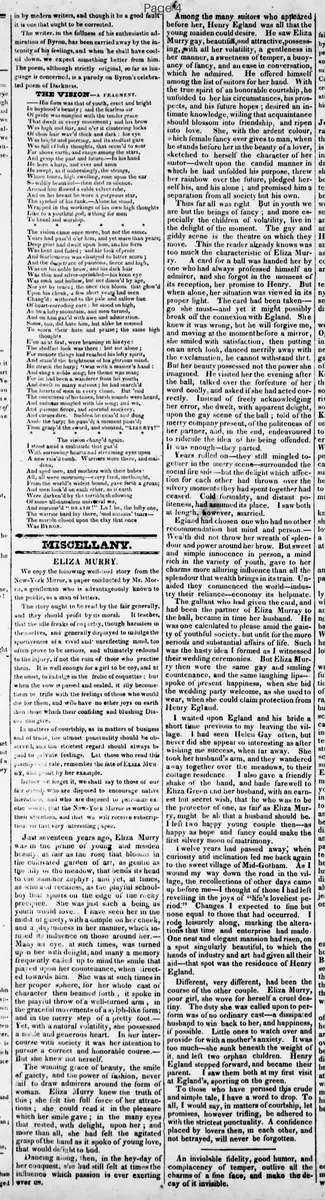
ELIZA MURRY
We copy the following well-told story from the New-York Mirror, a paper conducted by Mr. Morris, a gentleman who is advantageously known to the public, as a man of letters.
The story ought to be read by the fair generally, and they should profit by its moral. It teaches, that the idle freaks of coquetry, though harmless in themselves, and generally displayed to indulge the sportiveness of a vivid and unreflecting mind, too often prove to be serious, and ultimately redound to the injury, if not the ruin of those who practise them. It is well enough for a girl to be coy, and at the onset, to indulge in the frolic of coquettes: but when the vow is passed and sealed, it ill becomes them to trifle with the feelings of those who would die for them, and who have no other joys on earth than those which their confiding and blushing Diana can give.
In matters of courtship, as in matters of business and of trade, the utmost punctuality should be observed, and the strictest regard should always be paid to private feelings. Let those who read this plainly-told tale, remember the fate of Eliza Murry, and profit by her example.
Before we forget it, we shall say to those of our fair friends, who are disposed to encourage native literature, and who are disposed to patronize exotic works, that the New-York Mirror is worthy of their attention, and that we will receive subscriptions for that very interesting paper.
Just seventeen years ago, Eliza Murry was in the prime of young and maiden beauty, as fair as the rose that blooms in the cultivated garden of art, as gentle as the lily of the meadow, that bends its head to the summer zephyr; and yet, at times, as wild and reckless, as the playful school-boy that sports on the edge of the rocky precipice. She was just such a being as youth would love. I have seen her in the midst of gayety, with a dimple on her cheek, and a playfulness in her manner, which infused its influence on those around her. Many an eye, at such times, was turned upon her with delight, and many a memory frequently carried up to mind the smile that played upon her countenance, when directed towards him. She was at such times in her proper sphere, for her whole cast of character then beamed forth, it spoke in the playful throw of a well-turned arm, in the graceful movements of a sylph-like form; and in the merry step of a pretty foot.
Yet, with a natural volatility, she possessed a noble and generous heart. In her intercourse with society it was her intention to pursue a correct and honorable course. But she knew not herself.
The winning grace of beauty, the smile of gaiety, and the power of fashion, never fail to draw admirers around the form of woman. Eliza Murry knew the truth of this; she felt the full force of her attractions; she could read it in the pleasure which her smile gave; in the many eyes that rested, with delight, upon her; and more than all, she had felt the agitated grasp of the hand as it spoke of young love, that would delight to bud.
Dancing along, then, in the hey-day of her conquest, she had still felt at times the influence which passion is ever exerting over us.
Among the many suitors who appeared before her, Henry Egland was all that the young maiden could desire. He saw Eliza Murry gay, beautiful, and attractive, possessing, with all her volatility, a gentleness in her manner, a sweetness of temper, a buoyancy of fancy, and an ease in conversation, which he admired. He offered himself among the list of suitors for her hand. With the true spirit of an honorable courtship, he unfolded to her his circumstances, his prospects, and his future hopes; desired an intimate knowledge, willing that acquaintance should blossom into friendship, and ripen into love. She, with the ardent color which female fancy ever gives to man, when he stands before her in the beauty of a lover, sketched to herself the character of her suitor—dwelt upon the candid manner in which he had unfolded his purpose, threw her rainbow over the future, pledged herself his, and his alone; and promised him a separation from all society but his own.
Thus far all was right. But in youth we are but the beings of fancy; and more especially the children of volatility, live in the delight of the moment. The gay and giddy scene is the theatre on which they move. This the reader already knows was too much the characteristic of Eliza Murry.
A card for a ball was handed her by one who had always professed himself an admirer, and she forgot in the moment of its reception, her promise to Henry. But when alone, her situation was viewed in its proper light. The card had been taken—go she must—and yet it might possibly break off the connexion with Egland. She knew it was wrong, but he will forgive me, and moving at the moment before a mirror, she smiled with satisfaction, then putting on an arch look, danced merrily away with the exclamation, he cannot withstand that.
But her beauty possessed not the power she imagined. He visited her the evening after the ball, talked over the forfeiture of her word coolly, and asked if she had acted correctly. Instead of freely acknowledging her error, she dwelt, with apparent delight, upon the gay scene of the ball; told of the merry company present, of the politeness of her partner, and, in the end, endeavored to ridicule the idea of his being offended.
It was enough—they parted.
Years rolled on—they still mingled together in the merry scene—surrounded the social fire side—but the delight which affection for each other had thrown over the silvery moments they had spent together had ceased. Cold formality, and distant politeness, had assumed its place. I saw both at length, however, married.
Egland had chosen one who had no other recommendation but mind and person. Wealth did not throw her wreath of splendor and power around her brow. But sweet and simple innocence in person, a mind rich in the variety of youth, gave to her charms more alluring influence than all the splendor that wealth brings in its train. Unaided they commenced the world—industry their reliance—economy its helpmate.
The gallant who had given the card, and had been the partner of Eliza Murray to the ball, became in time her husband. He was one calculated to please amid the gaiety of youthful society, but unfit for the more serious and substantial affairs of life. Such was the hasty idea I formed as I witnessed their wedding ceremonies. But Eliza Murray then wore the same gay and smiling countenance, and the same laughing lips—spoke of present happiness, when she bid the wedding party welcome, as she used to wear, when she could claim protection from Henry Egland.
I waited upon Egland and his bride a short time previous to my leaving the village. I had seen Helen Gay often, but never did she appear so interesting as after wishing me success, when far away. She took her husband's arm, and they wandered away together over the meadows, to their cottage residence. I also gave a friendly shake of the hand, and bade farewell to Eliza Murray and her husband, with an earnest but secret wish, that he who was to be the protector of one, as fair as Eliza Murray, might be all that a husband should be.
I left two happy young couple then—as happy as hope and fancy could make the first silvery moon of matrimony.
Twelve years had passed away; when curiosity and inclination led me back again to the sweet village of Mid-Gotham. As I wound my way down the road in the village, the recollections of other days came up before me—I thought of those I had left revelling in the joys of "life's loveliest period." Changes I expected to find but none equal to those that had occurred. I rode leisurely along, marking the alterations that time and enterprise had made. One neat and elegant mansion had risen, on a spot singularly beautiful, to which the hands of industry and art had given all their aid—that spot was the residence of Henry Egland.
Different, very different, had been the course of the other couple. Eliza Murry, poor girl, she wove for herself a cruel destiny. The duty she was called upon to perform was of no ordinary cast—a dissipated husband to win back to her, and happiness, if possible. Little ones to watch over and provide for with a mother's anxiety. It was too much—she sunk beneath the weight of it, and left two orphan children. Henry Egland stepped forward, and became their parent. I saw them both at my first visit at Egland's, sporting on the green.
To those who have perused this crude and simple tale, I have a word to drop. To all, I would say, in matters of courtship, let promises, however trifling, be adhered to with the strictest punctuality. A confidence placed by lovers then, in each other, and not betrayed, will never be forgotten.
An inviolable fidelity, good humor, and complacency of temper, outlive all the charms of a fine face, and make the decay of it invisible.
What sub-type of article is it?
What themes does it cover?
What keywords are associated?
What entities or persons were involved?
Where did it happen?
Story Details
Key Persons
Location
Mid Gotham
Story Details
Eliza Murry, a volatile and beautiful young woman, promises herself to suitor Henry Egland but breaks her word by attending a ball with another admirer, leading to their breakup. She later marries the charming but irresponsible man from the ball, struggles with his dissipation and raising children, and dies young, leaving orphans whom the successful Egland adopts.