Thank you for visiting SNEWPapers!

Sign up free
Page thumbnail for Lancaster Gazette
Domestic News March 9, 1830

Lancaster Gazette

Lancaster, Worcester County, Massachusetts

What is this article about?

U.S. Senate Committee on Indian Affairs reports on the Cherokee question from the President's message, describing the tribe's condition and treaties, arguing national obligations to Georgia supersede those to the Cherokees, offering compensation instead of fulfillment. The article criticizes this as a moral triumph of power over justice.

Clipping
OCR Quality

98% Excellent

Full Text

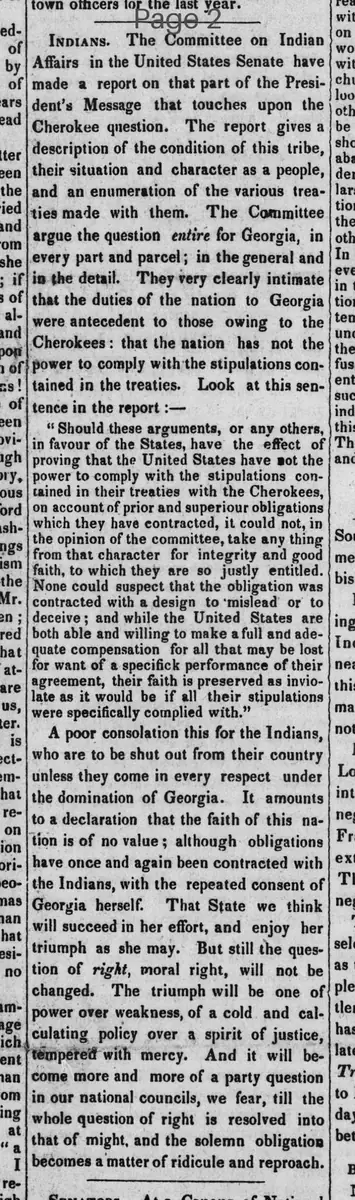
Indians. The Committee on Indian Affairs in the United States Senate have made a report on that part of the President's Message that touches upon the Cherokee question. The report gives a description of the condition of this tribe, their situation and character as a people, and an enumeration of the various treaties made with them. The Committee argue the question entire for Georgia, in every part and parcel; in the general and in the detail. They very clearly intimate that the duties of the nation to Georgia were antecedent to those owing to the Cherokees: that the nation has not the power to comply with the stipulations contained in the treaties. Look at this sentence in the report :— "Should these arguments, or any others, in favour of the States, have the effect of proving that the United States have not the power to comply with the stipulations contained in their treaties with the Cherokees, on account of prior and superior obligations which they have contracted, it could not, in the opinion of the committee, take anything from that character for integrity and good faith, to which they are so justly entitled. None could suspect that the obligation was contracted with a design to 'mislead or to deceive: and while the United States are both able and willing to make a full and adequate compensation for all that may be lost for want of a specific performance of their agreement, their faith is preserved as inviolate as it would be if all their stipulations were specifically complied with." A poor consolation this for the Indians, who are to be shut out from their country unless they come in every respect under the domination of Georgia. It amounts to a declaration that the faith of this nation is of no value; although obligations have once and again been contracted with the Indians, with the repeated consent of Georgia herself. That State we think will succeed in her effort, and enjoy her triumph as she may. But still the question of right, moral right, will not be changed. The triumph will be one of power over weakness, of a cold and calculating policy over a spirit of justice, tempered with mercy. And it will become more and more of a party question in our national councils, we fear, till the whole question of right is resolved into that of might, and the solemn obligation becomes a 'matter of ridicule and reproach.

What sub-type of article is it?

Indian Affairs Politics

What keywords are associated?

Cherokee Question Senate Report Indian Treaties Georgia Claims National Obligations Compensation Moral Right

Where did it happen?

Georgia

Domestic News Details

Primary Location

Georgia

Outcome

report argues u.s. cannot fulfill cherokee treaties due to prior obligations to georgia; offers full compensation to preserve national faith, implying cherokee displacement under georgia's domination.

Event Details

The Committee on Indian Affairs in the United States Senate reports on the Cherokee question, detailing the tribe's condition, situation, character, and treaties. It argues comprehensively for Georgia, stating national duties to the state precede those to the Cherokees and that the U.S. lacks power to comply with treaty stipulations due to prior superior obligations. The report maintains U.S. integrity by offering adequate compensation. The article views this as poor consolation for the Indians, declaring national faith valueless despite repeated treaties consented to by Georgia, predicting Georgia's success as a triumph of power over weakness and justice, potentially becoming a partisan issue reducing right to might.

Are you sure?