Thank you for visiting SNEWPapers!
Sign up free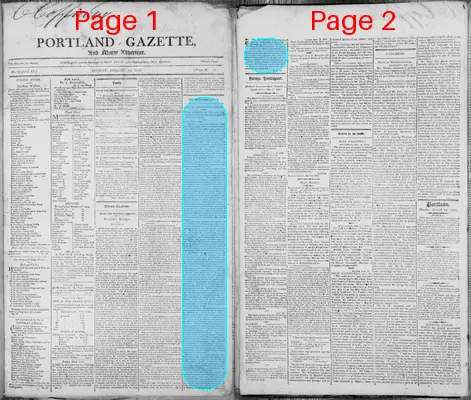
Portland Gazette, And Maine Advertiser
Portland, Cumberland County, Maine
What is this article about?
A letter to settlers in Lincoln County, Maine, without legal land titles, arguing they should negotiate purchases from proprietors for equitable terms rather than seeking legislative intervention, as such laws would be unjust and unequal. It highlights past hardships, opposition's costs, and the need for fair dealing.
Merged-components note: Continuation of the letter 'Communication....No. 2.' across pages; the second part was mislabeled as editorial but belongs to the same logical unit.
Clippings

1 of 2
OCR Quality
Full Text
FOR THE PORTLAND GAZETTE.
To the Settlers in the County of Lincoln who have not acquired a legal title to their Lands.
Fellow Citizens,
THAT you feel the conviction, that you have no legal title to the lands you are on, the most of you acknowledge: and your extreme reluctance to a decision at law, and opposition where any such decision has been obtained, is strong and convincing proof. You express a wish that the Legislature of the Commonwealth would interfere, that they would make such a law as you would dictate, and compel the proprietors to abandon their right, or transfer it to you.
Would this be just? Has a certain portion of the inhabitants of Lincoln county, any stronger reasons to urge for a law to accommodate their peculiar interests, than the inhabitants of Hampshire, Berkshire, or any other county? In other words, ought not the law by which real estate is held to be predicated on the same principle, and to operate equally through the state?
I know, and am ever ready to acknowledge that many of you have suffered extreme hardships-that you were under peculiar inconveniences, when you sat down upon the land you now occupy. But would not this have been your situation, would not your hardships and inconveniences have been as great and severe, if you had bought and paid for your lands at first? How then can the hardships and inconveniences you sustained be pleaded in support of a claim, where you have no title? Would not these hardships and inconveniences be more properly represented and urged, to obtain easy terms with him, in whom the title is vested? The Legislature have in fact, nothing to do in a settlement between you and the real proprietors, only to see that the laws are adapted to the general circumstances and genius of their constituents, that they are impartially and uniformly administered, giving you the same share in their protection as other citizens, in other parts of the Commonwealth, and no greater.
Upon the most deliberate examination of the circumstances, this appears to the writer to be the true state of the case, however disagreeable it may be to some of you to hear it. What then you will inquire must we do? My answer is, "agree with your adversary quickly." Let the proprietors make their locations and establish their lines and boundaries, and procure the best terms you can. You never will feel the manly independence of American Farmers, till you have a legal right to the soil you cultivate, held by the same tenure, as your fellow citizens in other parts of the Commonwealth hold theirs.
It is probable that number of you are not able to make prompt payment for the lots you are on, but were you disposed for an equitable settlement, there is no doubt you might obtain credit for a part, and probably a considerable part of the purchase money, to be paid by installments, at future periods, and if you were obliged eventually to dispose of a part to secure the rest it would I think be much better than to waste your time and money in unavailing contention, at the risque of losing the whole. Have not the means you have already employed to procrastinate a compromise operated much against you? The lands in controversy, have undoubtedly risen in the market fifty per cent. within ten years. How much better would it have been to have come forward at that time and have made that acknowledgment, which you now pretty generally concede you must and ought to make, that you have no lawful title, you would probably have obtained a longer pay-day, and made a saving of the rise of land, which is probably more than I have stated.
I know, you state that you could not find the real proprietors and you did not wish to be imposed on. There is some thing of weight in this, sufficient to cause delay, and would operate very much in your favor, if you could make it appear, that you have not taken the most direct means to prevent knowing. When the proprietors have come among you with the intention of ascertaining and making known their right, have you instead of aiding them, treated them with personal indignity and abuse? You know that the court, has paid thousands of dollars in damage, to the proprietors for personal injury, and you have rescued the culprits, and spoken of the transaction with triumph and exultation. It is in vain for you to say you wish to know who owns the soil, while you offer the grossest abuse and threaten destruction to them who have the power and inclination to inform you.
But say you, let the proprietors all come forward in a body and offer such terms as you judge proper and reasonable, and we will no longer oppose them! True-but is not this demand both absurd and unjust? It is certainly very unreasonable in you to insist upon making both sides of the bargain, 'tis absurd to demand it as a right.
You do not consult your own interest in making the claim-you would not only trade for yourselves, in this way, with that individual with whom you are personally concerned, but with all the proprietors' and for all the settlers. You forget that one man's right to his property is as good as another's, and by insisting that he shall dispose of his property
Therefore the consideration goes remedied if there is little, in fact, from the din; his property is at his liberty. On the principle of fair dealing no bargain can be made but with the full consent of parties, and to prevent deception, the object to be sold should be exposed to the free and uninterrupted examination of the parties; land, its limits should be known and both buyer and seller have free opportunity to examine quality, relative situation and quantity with all privileges appertaining, then any one is entitled to a preference he may plead it very innocently.
EQUITY.
What sub-type of article is it?
What themes does it cover?
What keywords are associated?
What entities or persons were involved?
Letter to Editor Details
Author
Equity.
Recipient
To The Settlers In The County Of Lincoln Who Have Not Acquired A Legal Title To Their Lands.
Main Argument
settlers without legal land titles should negotiate equitable purchases from proprietors quickly, as they have no valid claim and legislative interference to force transfers would be unjust and unequal across the state.
Notable Details