Thank you for visiting SNEWPapers!
Sign up free
Waterbury Evening Democrat
Waterbury, New Haven County, Connecticut
What is this article about?
British officials learn from naturalist Mr. Distant of dangerous poisonous spiders in Transvaal threatening soldiers, including the deadly Harpactira gigas and communal nest-building species. Spiders cause instant death in small animals and severe pain in larger ones via toxic hairs.
Clipping
OCR Quality
Full Text
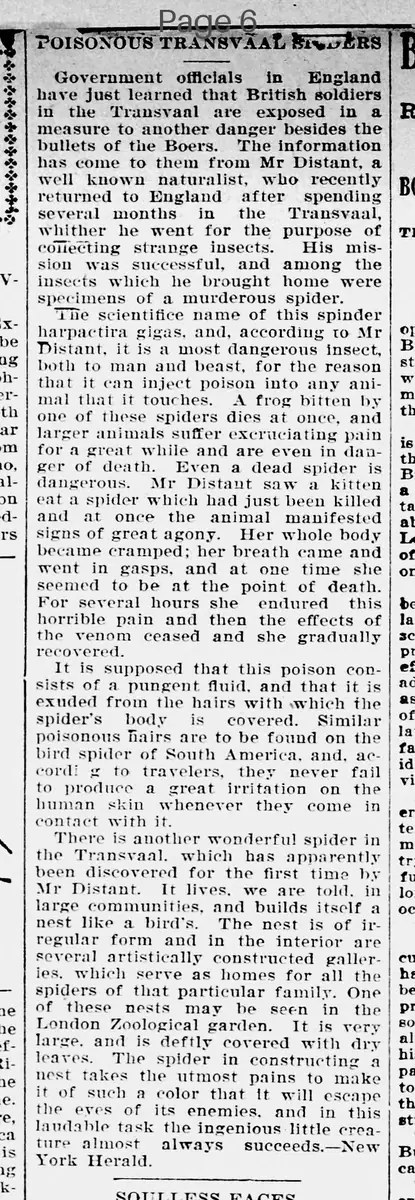
Government officials in England have just learned that British soldiers in the Transvaal are exposed in a measure to another danger besides the bullets of the Boers. The information has come to them from Mr. Distant, a well known naturalist, who recently returned to England after spending several months in the Transvaal, whither he went for the purpose of collecting strange insects. His mission was successful, and among the insects which he brought home were specimens of a murderous spider. The scientific name of this spider is harpactira gigas, and, according to Mr. Distant, it is a most dangerous insect, both to man and beast, for the reason that it can inject poison into any animal that it touches. A frog bitten by one of these spiders dies at once, and larger animals suffer excruciating pain for a great while and are even in danger of death. Even a dead spider is dangerous. Mr. Distant saw a kitten eat a spider which had just been killed and at once the animal manifested signs of great agony. Her whole body became cramped; her breath came and went in gasps, and at one time she seemed to be at the point of death. For several hours she endured this horrible pain and then the effects of the venom ceased and she gradually recovered.
It is supposed that this poison consists of a pungent fluid, and that it is exuded from the hairs with which the spider's body is covered. Similar poisonous hairs are to be found on the bird spider of South America, and, according to travelers, they never fail to produce a great irritation on the human skin whenever they come in contact with it.
There is another wonderful spider in the Transvaal, which has apparently been discovered for the first time by Mr. Distant. It lives, we are told, in large communities, and builds itself a nest like a bird's. The nest is of irregular form and in the interior are several artistically constructed galleries, which serve as homes for all the spiders of that particular family. One of these nests may be seen in the London Zoological garden. It is very large, and is deftly covered with dry leaves. The spider in constructing a nest takes the utmost pains to make it of such a color that it will escape the eyes of its enemies, and in this laudable task the ingenious little creature almost always succeeds.—New York Herald.
What sub-type of article is it?
What keywords are associated?
What entities or persons were involved?
Where did it happen?
Foreign News Details
Primary Location
Transvaal
Key Persons
Outcome
spiders pose danger to british soldiers; animals like frogs die instantly, larger ones suffer severe pain; even dead spiders toxic, as seen with a kitten's agony and recovery.
Event Details
Naturalist Mr. Distant reports poisonous Harpactira gigas spiders in Transvaal that inject venom via touch or hairs, deadly to small animals and painful to larger ones. Another communal spider builds camouflaged nests. Information alerts British officials to risks for soldiers beyond Boer bullets.