Thank you for visiting SNEWPapers!
Sign up free
Boon's Lick Times
Fayette, Howard County, Missouri
What is this article about?
Editorial in The Times (Fayette, MO, July 24, 1841) defends Whig loyalty to Harrison and Tyler, critiques pushes for an unconstitutional national bank akin to the old one, discusses fiscal agents, state consents for branches, Senate votes excluding foreigners, Rives' amendment rejection, and supports public lands distribution and pre-emptions.
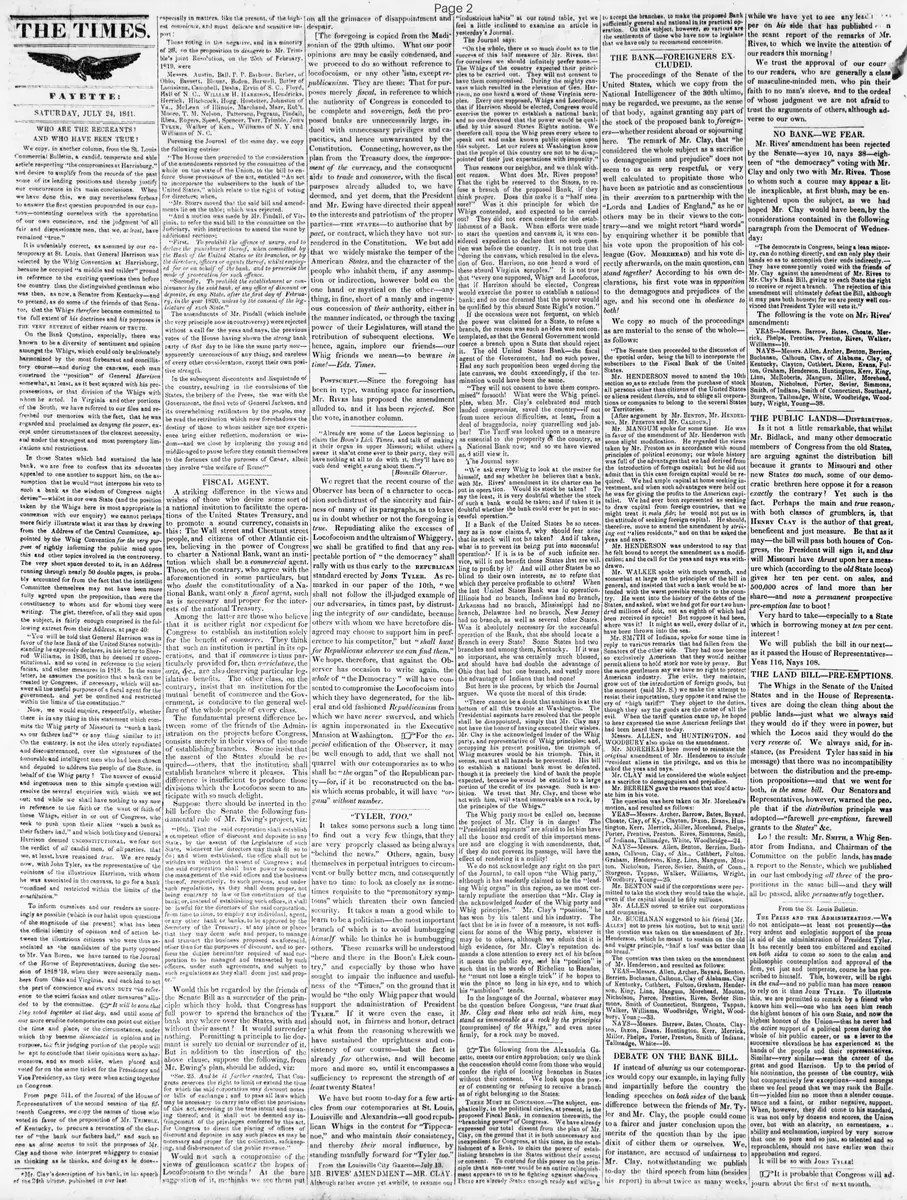
Merged-components note: The image overlaps spatially with the editorial bounding box and is sequential in reading order, likely representing the newspaper masthead or header illustration for this editorial section.
Clipping
OCR Quality
Full Text
FAYETTE:
SATURDAY, JULY 24, 1841.
WHO ARE THE RECREANTS?
AND WHO HAVE BEEN TRUE!
We copy, in another column, from the St. Louis Commercial Bulletin, a candid, temperate and able article respecting "the compromises at Harrisburg." and desire to amplify from the records of the past some of its leading positions and thereby justify our concurrence in its main conclusions. When we have done this, we may nevertheless forbear to answer the first question propounded in our caption—contenting ourselves with the approbation of our own conscience, and the judgment of all fair and dispassionate men, that we, at least, have remained "true."
It is undeniably correct, as assumed by our contemporary at St. Louis, that General Harrison was selected by the Whig Convention at Harrisburg because he occupied "a middle and milder" ground in reference to the exciting questions then before the country than the distinguished gentleman who was then, as now, a Senator from Kentucky—and to pretend, as do some of the friends of that Senator, that the Whigs therefore became committed to the full extent of his doctrines and his purposes is THE VERY REVERSE OF EITHER REASON OR TRUTH.
On the Bank Question, especially, there was known to be a diversity of sentiment and opinion amongst the Whigs, which could only be ultimately harmonized by the most forbearant and conciliatory course—and during the canvass, each man construed the "position" of General Harrison somewhat, at least, as it best squared with his prepossessions, or that division of the Whigs with whom he acted. In Virginia and other portions of the South, we have referred to our files and refreshed our memories with the fact, that he was regarded and proclaimed as denying the power, except under circumstances of the clearest necessity, and under the strongest and most peremptory limitations and restrictions.
In those States which had sustained the late bank, we are free to confess that its advocates appealed to one another to support him, on the assumption that he would "not interpose his veto to such a bank as the wisdom of Congress might devise"—whilst in our own State (and the position taken by the Whigs here is most appropriate in connexion with our enquiry) we cannot perhaps more fairly illustrate what it was than by drawing from the Address of the Central Committee, appointed by the Whig Convention for the very purpose of rightly informing the public mind upon this and other topics involved in the controversy.
'The very short space devoted to it, in an Address running through nearly 50 double pages, is probably accounted for from the fact that the intelligent Committee themselves may not have been more fully agreed upon the proposition, than were the constituency to whom and for whom they were writing. The gist, therefore, of all they said upon the subject, is fairly enough comprised in the following extract from their Address, at page 40:
"You will be told that General Harrison was in favor of the late Bank of the United States notwithstanding he expressly declares, in his letter to Sherrod Williams, in 1836, that he deemed it unconstitutional, and so voted in reference to the scire facias, and other measures in 1818. In the same letter, he assumes the position that a bank can be created by Congress, if necessary, which will answer all the useful purposes of a fiscal agent for the government, and yet be confined and restricted within the limits of the constitution."
Now, we would enquire, respectfully, whether there is any thing in this statement which commits the Whig party of Missouri to "such a bank as our fathers had" or any thing similar to it?
"On the contrary, is not the idea utterly repudiated and discountenanced, over the signatures of the honorable and intelligent men who had been chosen and deputed to address the people of the State, in behalf of the Whig party? The answer of candid and ingenuous men to this simple question will resolve the several enquiries with which we set out: and while we shall have nothing to say now in reference to the faith or the want of faith of those Whigs, either in or out of Congress, who seek to push upon their allies "such a bank as their fathers had," and which both they and General Harrison deemed UNCONSTITUTIONAL, we fear not the verdict of all candid men, of all parties, that we, at least, have remained true. We are ready now, with John Tyler, as the representative of the opinions of the illustrious Harrison, with whom he was associated in the canvass, to go for a bank "confined and restricted within the limits of the constitution."
To inform ourselves and our readers as unerringly as possible (which is our habit upon questions of the magnitude of the present) what has been the official identity of opinion and of action between the illustrious citizens who were thus associated as the candidates of the party opposed to Mr. Van Buren, we have turned to the Journal of the House of Representatives, during the session of 1818-'19, when they were severally members from Ohio and Virginia, and each had to act the part of conscience and sworn duty "in reference to the scire facias and other measures" alluded to by the committee. It will be seen that they voted together at that day, and until some of our more erudite cotemporaries can point out either the time and place, or the circumstances, under which they became dissociated in opinion and in purpose, the fair judging portion of the people will be apt to conclude that their opinions were as harmonious, and as much alike, when placed and voted for on the same ticket for the Presidency and Vice Presidency, as they were when acting together in Congress.
From page 311, of the Journal of the House of Representatives of the second session of the fifteenth Congress, we copy the names of those who voted in favor of the proposition of Mr. TRIMBLE, of Kentucky, to procure a revocation of the charter of "the bank our fathers had," and such an one as alone seems to suit the purposes of Mr. Clay and those who interpret whiggery to consist in thinking as he thinks, and doing as he does—
*Mr. Clay's description of his bank, in his speech of the 24th ult., published in our last.
Those voting in the negative, and in a minority of 39, on the proposition to disagree to Mr. Trimble's joint Resolution, on the 25th of February, 1819, were
Messrs. Austin, Ball, P. P. Barbour, Barber, of Ohio, Bassett, Blount, Boden, Burwell, Butler of Louisiana, Campbell, Desha, Ervin of S. C., Floyd, Hall of N. C., WILLIAM H. Harrison, Hendricks, Herrick, Hitchcock, Hogg, Hostetter, Johnston of Va., McLean of Illinois, Marchand, Marr, Ro't. Moore, T. M. Nelson, Patterson, Pegram, Pindall, Rhea, Rogers, Speed, Spencer, Tarr, Trimble, JOHN TYLER, Walker of Ky., Williams of N. C. and Williams of N. Y.
Pursuing the Journal of the same day, we copy the following entries:
"The House then proceeded to the consideration of the amendments reported by the committee of the whole on the state of the Union, to the bill to enforce those provisions of the act, entitled "An act to incorporate the subscribers to the bank of the United States," which relate to the right of voting for directors; when,
"Mr. Storrs moved that the said bill and amendments lie on the table; which was rejected.
"And a motion was made by Mr. Pindall, of Virginia, to refer the said bill to the committee on the Judiciary, with instructions to amend the same by additional sections;
"First. To prohibit the offence of usury, and to declare the punishment thereof, when committed by the Bank of the United States or its branches, or by the directors, officers or agents thereof, whilst employed for or on behalf of the bank, and to prescribe the mode of prosecution for such offence.
"Secondly, To prohibit the establishment or continuance by the said bank, of any office of discount or deposite, in any State, after the first day of February, in the year 1820, unless by the consent of the legislature of such State."
The amendments of Mr. Pindall (which include the very principle now in controversy) were rejected without a call for the yeas and nays, the previous votes of the House having shown the strong bank party of that day to be like the same party now—apparently unconscious of any thing, and careless of every other consideration, except their own positive strength.
In the subsequent discontents and disquietude of the country, resulting in the convulsions of the States, the bribery of the Press, the war with the Government, the final veto of General Jackson, and its overwhelming ratification by the people, may be read the retribution which now foreshadows the destiny of those to whom neither age nor experience seems to have taught any other lesson than that of the middle-aged to pause before they commit themselves to the fortunes and the purposes of Caesar, albeit they involve "the welfare of Rome!"
FISCAL AGENT.
A striking difference in the views and wishes of those who desire some sort of a national institution to facilitate the operations of the United States Treasury, and to promote a sound currency, consists in this: The Wall street and Chestnut street people, and citizens of other Atlantic cities, believing in the power of Congress to charter a National Bank, want an institution which shall be a commercial agent.
Those, on the contrary, who agree with the aforementioned in some particulars, but who doubt the constitutionality of a National Bank, want only a fiscal agent, such as is necessary and proper for the interests of the national Treasury.
Among the latter are those who believe that it is neither right nor expedient for Congress to establish an institution solely for the benefit of commerce. They think that such an institution is partial in its operations, and that if commerce is thus particularly provided for, then agriculture, the arts, &c., are also deserving particular legislative benefits. The other class, on the contrary, insist that an institution for the mutual benefit of commerce and the Government, is conducive to the general welfare of the whole people of every class.
The fundamental present difference between some of the friends of the Administration on the projects before Congress, consists merely in their views of the mode of establishing branches. Some insist that the assent of the States should be required—others, that the institution shall establish branches where it pleases. This difference is insufficient to produce those divisions which the Locofocos seem to anticipate with so much delight.
Suppose there should be inserted in the bill before the Senate the following fundamental rule of Mr. Ewing's project, viz:
16th. That the said corporation shall establish a competent office of discount and deposite in any State, by the assent of the Legislature of such State, whenever the directors may think fit so to do; and when established, the office shall not be withdrawn without the assent of Congress; and the said corporation shall have power to commit the management of the said offices and the business thereof, respectively, to such persons, and under such regulations, as they shall deem proper, not being contrary to law or the constitution of the bank; or, instead of establishing such offices, it shall be lawful for the directors of the said corporation, from time to time, to employ any individual, agent, or any other bank or banks, to be approved by the Secretary of the Treasury, at any place or places that they may deem safe and proper, to manage and transact the business proposed as aforesaid, other than for the purposes of discount, and to perform the duties hereinafter required of said corporation to be managed and transacted by such officers, under such agreements, and subject to such regulations as they shall deem just and proper."
Would this be regarded by the friends of the Senate Bill as a surrender of the principle which they hold, that Congress has full power to spread the branches of the bank any where over the States, with and without their assent? It would surrender nothing. Permitting a principle to lie dormant is surely no denial or surrender of it.
But in addition to the insertion of the above clause, suppose the following, from Mr. Ewing's plan, should be added, viz:
"Sec. 23. And be it further enacted, That Congress reserves the right to limit or extend the time for which the said corporation may discount notes or bills of exchange; and to pass all laws which may be necessary to carry into effect the provisions of this act, according to the true intent and meaning thereof; and it shall not be deemed any infringement of the privileges conferred by this act, for Congress to direct the placing of offices of discount and deposite in any such places as may be necessary and proper for the collection, safekeeping, and disbursement of the public revenue."
Would not such a compromise of the views of gentlemen scatter the hopes of Locofocoism to the winds? At the bare suggestion of it, methinks we see them put on all the grimaces of disappointment and despair.
[The foregoing is copied from the Madisonian of the 29th ultimo. What our poor opinions are may be easily condensed, and we proceed to do so without reference to locofocoism, or any other ism, except republicanism. They are these: That for purposes merely fiscal, in reference to which the authority of Congress is conceded to be complete and sovereign, both the proposed banks are unnecessarily large, indued with unnecessary privileges and capacities, and hence unwarranted by the Constitution. Connecting, however, as the plan from the Treasury does, the improvement of the currency, and the consequent aids to trade and commerce, with the fiscal purposes already alluded to, we have deemed, and yet deem, that the President and Mr. Ewing have directed their appeal to the interests and patriotism of the proper parties—THE STATES—to authorise that by pact, or contract, which they have not surrendered in the Constitution. We but add that we widely mistake the temper of the American States, and the character of the people who inhabit them, if any assumption or indirection, however bold on the one hand or mystical on the other—any thing, in fine, short of a manly and ingenuous concession of their authority, either in the manner indicated, or through the taxing power of their Legislatures, will stand the retribution of subsequent elections. We hence, again, implore our friends—our Whig friends we mean—to beware in time!—Eds. Times.
P.S.—Since the foregoing has been in type, wanting space for insertion, Mr. Rives has proposed the amendment alluded to, and it has been rejected. See the vote, in another column.
"Already are some of the Locos beginning to claim the Boon's Lick Times, and talk of making it their organ in upper Missouri; whilst others swear it sha'n't come over to their party, they'll have nothing at all to do with it, they'll have no such dead weight swung about them."
[ Boonville Observer.
We regret that the recent course of the Observer has been of a character to occasion such distrust of the sincerity and fairness of many of its paragraphs, as to leave us in doubt whether or not the foregoing is true. Repudiating alike the excesses of Locofocoism and the ultraism of Whiggery, we shall be gratified to find that any respectable portion of "the democracy" shall rally with us thus early to the REPUBLICAN standard erected by John Tyler. As remarked in our paper of the 10th, "we shall not follow the ill-judged example of our adversaries, in times past, by distrusting the integrity of our candidate, because others with whom we have heretofore disagreed may choose to support him in preference to his competitor," but "shall hunt for Republicans wherever we can find them."
We hope, therefore, that against the Observer has occasion to write again, the whole of "the Democracy" will have consented to compromise the Locofocoism into which they have degenerated, for the liberal and old fashioned Republicanism from which we have never swerved, and which is again impersonated in the Executive Mansion at Washington. For the especial edification of the Observer, it may be well enough to add, that we shall not quarrel with our cotemporaries as to who shall be "the organ" of the Republican party—for, if it be reconstructed on the basis which seems probable, it will have "organs" without number.
"TYLER, TOO."
It takes some persons such a long time to find out a very few things, that they are very properly classed as being always "behind the news." Others, again, busy themselves in perpetual intrigues to circumvent or bully better men, and consequently have no time to look as closely as is sometimes requisite to the "premonitory symptoms" which threaten their own fancied security. It takes a man a good while to learn to be a politician—the most important branch of which is to avoid humbugging himself while he thinks he is humbugging others. These remarks will be understood "here and there in the Boon's Lick country," and especially by those who have sought to impair the influence and usefulness of the "Times," on the ground that it would be "the only Whig paper that would support the administration of President Tyler." If it were even the case, it should not, in fairness and honor, detract a whit from the reasoning wherewith we have sustained the uprightness and consistency of our course—but the fact is already far otherwise, and will become more and more so, until it encompasses a sufficiency to represent the strength of at least twenty States.
We have but room to-day for a few articles from our cotemporaries at St. Louis, Louisville and Alexandria—all good republican Whigs in the contest for "Tippecanoe," and who maintain their consistency and thereby their moral influence, by standing manfully forward for "Tyler too."
From the Louisville City Gazette—July 13.
MR. RIVES' AMENDMENT—MR. CLAY.
Although rather averse yet awhile, to resume our "industrious habits" at our round table, yet we feel a little inclined to examine an article in yesterday's Journal.
The Journal says:
"On the whole, there is so much doubt as to the success of this half measure of Mr. Rives, that for ourselves we should infinitely prefer none. The Whigs of the country expected their principles to be carried out. They will not consent to have them compromised. During the mighty canvass which resulted in the elevation of Gen. Harrison, no one heard a word of these Virginia scruples. Every one supposed, Whigs and Locofocos, that if Harrison should be elected, Congress would exercise the power to establish a national bank; and no one dreamed that the power would be qualified by this absurd States Rights notion. We therefore call upon the Whig press every where to speak out and make known public opinion upon this subject. Let our rulers at Washington know that the people of this country are not to be disappointed of their just expectations with impunity."
Thus reasons our neighbor, and we think without reason. What does Mr. Rives propose? That the right be reserved to the States, to refuse a branch of the proposed Bank, if they think proper. Does this make it a "half measure?" Was it this principle for which the Whigs contended, and expected to be carried out? They did not even contend for the establishment of a Bank. When efforts were made to start the question and canvass it, it was considered expedient to declare that no such question was before the country. It is not true that "during the canvass, which resulted in the elevation of Gen. Harrison, no one heard a word of these absurd Virginia scruples." It is not true that "every one supposed, Whigs and Locofocos, that if Harrison should be elected, Congress would exercise the power to establish a national bank; and no one dreamed that the power would be qualified by this absurd State Right's notion."
If the occasions were not frequent, on which the power was claimed for a State, to refuse a branch, the reason was such an idea was not contemplated, as that the General Government would coerce a branch upon a State that should reject it. The old United States Bank—the fiscal agent of the Government, had no such power. Had any such proposition been urged during the late canvass, we doubt exceedingly, if the termination would have been the same.
"They will not consent to have them compromised" forsooth! What were the Whig principles, when Mr. Clay's celebrated and much lauded compromise, saved the country—if not from more serious difficulties, at least, from a deal of braggadocia, noisy quarrelling and jabber? The Tariff was looked upon as a measure as essential to the prosperity of the country, as a National Bank now; and so we have viewed and still view it.
The Journal says:
"We ask every Whig to look at the matter for himself, and say whether he believes that a bank, with Mr. Rives' amendment in its charter can be put in operation. Would its stock be taken? To say the least, it is very doubtful whether the stock of such a bank would be taken; and if taken it is doubtful whether the bank could ever be put in successful operation."
If a Bank of the United States be so necessary as is now claimed, why should fear arise that its stock will not be taken? And if taken, what is to prevent its being put into successful operation?— If it is to be of such infinite service, will it not benefit those States that are willing to profit by it? And will other States be so blind to their own interests, as to refuse that which they perceive profitable to others? When the last United States Bank was in operation, Illinois had no branch, Indiana had no branch, Arkansas had no branch, Mississippi had no branch, Delaware had no branch, New Jersey had no branch, as well as several other States. Was it absolutely necessary for the successful operation of the Bank, that she should locate a Branch in every State? Some States had two branches and among them, Kentucky. If it was so important, she was certainly much blessed and should have had double the advantage of Ohio that had but one branch, and vastly more the advantage of Indiana that had none!
But here is the process, by which the Journal argues. We quote the moral of this tirade:
"There cannot be a doubt that ambition is at the bottom of all this trouble at Washington. The Presidential aspirants have resolved that the people shall be disappointed, simply that Mr. Clay may not have the honor of having executed their wishes. Mr. Clay is the acknowledged leader of the Whig party, and representative of Whig principles; and, occupying his present position, the triumph of Whig measures would be his triumph. This, it seems, must at all hazards be prevented. His bill to establish a national bank must be defeated, though it is precisely the kind of bank the people expected, because he would be entitled to a large portion of the credit of its passage. Such is ambition. We trust that Mr. Clay, and those who act with him, will stand immoveable as a rock, by the principles of the Whigs."
The Whig party must be called on, because the project of Mr. Clay is in danger! The "Presidential aspirants" are afraid to let him have all the honor and credit of this important measure and are clogging it with amendments, that, if they do not prevent its passage, will have the effect of rendering it a nullity!
We do not acknowledge any right on the part of the Journal, to call upon 'the Whig party,' although it has modestly claimed to be the "leading Whig organ" in this region, as we most certainly repudiate the assertion that "Mr. Clay is the acknowledged leader of the Whig party and Whig principles." Mr. Clay's "position," he has won by his talent and his industry. The fact that he is in favor of a measure, is not sufficient for some of the Whig party, whatever it may be to others, although we admit that it is high evidence, for Mr. Clay's reputation demands a close attention to every act of his before it meets the public eye, and his "position" is such that in the words of Richelieu to Baradas, he "must not lose a single trick" if he hopes to win the place so long in his eye, and to which his "ambition" tends.
In the language of the Journal, whatever may be the question before Congress, "we trust that Mr. Clay and those who act with him, may stand as immoveable as a rock by the principles [compromises] of the Whigs," and even more firmly, for a rock may be moved.
The following from the Alexandria Gazette, meets our entire approbation; only we think the concession should come from those who would confer the right of locating branches in States without their consent. We look upon the power of consenting or refusing to receive a branch as of right belonging to the States:
There Must Be Concession.—The subject, emphatically, in the political circles, at present, is the proposed Fiscal Bank, in connexion therewith, the "branching power" of Congress. We have already expressed our total dissent from the plan of Mr. Clay, on the ground that it is both unnecessary and inexpedient for Congress, at this time, in the establishment of a Bank, to claim the power of establishing branches in the States without their assent or consent. To contend for this power on the principle that a non-user would be an entire relinquishment appears to us to be fighting against shadows. There are already States enough ready and willing to accept the branches, to make the proposed Bank sufficiently general and national in its practical operation. On this subject, however, so various are the sentiments of those who have now to legislate that we have only to recommend concession.
THE BANK—FOREIGNERS EXCLUDED.
The proceedings of the Senate of the United States, which we copy from the National Intelligencer of the 30th ultimo, may be regarded, we presume, as the sense of that body, against granting any part of the stock of the proposed bank to foreigners—whether resident abroad or sojourning here. The remark of Mr. Clay, that "he considered the whole subject as a sacrifice to demagogueism and prejudice" does not seem to us as very respectful, or very well calculated to propitiate those who have been as patriotic and as conscientious in their aversion to a partnership with the "Lords and Ladies of England," as he or others may be in their views to the contrary—and we might retort "hard words" by enquiring whether it be possible that his vote upon the proposition of his colleague (Gov. Morehead) and his vote directly afterwards, on the main question, can stand together? According to his own declarations, his first vote was in opposition to the demagogues and prejudices of the age, and his second one in obedience to both!
We copy so much of the proceedings as are material to the sense of the whole—as follows:
"The Senate then proceeded to the discussion of the special order, being the bill to incorporate the subscribers to the Fiscal Bank of the United States.
Mr. HENDERSON moved to amend the 10th section so as to exclude from the purchase of stock all persons other than citizens of the United States or aliens resident therein, and to oblige all corporations or companies to belong to the several States or Territories.
[After argument by Mr. Benton, Mr. Henderson, Mr. Preston and Mr. Calhoun.
Mr. MANGUM spoke for some time. He was in favor of the amendment of Mr. Henderson with some slight modification. He regarded the views taken by Mr. Preston as in accordance with sound principles of political economy; our whole history was full of the advantages that we had derived from the introduction of foreign capital; but he did not admit that in this case foreign capital would be required. We had ample capital at home seeking investment, and when such advantages were held out he was for giving the profits to the American capitalist. We had ever been represented as seeking to draw capital from foreign countries, that we might treat it mala fide; he would not put us in the attitude of seeking foreign capital. He should, therefore, move to amend the amendment by striking out "alien residents," and on that he asked the yeas and nays.
Mr. HENDERSON was understood to say that he felt bound to accept the amendment as a modification: and the call for the yeas and nays was withdrawn.
Mr. WALKER spoke with much warmth, and somewhat at large on the principles of the bill in general, and insisted that such a bank would be attended with the worst possible results to the country. He went into the history of the debts of the States, and asked, what we had got for our two hundred millions of debt, not an eighth of which had been received in specie? But suppose it had been, where was it? It might as well, every dollar of it, have been thrown into the sea.
Mr. SMITH of Indiana, spoke for some time in reply to various remarks that had fallen from the Senators of the other side. They had now become so exclusively American that they would neither permit aliens to hold stock nor vote by proxy. But the same gentlemen say we have no right to protect American industry. The evils, they maintain, grow out of the introduction of foreign goods, but the moment (said Mr. S.) we make the attempt to resist their importation, they oppose it and raise the cry of "high tariff!" They object to the duties, though they say the goods are the cause of all the evil. When the tariff question came up, he hoped to hear expressed the same American feelings that had been heard there to-day.
Messrs. ALLEN, and HUNTINGTON, and WOODBURY also spoke on the amendment.
Mr. MOREHEAD here moved to reinstate the original amendment of Mr. Henderson to include "resident aliens in the privilege, and on this he asked the yeas and nays.
Mr. CLAY said he considered the whole subject as a sacrifice to demagoguism and prejudice.
Mr. BERRIEN gave the reasons that would actuate him in his vote.
The question was here taken on Mr. Morehead's motion, and resulted as follows:
YEAS—Messrs. Archer, Barrow, Bates, Bayard, Choate, Clay, of Ky., Clayton, Dixon, Evans, Huntington, Kerr, Merrick, Miller, Morehead, Phelps, Porter, Prentiss, Preston, Rives, Simmons, Smith, of Indiana, Tallmadge, White, Woodbridge—24.
NAYS—Messrs. Allen, Benton, Berrien, Buchanan, Calhoun, Clay, of Ala., Cuthbert, Fulton, Graham, Henderson, King, Linn, Mangum, Mouton, Nicholson, Pierce, Sevier, Smith, of Conn., Sturgeon, Tappan, Walker, Williams, Wright, Woodbury, Young—25.
Mr. BENTON said if the corporations were permitted to take the stock they would take the whole, even if the capital should be fifty millions.
Mr. ALLEN moved to strike out corporations and companies.
Mr. BUCHANAN suggested to his friend [Mr. Allen] not to press his motion, but to wait until the question was taken on the amendment of Mr. Henderson, which he meant to sustain on the old and vulgar principle, "half a loaf was better than no bread."
The question was then taken on the amendment of Mr. Henderson, and resulted as follows:
YEAS—Messrs. Allen, Archer, Bayard, Benton, Berrien, Buchanan, Calhoun, Clay of Alabama, Clay of Kentucky, Cuthbert, Fulton, Graham, Henderson, King, Linn, Mangum, Morehead, Mouton, Nicholson, Pierce, Prentiss, Rives, Sevier, Simmons, Smith of Connecticut, Sturgeon, Tappan, Walker, Williams, Woodbridge, Wright, Woodbury, Young—33.
NAYS—Messrs. Barrow, Bates, Choate, Clayton, Dixon, Evans, Huntington, Kerr, Merrick, Miller, Phelps, Porter, Preston, Smith of Indiana, Tallmadge, White—16.
DEBATE ON THE BANK BILL.
If instead of abusing us our cotemporaries would copy our example, in laying fully and impartially before the country the leading speeches on both sides of the bank difference between the friends of Mr. Tyler and Mr. Clay, the people could come to a fairer and juster conclusion upon the merits of the question than by the ipse dixit of either them or ourselves. We, for instance, are accused of unfairness to Mr. Clay, notwithstanding we publish to-day the third speech from him (besides his report) in about twice as many weeks while we have yet to see any leader on his side that has published even the scant report of the remarks of Mr. Rives, to which we invite the attention of our readers this morning!
We trust the approval of our course to our readers, who are generally a class of masculine-minded men, who pin their faith to no man's sleeve, and to the ordeal of whose judgment we are not afraid to trust the arguments of others, although adverse to our own.
NO BANK—WE FEAR.
Mr. Rives' amendment has been rejected by the Senate—ayes 10, nays 38—eighteen of "the democracy" voting with Mr. Clay and only two with Mr. Rives. Those to whom such a course may appear a little inexplicable, at first blush, may be enlightened upon the subject, as we had hoped Mr. Clay would have been, by the considerations contained in the following paragraph from the Democrat of Wednesday:
"The democrats in Congress, being a lean minority, can do nothing directly, and can only play their hands so as to accomplish their ends indirectly.— They have consequently voted with the friends of Mr. Clay against the amendment of Mr. Rives to Mr. Clay's Bank Bill, giving to each State the right to receive or reject a branch. The rejection of this amendment will ultimately defeat the Bill, although it may pass both houses; for we are pretty well convinced that President Tyler will veto it."
The following is the vote on Mr. Rives' amendment:
YEAS—Messrs. Barrow, Bates, Choate, Merrick, Phelps, Prentiss, Preston, Rives, Walker, Williams—10.
NAYS—Messrs. Allen, Archer, Benton, Berrien, Buchanan, Calhoun, Clay, of Alabama, Clay, of Kentucky, Clayton, Cuthbert, Dixon, Evans, Fulton, Graham, Henderson, Huntington, Kerr, King, Linn, McRoberts, Mangum, Miller, Morehead, Mouton, Nicholson, Porter, Sevier, Simmons, Smith, of Indiana, Smith of Connecticut, Southard, Sturgeon, Tallmadge, White, Woodbridge, Woodbury, Wright, Young—38.
THE PUBLIC LANDS—DISTRIBUTION.
Is it not a little remarkable, that whilst Mr. Bidlack, and many other democratic members of Congress from the old States, are arguing against the distribution bill because it grants to Missouri and other new States too much, some of our democratic brethren here oppose it for a reason exactly the contrary? Yet such is the fact. Perhaps the main and true reason, with both classes of grumblers, is, that Henry Clay is the author of that great, beneficent and just measure. Be that as it may—the bill will pass both houses of Congress, the President will sign it, and thus will Missouri have thrust upon her a measure which (according to the old State locos) gives her ten per cent. on sales, and 500,000 acres of land more than her share—and now a permanent prospective pre-emption law to boot!
Very hard to take—especially to a State which is borrowing money at ten per cent. interest!
We will publish the bill in our next—as it passed the House of Representatives—Yeas 116, Nays 108.
THE LAND BILL—PRE-EMPTIONS.
The Whigs in the Senate of the United States and in the House of Representatives are doing the clean thing about the public lands—just what we always said they would do if they were in power, but which the Locos said they would do the very reverse of. We always said, for instance, (as President Tyler has said in his message) that there was no incompatibility between the distribution and the pre-emption propositions—and that we went for both, in the same bill. Our Senators and Representatives, however, warned the people that if the distribution principle was adopted "farewell pre-emptions, farewell grants to the States" &c.
Lo! the result: Mr. SMITH, a Whig Senator from Indiana, and Chairman of the Committee on the public lands, has made a report to the Senate, which we published in our last embodying all three of the propositions in the same bill—and they will all be passed, alike permanently together.
From the St. Louis Bulletin.
The Press and The Administration.—We do not anticipate—at least not presently—the very ardent and eulogistic support of the press in aid of the administration of President Tyler. It has recently been too embittered and excited on both sides to come so soon to the calm and philosophic contemplation and approval of the firm, yet just and temperate, course he has prescribed to himself. This, however, will be right in the end—and no public man has more reason to rely on it than John Tyler. To illustrate this, we are permitted to remark by a friend who knows him well—one who has seen him reach the highest honors of his own State, and now the highest honors of the Union—that he never had the active support of a political press during the whole of his public career, or as a lever to the successive elevations he has experienced at the hands of the people and their representatives.
Similar—very similar—was the career of the great and good Harrison. Up to the period of his nomination, the presses of the country, with but comparatively few exceptions—and amongst these we feel proud that we may rank the Bulletin—yielded him no more than a slender countenance and a faint, or rather negative, support. When, however, they did come to his standard, it was not only by dozens and scores, the Union over, but with an alacrity, an earnestness, ability and acclamation, inspired by very sorrow that one so pure and so just, so talented and so reproachless, should not have earlier won their approbation and regard.
It will be so with John Tyler!
It is probable that Congress will adjourn about the first of next month.
What sub-type of article is it?
What keywords are associated?
What entities or persons were involved?
Editorial Details
Primary Topic
Whig Consistency On National Bank And Support For Tyler Over Clay's Proposals
Stance / Tone
Defensive Of Tyler And Constitutional Limits, Critical Of Unconstitutional Bank Revival
Key Figures
Key Arguments