Thank you for visiting SNEWPapers!
Sign up free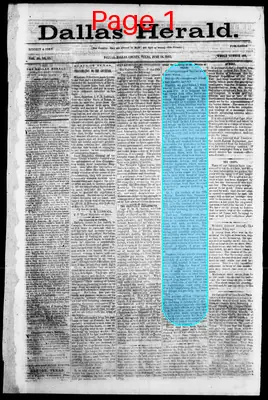
Dallas Herald
Dallas, Dallas County, Texas
What is this article about?
A Cincinnati Gazette correspondent defends Ohio troops accused of fleeing at the Battle of Shiloh, claiming units from Michigan, Iowa, Wisconsin, Illinois, and Missouri also retreated in panic on Sunday due to surprise attack, while praising the 77th Ohio's conduct on Tuesday per Gen. Sherman's report.
Clipping

OCR Quality
Full Text
A correspondent of the Cincinnati Gazette writes:
Did the Ohio troops run? It's all a base slander, isn't it?
Frankly, my good friend, I think some of them did run. In fact, I am sure of it. It so happens, too, that troops from other States ran also. Thus I happen to know that certain Michigan regiments who were brought up to support McClernand's line, when Sherman was falling back, broke in such confusion as to be utterly worthless. So I know of Iowa and Wisconsin troops, that fled in as wild panic as any. So, too, raw Illinois troops wavered and fell back. In fact, I do not know any troops on the field on Sunday that did not do some running, and there was not a few that ran quite as fast, as early, and as far as those from Ohio.
The motley crowd that thronged the bluffs and sneaked behind the river banks for protection on Sunday afternoon, were not all nor mainly Ohioans. I saw plenty of Illinoisans there, with the usual coward's story about how their regiments were cut to pieces; plenty of Missourians, Iowans, and others from the regiments which assume such special virtue about Ohio runaways. They were not Ohio officers, who swam across the Tennessee, seen in their wild dread of deadly pursuit, and Ohio regimental rolls do not contain the names of all the panic-stricken herd that drowned or narrowly escaped drowning in the same.
As to the conduct of the 77th Ohio on Tuesday, Gen. Sherman's official report just published leaves nothing to be added or subtracted. But as to the conduct of the 53d, 77th, and portions of other regiments on Sunday morning, there is a good deal to be said.
They ran. Certainly--ran, some of them without their arms, all of them in a confusion that rendered them well nigh worthless. You would have done the same. The blatant critics, who are talking about racing, and carefully neglecting to say anything about their own runaways, would have run away themselves, even had they been as brave as generals of theirs who rode coolly through tempests of grape and whirlwinds of musket balls unharmed.
Suppose you are quietly sleeping, when you are suddenly startled by the crash of a volley of musketry, and a rebel, musket in hand, rushing at you from the door of your tent. You might defend yourself, even in such sudden surprise, if your weapons were at hand and in readiness, but otherwise--I strongly suspect you would be getting out of the other side of the tent as fast as vigorous legs could carry you. Don't be complaining, then, if some raw troops did precisely the same thing.
The account of that "disgraceful running of the Ohio troops" on Sunday morning is substantially this: The men were completely surprised. Some of their officers were bayoneted in their beds; others were shot in their tents while springing up; all were under heavy fire from an enemy in their camps before they had an instant for seeking and grasping their weapons.
There may have been Spartan veterans who, under such circumstances, would have stood to be shot down, rather than "disgracefully run," but I suppose modern armies do not contain many of them.
What sub-type of article is it?
What themes does it cover?
What keywords are associated?
What entities or persons were involved?
Where did it happen?
Story Details
Key Persons
Location
Shiloh, Tennessee River
Event Date
Sunday Morning And Tuesday At Shiloh
Story Details
Correspondent refutes slander against Ohio troops for running at Shiloh on Sunday due to surprise rebel attack while sleeping, notes similar retreats by troops from other states, praises 77th Ohio on Tuesday per Sherman's report, and contextualizes panic as understandable for raw troops.