Thank you for visiting SNEWPapers!
Sign up free
Domestic News
February 6, 1809
Portland Gazette, And Maine Advertiser
Portland, Cumberland County, Maine
What is this article about?
G. W. Campbell, a duellist and pupil of Gen. Bobadill, challenges Mr. Quincy to a duel after a congressional debate, as reported in criticism of Democratic bullying tactics against Federalists in New England.
Clipping
OCR Quality
85%
Good
Full Text
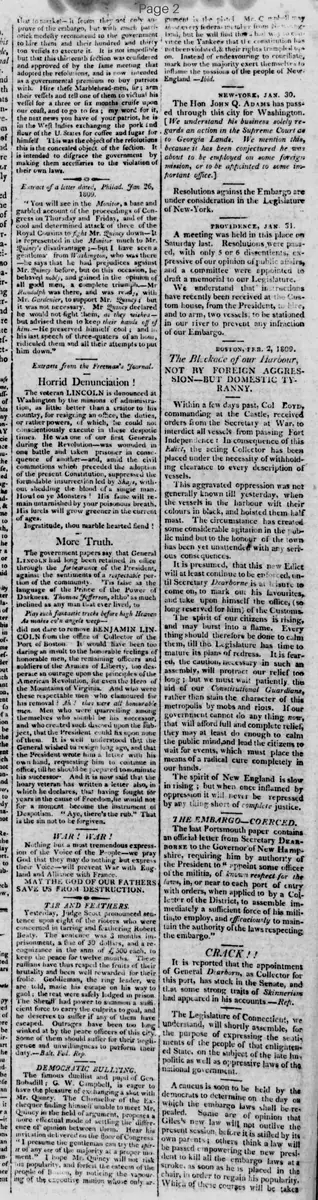
DEMOCRATIC BULLYING
The famous duellist and pupil of Gen. Bobadill, G. W. Campbell, is eager to have the pleasure of exchanging a shot with Mr. Quincy. The Chancellor of the Exchequer finding himself unable to meet Mr. Quincy in the field of argument, proposes a more effectual mode of settling the difference of opinion between them. Hear his invitation delivered on the floor of Congress.
"I presume the gentleman can try the spirit of any one of the majority at a proper moment." I hope Mr. Quincy will not risk his popularity and forfeit the esteem of the people of Boston, by noticing the vapouring of the executive minion whose only argument is the pistol. Mr. Campbell may shoot every federal member from N. to S. but he will find this a bad way to convince the Yankees that the constitution has not been violated and their rights trampled upon. Instead of endeavouring to conciliate, mark how the majority exert themselves to inflame the passions of the people of New England. -Ibid.
The famous duellist and pupil of Gen. Bobadill, G. W. Campbell, is eager to have the pleasure of exchanging a shot with Mr. Quincy. The Chancellor of the Exchequer finding himself unable to meet Mr. Quincy in the field of argument, proposes a more effectual mode of settling the difference of opinion between them. Hear his invitation delivered on the floor of Congress.
"I presume the gentleman can try the spirit of any one of the majority at a proper moment." I hope Mr. Quincy will not risk his popularity and forfeit the esteem of the people of Boston, by noticing the vapouring of the executive minion whose only argument is the pistol. Mr. Campbell may shoot every federal member from N. to S. but he will find this a bad way to convince the Yankees that the constitution has not been violated and their rights trampled upon. Instead of endeavouring to conciliate, mark how the majority exert themselves to inflame the passions of the people of New England. -Ibid.
What sub-type of article is it?
Politics
What keywords are associated?
Duel Challenge
Congressional Debate
Political Bullying
Federalist
Democratic Republicans
What entities or persons were involved?
G. W. Campbell
Mr. Quincy
Gen Bobadill
Domestic News Details
Key Persons
G. W. Campbell
Mr. Quincy
Gen Bobadill
Event Details
G. W. Campbell challenges Mr. Quincy to a duel after failing to debate him in Congress, with the invitation given on the floor: 'I presume the gentleman can try the spirit of any one of the majority at a proper moment.' The response criticizes this as Democratic bullying to inflame New England passions rather than conciliate.