Thank you for visiting SNEWPapers!
Sign up free
Alexandria Gazette
Alexandria, Alexandria County, District Of Columbia
What is this article about?
Governor Tazewell's address to the Virginia General Assembly discusses foreign and interstate relations, recommends no action on Maryland's boundary suit, critiques federal policies, addresses counterfeiting and finances, praises agricultural health, and suggests curtailing revolutionary war claims investigations. (248 characters)
Clipping
OCR Quality
Full Text
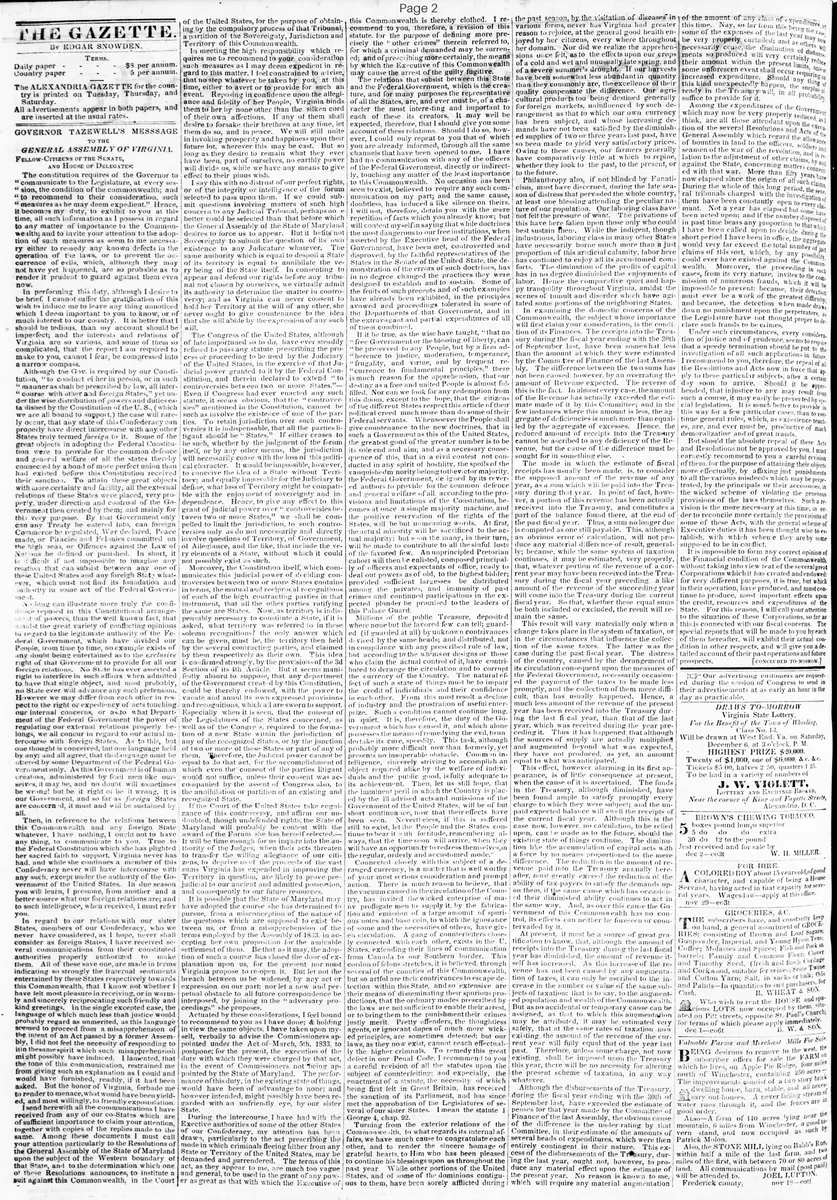
TO THE
GENERAL ASSEMBLY OF VIRGINIA.
Fellow-Citizens of the Senate, and House of Delegates:
The constitution requires of the Governor to "communicate to the Legislature, at every session, the condition of the commonwealth; and to recommend to their consideration, such measures as he may deem expedient." Hence, it becomes my duty, to exhibit to you at this time, all such information as I possess in regard to any matter of importance to the Commonwealth; and to invite your attention to the adoption of such measures as seem to me necessary either to remedy any known defects in the operation of the laws, or to prevent the occurrence of evils, which, although they may not have yet happened, are so probable as to render it prudent to guard against them even now.
In performing this duty, although I desire to be brief, I cannot suffer the gratification of this wish to induce me to leave any thing unnoticed which I deem important to you to know, or of much interest to our country. It is better that I should be tedious, than my account should be imperfect; and the interests and relations of Virginia are so various, and some of them so complicated, that the report I am required to make to you, cannot, I fear, be compressed into a narrow compass.
Although the Gov. is required by our Constitution, "to conduct either in person, or in such manner as shall be prescribed by law, all intercourse with other and foreign States," yet under the wise distribution of powers and duties established by the Constitution of the U.S., (which we are all bound to support,) the case will rarely occur, that any state of this Confederacy can properly have direct intercourse with any other States truly termed foreign to it. Some of the great objects in adopting the Federal Constitution were to provide for the common defence and general welfare of all the states thereby connected by a bond of more perfect union than had existed before this Constitution received their sanction. To attain these great objects with more certainty and facility, all the external relations of these States were placed, very properly, under direction and control of the Government then created by them; and mainly for this very purpose. By that Government only can any Treaty be entered into, can foreign Commerce be regulated, War declared, Peace made, or Piracies and Felonies committed on the high seas, or Offences against the Law of Nations be defined or punished. In short, it is difficult if not impossible to imagine any relation that can subsist between any one of these United States and any foreign State whatever, which must not find its foundation and authority in some act of the Federal Government.
Nothing can illustrate more truly the confidence reposed in this Constitutional arrangement of powers, than the well known fact, that amidst the great variety of conflicting opinions to regard to the legitimate authority of the Federal Government, which have divided our People, from time to time, no example exists of any doubt being entertained as to the exclusive right of that Government to provide for all our foreign relations. No State has ever asserted a right to interfere in such affairs when admitted to have that single object, and most probably, no State ever will advance any such pretension. However we may differ from each other in respect to the right or expediency of acts touching our internal concerns, or as to what Department of the Federal Government the power of regulating our external relations properly belongs, we all concur in regard to our actual intercourse with foreign States. As to this, but one thought is conceived, but one language held by any; and all agree, that this language must be uttered by some Department of the Federal Government only. As this Government is of human creation, administered by frail men like ourselves, it may be, and no doubt will sometimes be wrong; but be it right or be it wrong, it is our Government, and so far as foreign States are concerned, it must and will be sustained by all.
Then, in reference to the relations between this Commonwealth and any foreign State whatever, I have nothing, I ought not to have any thing, to communicate to you. True to the Federal Constitution which she has plighted her sacred faith to support, Virginia never has had, and while she continues a member of this Confederacy never will have intercourse with any such, except under the authority of the Government of the United States. In due season you will learn, I presume, from another and a better source what our foreign relations are; and to such intelligence, when received, I must refer you.
In regard to our relations with our sister States, members of our Confederacy, who we never have considered, as I hope, never shall consider as foreign States, I have received several communications from their constituted authorities properly authorized to make them. All of these save one, are made in terms indicating so strongly the fraternal sentiments entertained by these States respectively towards this Commonwealth, that I know not whether I have felt most pleasure in receiving, or in warmly and sincerely reciprocating such friendly and kind greetings. In the single excepted case, the language of which much less than justice would probably regard as unmerited, as this language seemed to proceed from a misapprehension of the intent of an Act passed by a former Assembly, I did not feel the necessity of responding to it in the same spirit which such misapprehension might possibly have induced. I lamented, that the tone of this communication, restrained me from giving such an explanation as I could and would have furnished, readily, if it had been asked. But the honor of Virginia, forbade me to render to menace, what would have been yielded, and most willingly, to friendly expostulation.
I send herewith all the communications I have received from any of our co-States which are of sufficient importance to claim your attention, together with copies of the replies made to the same. Among these documents I must call your attention particularly to the Resolutions of the General Assembly of the State of Maryland upon the subject of the Western boundary of that State, and to the determination which one of these Resolutions announces, to institute a suit against this Commonwealth, in the Court of the United States, for the purpose of obtaining by the compulsory process of that Tribunal, a partition of the Sovereignty, Jurisdiction and Territory of this Commonwealth.
In meeting the high responsibility which requires me to recommend to your consideration such measures as I may deem expedient in regard to this matter, I feel constrained to advise, that no step whatever be taken by you, at this time, either to avert or to provide for such an event. Reposing in confidence upon the allegiance and fidelity of her People, Virginia binds them to her by none other than the silken cord of their own affections. If any of them shall desire to forsake their brethren at any time, let them do so, and in peace. We will still unite in invoking prosperity and happiness upon their future lot, wherever this may be cast. But so long as they desire to remain what they ever have been, part of ourselves, no earthly power will divide us, while we have any means to give effect to their pious wish.
I say this with no distrust of our perfect rights, or of the integrity or intelligence of the forum selected to pass upon them. If we could submit questions involving matters of such high concern to any Judicial Tribunal, perhaps no better could be selected than that before which the General Assembly of the State of Maryland desires to force us to appear. But it befits not Sovereignty to submit the question of its own existence to any Judicature whatever. The same authority which is equal to despoil a State of its territory is equal to annihilate the very being of the State itself. In consenting to appear and defend our rights before any tribunal not chosen by ourselves, we virtually admit its authority to determine the matter in controversy; and as Virginia can never consent to hold her Territory at the will of any other, she never ought to give countenance to the idea that she will abide by the expression of any such will.
The Congress of the United States, although of late importuned so to do, have ever steadily refused to pass any statute prescribing the process or proceeding to be used by the Judiciary of the United States, in the exercise of that Judicial power granted to it by the Federal Constitution, and therein declared to extend "to controversies between two or more States."
Even if Congress had ever enacted any such statute, it seems obvious, that the "controversies" mentioned in the Constitution, cannot be such as involve the existence of one of the parties. To retain jurisdiction over such controversies it is indispensable, that all the parties litigant should be "States." If either ceases to be such, whether by the judgment of the forum itself, or by any other means, the jurisdiction will necessarily cease with the loss of this political character. It would be impossible, however, to conceive the idea of a State without Territory; and equally impossible for the Judiciary to define, what loss of Territory might be compatible with the enjoyment of sovereignty and independence. Hence, to give any effect to this grant of judicial power over "controversies between two or more States," we shall be compelled to limit the jurisdiction, to such controversies only as do not necessarily and directly involve questions of Territory, of Government, of Allegiance, and the like, that include the very elements of a State, without which it could not possibly exist as such.
Moreover, the Constitution itself, which communicates this judicial power of deciding controversies between two or more States contains in terms, the mutual and reciprocal recognitions of each of the high contracting parties in that instrument, that all the other parties ratifying the same are States. Now, as territory is indispensably necessary to constitute a State, if it is asked, what territory was referred to in these solemn recognitions? the only answer which can be given, must be, the territory then held by the several contracting parties, and claimed by them respectively as their own. This idea is confirmed strongly, by the provisions of the 3d Section of its 4th Article. But it seems manifestly absurd to suppose, that any department of the Government created by this Constitution, could be thereby endowed, with the power to vacate and annul its own expressed provisions and recognitions, which all are sworn to support. Especially when it is seen, that the consent of the Legislatures of the States concerned, as well as of the Congress, required to the formation of a new State within the jurisdiction of any of the recognized States, or by the junction of two or more of these States or part of any of them. Therefore, the Judicial power cannot be equal to do that act, for the accomplishment of which even the consent of the parties litigant would not suffice, unless their consent was accompanied by the assent of Congress also, to the annihilation or partition of an existing and recognized State.
If the Court of the United States take cognizance of this controversy, and affirm our undoubted, though undefended rights, the State of Maryland will probably be content with the award of the Forum she has herself selected. It will be time enough for us to inquire into the authority of the Judges, when their acts threaten to transfer the willing allegiance of our citizens, to deprive us of the proceeds of the vast sums Virginia has expended in improving the Territory in question, are likely to prove prejudicial to our ancient and admitted possession, and consequently to our future resources.
It is possible that the State of Maryland may have adopted the course she has determined to pursue, from a misconception of the nature of the questions which are supposed to exist between us, or from a misapprehension of the terms employed by the Assembly of 1833, in accepting her own proposition for the amicable settlement of them. Be that as it may, the adoption of such a course has closed the door of explanation upon us, for the present nor must Virginia propose to re-open it. But let not the breach between us be widened, by any act or expression on our part: nor let a new and perpetual obstacle to all future correspondence be interposed, by joining in the "adversary proceedings" she proposes.
Actuated by these considerations, I feel bound to recommend to you as I have done; & holding in view the same objects, I have taken upon myself, verbally to advise the Commissioners appointed under the Act of March 5th, 1833, to postpone, for the present, the execution of the duty with which they were charged by that act, in the event of Commissioners not being appointed by the State of Maryland. The performance of this duty, in the existing state of things, would have been of advantage to none: and however intended, might possibly have been regarded with an unfriendly eye, by our sister State.
During the intercourse I have had with the Executive authorities of some of the other States of our Confederacy, my attention has been drawn, particularly to the act prescribing the mode in which criminals fleeing hither from any State or Territory of the United States, may be demanded and surrendered. The terms of this act, as they appear to me, are much too vague and general, to be used in the grant of any power as great as that with which the Executive of this Commonwealth is thereby clothed. I recommend to you, therefore, a revision of this statute, for the purpose of defining more precisely the "other crimes" therein referred to, for which a criminal demanded may be surrendered; and of prescribing more certainly, the means by which the Executive of this Commonwealth may cause the arrest of the guilty fugitive.
The relations that subsist between this State and the Federal Government, which is the creature, and for many purposes the representative of all the States, are, and ever must be, of a character the most interesting and important to each of these its creators. It may well be expected, therefore, that I should give you some account of these relations. Should I do so, however, I could only repeat to you that of which you are already informed, through all the same channels that have been opened to me. I have had no communication with any of the officers of the Federal Government, directly or indirectly, touching any matter of the least importance to this Commonwealth. No occasion has been seen to exist, believed to require any such communication on my part; and the same cause, doubtless, has induced a like silence on theirs.
I will not, therefore, detain you with the mere repetition of facts which you already know; but will content myself in saying that while doctrines the most dangerous to our free institutions, when asserted by the Executive head of the Federal Government, have been met, controverted and disproved, by the faithful representatives of the States in the Senate of the United States, the demonstration of the errors of such doctrines, has in no degree changed the practices they were designed to establish and to sustain. Some of the fruits of such precepts and of such examples have already been exhibited, in the principles avowed and proceedings tolerated in some of the Departments of that Government, and in the extravagant and partial expenditures of all of them combined.
If it be true, as the wise have taught, "that no free Government or the blessing of liberty, can be preserved to any People, but by a firm adherence to justice, moderation, temperance, frugality, and virtue, and by frequent recurrence to fundamental principles," there is much reason for the apprehension, that our destiny as a free and united People is almost fulfilled. Nor can we look for any redemption from this doom, except to the hope, that the citizens of the different States respect this article of their political creed much more than do some of their Federal servants. Whensoever the People shall give countenance to the new doctrines, that in such a Government as this of the United States, the greatest good of the greater number is to be its sole end and aim; and as a necessary consequence of this, that in a civil contest not conducted in any spirit of hostility, the spoils of the vanquished minority belong to the victor majority, the Federal Government, designed by its revered authors to provide for the common defence and general welfare of all, according to the provisions and limitations of the Constitution, becomes at once a simple majority machine, and the positive reservation of the rights of the States, will be but unmeaning words. At first the actual minority will be sacrificed to the actual majority: but soon the many, in their turn, will be made to contribute to all the sinful lusts of the favored few. An unprincipled Pretorian cohort will then be enlisted, composed principally of officers and expectants of office, ready to deal out powers as of old, to the highest bidder: provided sufficient largesses be distributed among the privates, and immunity of past crimes and continued participations in the expected plunder be promised to the leaders of this Palace Guard.
Millions of the public Treasure, deposited where none but the favored few can tell; guarded (if guarded at all) by unknown contrivances devised by the same heads; and distributed, not in compliance with any prescribed rule of law, but according to the whims or designs of those who claim the actual control of it, have contributed to derange the circulation and to corrupt the currency of the Country. The natural effect of such a state of things must be to impair the credit of individuals and their confidence in each other. From this must result a decline of industry and the prostration of useful enterprise. Such a condition cannot continue long, in quiet. It is, therefore, the duty of the Government which has caused it, and which alone possesses the means of remedying the evil, to undertake its cure, speedily. This task, although probably more difficult now than formerly, yet presents no insuperable obstacle. Common intelligence, sincerely striving to accomplish an object required alike by the welfare of individuals and the public good, is fully adequate to its achievement. Then, let us still hope, that the imminent peril in which the Country is placed by the ill advised acts and omissions of the Government of the United States, will be of but short continuance, now that their effects have been seen. Nevertheless, if this is suffered still to exist, let the People and the States continue to bear it with fortitude, remembering always, that the time soon will arrive, when they will have an opportunity to redress themselves, in the regular, orderly and accustomed mode.
Connected closely with this subject of a deranged currency, is a matter that is well worthy of your most serious consideration and prompt action. There is much reason to believe, that the vacuum caused in the circulation of the Country, has invited the wicked enterprise of many profligate men to supply it, by the fabrication and emission of a large amount of spurious notes and base coin, to which the ignorance of some and the necessities of others, have given circulation. A gang of counterfeiters closely connected with each other, exists in the U. States, extending their lines of communication from Canada to our Southern border. This cordon of felons stretches, it is believed, through several of the counties of this Commonwealth, but so artful are their contrivances to escape detection within this State, and so extensive are their means of disseminating their spurious productions, that the ordinary modes prescribed by the laws are not sufficient to enable their arrest, or to bring them to the punishment their crimes justly merit. Petty offenders, the thoughtless agents, or ignorant dupes of much more wicked principals, are sometimes detected: but our laws, as they now exist, cannot reach effectually the higher criminals. To remedy this great defect in our Penal Code, I recommend to you a careful revision of all the statutes upon the subject of counterfeiting; and especially, the enactment of a statute, the necessity of which being first felt in Great Britain, has received the sanction of its Parliament, and has since met the approbation of the Legislatures of several of our sister States. I mean the statute 1 George 4, chap. 92.
Turning from the exterior relations of the Commonwealth, to what regards its internal affairs, we have much cause to congratulate each other, and to render the sincere homage of grateful hearts, to Him who has been pleased to continue his blessings upon us throughout the past year. While other portions of the United States, and of some of the dominions contiguous to them, have been sorely afflicted during the past season, by the visitation of diseases in various forms, never has Virginia had greater reason to rejoice, at the general good health enjoyed by her citizens, every where throughout her domain. Nor did we realize the apprehensions once felt, as to the effects upon our crops of a cold and wet and unusually late spring, and of a severe summer's drought. If our harvests have been somewhat less abundant in quantity than they commonly are, the excellence of their quality compensate the difference. Our agricultural products too being destined generally for foreign markets, uninfluenced by such derangement as that to which our own currency has been subject, and whose increasing demands have not been satisfied by the diminished supplies of two or three years last past, have so been made to yield very satisfactory prices. Owing to these causes, our farmers generally have comparatively little at which to repine, whether they look to the past, to the present, or to the future.
Philanthropy also, if not blinded by Fanaticism, must have discerned, during the late season of distress that pervaded the whole country, at least one blessing attending the peculiar nature of our population. Our laboring class have not felt the pressure of want. The privations of this have here fallen upon those only who could best sustain them. While the indigent, though industrious, laboring class in many other States have necessarily borne much more than a just proportion of this artificial calamity, labor here has continued to enjoy all its accustomed comforts. The diminution of the profits of capital has in no degree diminished the enjoyments of labor. Hence the comparative quiet and happy tranquility throughout Virginia, amidst the scenes of tumult and disorder which have agitated some portions of the neighboring States.
In examining the domestic concerns of the Commonwealth, the subject whose importance will first claim your consideration, is the condition of its Finances. The receipts into the Treasury during the fiscal year ending with the 30th of September last, have been somewhat less than the amount at which they were estimated by the Committee of Finance of the last Assembly. The difference between the two sums has not been caused, however, by an overrating the amount of Revenue expected. The reverse of this is the fact. In almost every case, the amount of the Revenue has actually exceeded the estimate made of it by this Committee; and in the few instances where this amount is less, the aggregate of deficiencies is much more than equalled by the aggregate of excesses. Hence, the reduced amount of receipts into the Treasury cannot be ascribed to any deficiency of the Revenue, but the cause of the difference must be sought for in something else.
The mode in which the estimate of fiscal receipts has usually been made, is, to consider the supposed amount of the revenue of any year, as a sum which will be paid into the Treasury during that year. In point of fact, however, a portion of this revenue has been actually received into the Treasury, and constitutes a part of the balance found there, at the end of the past fiscal year. Thus, a sum no longer due is computed as one still payable. This, although an obvious error of calculation, will not produce any material difference of result, generally; because, while the same system of taxation continues, it may be estimated, very properly, that, whatever portion of the revenue of a current year may have been received into the Treasury during the fiscal year preceding, a like amount of the revenue of the succeeding year will come into the Treasury during the current fiscal year. So that, whether these equal sums be both included or excluded, the result will remain the same.
This result will vary materially only when a change takes place in the system of taxation, or in the circumstances that influence the collection of the same taxes. The latter was the case during the past fiscal year. The distress of the country, caused by the derangement of its circulation consequent upon the measures of the Federal Government, necessarily occasioned the payment of the taxes to be made less promptly, and the collection of them more difficult, than has usually happened. Hence, a much less amount of the revenue of the present year has been received into the Treasury during the last fiscal year, than that of the last year, which was received during the year preceding it. Thus it has happened, that although the sources of supply are actually multiplied and augmented beyond what was expected, they have not produced, as yet, an amount equal to what was anticipated.
This effect, however alarming in its first appearance, is of little consequence at present, when the cause of it is ascertained. The funds in the Treasury, although diminished, have been found ample to satisfy promptly every charge to which they were subject; and the unpaid expected balance will swell the receipts of the current fiscal year. Although this is the case now, however, no calculation, to be relied upon, can be made as to the future, should the existing state of things continue. The diminution like the accumulation of capital acts with a force by no means proportioned to the mere difference. The reduction in the amount of revenue paid into the Treasury annually hereafter, must greatly exceed the reduction of the ability of tax-payers to satisfy the demands upon them, if the same cause which has occasioned their diminished ability continues to act in the same way. And, as over this cause the Government of this Commonwealth has no control, its effects can neither be foreseen or countervailed by it.
At present, it must be a source of great gratification to know, that, although the amount of receipts into the Treasury during the last fiscal year has diminished, the amount of revenue itself has increased. As this increase of the revenue has not been caused by any augmentation of taxes, it can only be ascribed to the increase in the number or value of the same subjects of taxation: that is to say, to the augmented population and wealth of the Commonwealth. But as no accidental or temporary cause can be assigned, as that to which this augmentation may be attributed, it may be estimated very safely, that at the same rates of taxation now existing, the amount of the revenue of the current year will fully equal that of the year last past. Therefore, unless some charge, not now existing, shall be imposed upon the Treasury this year, there will be no necessity for altering the present scheme of taxation, in any way whatever.
Although the disbursements of the Treasury, during the fiscal year ending with the 30th of September last, have exceeded the estimate of expenses for that year made by the Committee of Finance of the last Assembly, the obvious cause of the difference is the under rating by that Committee, in their estimate of the amounts of several heads of expenditures, which were then entirely contingent in their nature. This excess of the disbursements of the Treasury, during the last year, ought not, however, to produce any material effect upon the estimate of the present year. No reason is known to me, which will require any material augmentation of the amount of any claim of expenditures at this time. Nay, the expenditures may be very properly curtailed; and as others yield their amount unless some unforeseen event occur requiring expenditure. Should any of this kind unexpectedly happen, the surplus already in the Treasury will provide for it.
Among the expenditures of the Government which I think may be very properly curtailed, are all those now attendant upon the investigation by the Assembly of several land warrants which the Resolutions and Acts in regard to the officers and the soldiers of the revolution and other matters claims and connected by in and re against the State adjustment concerning of the of revolution other matters claims and connect by in and re now elapsed that whole since war of the More this origin long than of period fifty all such years the claims seve have tribunals been charged constantly with the open investigation to every clai- of Not year has elapsed but some have acted upon and if the number disposed of period time been bears I called have any been upon proportion in to office decide the to during that aggregate which the the would very far exceed the total number of just claims of this sort, which, by any possibility could ever have existed against the Commonwealth.
Moreover, the proceeding in such cases, from its very nature, invites to the commission of numerous frauds, which it will be impossible to prevent: because, their detection must ever be a work of the greatest difficulty and because, the detection when made draws down no punishment upon the perpetrators, as the Legislature have not thought proper to declare such frauds to be crimes.
Under such circumstances, every consideration of justice and of prudence, seems to require that a speedy termination should be put to the investigation of all such applications in future. I recommend to you, therefore, the repeal of all the Resolutions and Acts now in force that apply to these particular subjects, after a certain day soon to arrive. Should it be apprehended, that injustice to any may result from such a course, it may easily be prevented by special legislation. It is much better to provide in this way for a few particular cases, than to continue general rules, which, as experience teaches, are, and ever must be, productive of much demoralization and of great frauds.
But should the absolute repeal of these Acts and Resolutions not be approved by you, I must earnestly recommend to you a careful revision of them, for the purpose of attaining their objects more effectually, by affixing just punishments to all the various misdeeds which may be perpetrated, by the principals or their accessories, in the wicked scheme of violating the generous provisions of the laws themselves. Such a revision is the more necessary at this time, in order to reconcile more certainly the provisions of some of these Acts, with the general scheme of Executive duties it has been thought wise to establish, with which scheme they are by some supposed to be in conflict.
It is impossible to form any correct opinion of the Financial condition of the Commonwealth, without taking into view that of the several great Corporations which it has created and endowed: for very different purposes, it is true, but which in their operation, have produced, and must continue to produce, most important effects upon the credit, resources and expenditures of the State. For this reason, I will call your attention to the situation of these Corporations, so far as this is connected with our fiscal concerns. The special reports that will be made to you by each of them hereafter, will exhibit their actual condition in other respects, and will give you a detailed account of their past operations and future prospects.
[CONCLUDED TO-MORROW.]
What sub-type of article is it?
What keywords are associated?
What entities or persons were involved?
Where did it happen?
Story Details
Key Persons
Location
Virginia
Event Date
1833 1834
Story Details
Governor Tazewell addresses the Virginia legislature on constitutional duties, foreign and interstate relations emphasizing federal authority, recommends against engaging in Maryland's boundary suit, critiques federal economic policies and currency issues, urges revisions to counterfeiting and fugitive criminal laws, reports on healthy finances and agriculture, and suggests ending investigations into revolutionary war claims to prevent fraud.