Thank you for visiting SNEWPapers!
Sign up free
Editorial
March 17, 1806
Norfolk Gazette And Publick Ledger
Norfolk, Virginia
What is this article about?
The Publick Ledger editorial analyzes intelligence from France confirming Napoleon's victories over Austria, lamenting the threat to European independence and praising Austria's resistance. It criticizes French domination while expressing sympathy for liberty, and notes a British-Russian expedition to Naples amid sparse French reports.
Clipping
OCR Quality
98%
Excellent
Full Text
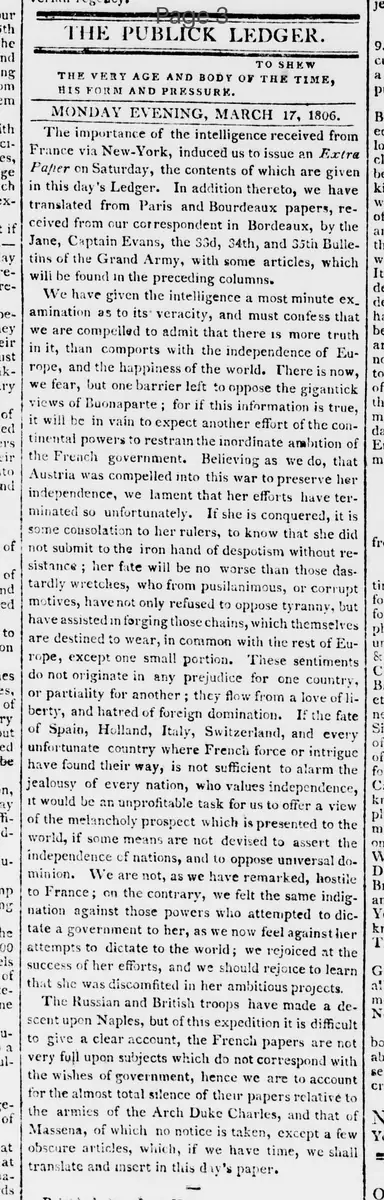
THE PUBLICK LEDGER.
TO SHEW THE VERY AGE AND BODY OF THE TIME, HIS FORM AND PRESSURE.
MONDAY EVENING, MARCH 17, 1806.
The importance of the intelligence received from France via New-York, induced us to issue an Extra Paper on Saturday, the contents of which are given in this day's Ledger. In addition thereto, we have translated from Paris and Bourdeaux papers, received from our correspondent in Bordeaux, by the Jane, Captain Evans, the 33d, 34th, and 35th Bulletins of the Grand Army, with some articles, which will be found in the preceding columns.
We have given the intelligence a most minute examination as to its veracity, and must confess that we are compelled to admit that there is more truth in it, than comports with the independence of Europe, and the happiness of the world. There is now, we fear, but one barrier left to oppose the gigantick views of Buonaparte; for if this information is true, it will be in vain to expect another effort of the continental powers to restrain the inordinate ambition of the French government. Believing as we do, that Austria was compelled into this war to preserve her independence, we lament that her efforts have terminated so unfortunately. If she is conquered, it is some consolation to her rulers, to know that she did not submit to the iron hand of despotism without resistance; her fate will be no worse than those dastardly wretches, who from pusillanimous, or corrupt motives, have not only refused to oppose tyranny, but have assisted in forging those chains, which themselves are destined to wear, in common with the rest of Europe, except one small portion. These sentiments do not originate in any prejudice for one country, or partiality for another; they flow from a love of liberty, and hatred of foreign domination. If the fate of Spain, Holland, Italy, Switzerland, and every unfortunate country where French force or intrigue have found their way, is not sufficient to alarm the jealousy of every nation, who values independence, it would be an unprofitable task for us to offer a view of the melancholy prospect which is presented to the world, if some means are not devised to assert the independence of nations, and to oppose universal dominion. We are not, as we have remarked, hostile to France; on the contrary, we felt the same indignation against those powers who attempted to dictate a government to her, as we now feel against her attempts to dictate to the world; we rejoiced at the success of her efforts, and we should rejoice to learn that she was discomfited in her ambitious projects.
The Russian and British troops have made a descent upon Naples, but of this expedition it is difficult to give a clear account, the French papers are not very full upon subjects which do not correspond with the wishes of government, hence we are to account for the almost total silence of their papers relative to the armies of the Arch Duke Charles, and that of Massena, of which no notice is taken, except a few obscure articles, which, if we have time, we shall translate and insert in this day's paper.
TO SHEW THE VERY AGE AND BODY OF THE TIME, HIS FORM AND PRESSURE.
MONDAY EVENING, MARCH 17, 1806.
The importance of the intelligence received from France via New-York, induced us to issue an Extra Paper on Saturday, the contents of which are given in this day's Ledger. In addition thereto, we have translated from Paris and Bourdeaux papers, received from our correspondent in Bordeaux, by the Jane, Captain Evans, the 33d, 34th, and 35th Bulletins of the Grand Army, with some articles, which will be found in the preceding columns.
We have given the intelligence a most minute examination as to its veracity, and must confess that we are compelled to admit that there is more truth in it, than comports with the independence of Europe, and the happiness of the world. There is now, we fear, but one barrier left to oppose the gigantick views of Buonaparte; for if this information is true, it will be in vain to expect another effort of the continental powers to restrain the inordinate ambition of the French government. Believing as we do, that Austria was compelled into this war to preserve her independence, we lament that her efforts have terminated so unfortunately. If she is conquered, it is some consolation to her rulers, to know that she did not submit to the iron hand of despotism without resistance; her fate will be no worse than those dastardly wretches, who from pusillanimous, or corrupt motives, have not only refused to oppose tyranny, but have assisted in forging those chains, which themselves are destined to wear, in common with the rest of Europe, except one small portion. These sentiments do not originate in any prejudice for one country, or partiality for another; they flow from a love of liberty, and hatred of foreign domination. If the fate of Spain, Holland, Italy, Switzerland, and every unfortunate country where French force or intrigue have found their way, is not sufficient to alarm the jealousy of every nation, who values independence, it would be an unprofitable task for us to offer a view of the melancholy prospect which is presented to the world, if some means are not devised to assert the independence of nations, and to oppose universal dominion. We are not, as we have remarked, hostile to France; on the contrary, we felt the same indignation against those powers who attempted to dictate a government to her, as we now feel against her attempts to dictate to the world; we rejoiced at the success of her efforts, and we should rejoice to learn that she was discomfited in her ambitious projects.
The Russian and British troops have made a descent upon Naples, but of this expedition it is difficult to give a clear account, the French papers are not very full upon subjects which do not correspond with the wishes of government, hence we are to account for the almost total silence of their papers relative to the armies of the Arch Duke Charles, and that of Massena, of which no notice is taken, except a few obscure articles, which, if we have time, we shall translate and insert in this day's paper.
What sub-type of article is it?
Foreign Affairs
War Or Peace
Imperialism
What keywords are associated?
Napoleon
Buonaparte
European Independence
French Ambition
Austria War
Naples Expedition
Continental Powers
What entities or persons were involved?
Buonaparte
Austria
France
Russia
Britain
Naples
Arch Duke Charles
Massena
Spain
Holland
Italy
Switzerland
Editorial Details
Primary Topic
Napoleon's Conquests And Threat To European Independence
Stance / Tone
Anti French Domination, Pro Liberty And Resistance
Key Figures
Buonaparte
Austria
France
Russia
Britain
Naples
Arch Duke Charles
Massena
Spain
Holland
Italy
Switzerland
Key Arguments
Intelligence From France Confirms Napoleon's Victories, Threatening European Independence.
Only One Barrier Remains Against Buonaparte's Ambitions.
Continental Powers Unlikely To Resist Further If Information Is True.
Austria Fought To Preserve Independence And Resisted Despotism.
Conquered Nations Like Spain, Holland, Italy, Switzerland Warn Of French Domination.
Sentiments Stem From Love Of Liberty And Hatred Of Foreign Rule.
Not Hostile To France But Oppose Her Dictating To The World.
British Russian Descent On Naples Reported, But French Papers Silent On Unfavorable Topics.