Thank you for visiting SNEWPapers!
Sign up free
Danbury Times
Danbury, Fairfield County, Connecticut
What is this article about?
Excerpt from Horace Mann's latest Annual Report to Massachusetts Board of Education criticizes intellectual neglect of factory children under 15, despite 1836 law requiring three months schooling. Warns of long-term societal retribution if education is ignored.
Clipping
OCR Quality
Full Text
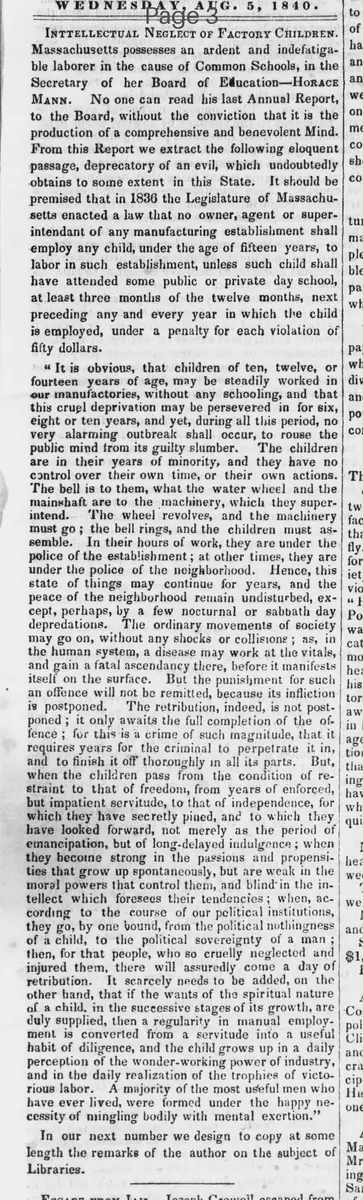
Massachusetts possesses an ardent and indefatigable laborer in the cause of Common Schools, in the Secretary of her Board of Education—Horace Mann. No one can read his last Annual Report, to the Board, without the conviction that it is the production of a comprehensive and benevolent Mind.
From this Report we extract the following eloquent passage, deprecatory of an evil, which undoubtedly obtains to some extent in this State. It should be premised that in 1836 the Legislature of Massachusetts enacted a law that no owner, agent or superintendent of any manufacturing establishment shall employ any child, under the age of fifteen years, to labor in such establishment, unless such child shall have attended some public or private day school, at least three months of the twelve months, next preceding any and every year in which the child is employed, under a penalty for each violation of fifty dollars.
"It is obvious, that children of ten, twelve, or fourteen years of age, may be steadily worked in our manufactories, without any schooling, and that this cruel deprivation may be persevered in for six, eight or ten years, and yet, during all this period, no very alarming outbreak shall occur, to rouse the public mind from its guilty slumber. The children are in their years of minority, and they have no control over their own time, or their own actions. The bell is to them, what the water wheel and the mainshaft are to the machinery, which they superintend. The wheel revolves, and the machinery must go; the bell rings, and the children must assemble. In their hours of work, they are under the police of the establishment; at other times, they are under the police of the neighborhood. Hence, this state of things may continue for years, and the peace of the neighborhood remain undisturbed, except, perhaps, by a few nocturnal or sabbath day depredations. The ordinary movements of society may go on, without any shocks or collisions; as, in the human system, a disease may work at the vitals, and gain a fatal ascendancy there, before it manifests itself on the surface. But the punishment for such an offence will not be remitted, because its infliction is postponed. The retribution, indeed, is not postponed; it only awaits the full completion of the offence; or this is a crime of such magnitude, that it requires years for the criminal to perpetrate it in, and to finish it off thoroughly in all its parts. But, when the children pass from the condition of restraint to that of freedom, from years of enforced but impatient servitude, to that of independence, for which they have secretly pined, and to which they have looked forward, not merely as the period of emancipation, but of long-delayed indulgence; when they become strong in the passions and propensities that grow up spontaneously, but are weak in the moral powers that control them, and blind in the intellect which foresees their tendencies; when, according to the course of our political institutions, they go, by one bound, from the political nothingness of a child, to the political sovereignty of a man; then, for that people, who so cruelly neglected and injured them, there will assuredly come a day of retribution. It scarcely needs to be added, on the other hand, that if the wants of the spiritual nature of a child, in the successive stages of its growth, are duly supplied, then a regularity in manual employment is converted from a servitude into a useful habit of diligence, and the child grows up in a daily perception of the wonder-working power of industry, and in the daily realization of the trophies of victorious labor. A majority of the most useful men who have ever lived, were formed under the happy necessity of mingling bodily with mental exertion."
In our next number we design to copy at some length the remarks of the author on the subject of Libraries.
What sub-type of article is it?
What keywords are associated?
What entities or persons were involved?
Where did it happen?
Domestic News Details
Primary Location
Massachusetts
Event Date
1836
Key Persons
Outcome
potential long-term societal retribution for neglecting child education; benefits of combining manual labor with schooling for character development.
Event Details
Horace Mann's Annual Report highlights intellectual neglect of factory children aged 10-14 despite 1836 Massachusetts law requiring three months annual schooling for those under 15 employed in manufacturing, with $50 penalty for violations. Passage warns of hidden societal harm leading to future retribution upon children's adulthood.