Thank you for visiting SNEWPapers!
Sign up free
Editorial
June 17, 1924
Atlanta Tri Weekly Journal
Atlanta, Fulton County, Georgia
What is this article about?
Dr. Frank Crane critiques how reform movements and institutions inevitably produce 'Pharisees'—rigid professionals who prioritize minutiae over substance. He prefers youthful creativity and direct engagement with art, religion, and life over academic criticism and aged bureaucracy, using examples from literature, university lectures, and religious figures.
Clipping
OCR Quality
98%
Excellent
Full Text
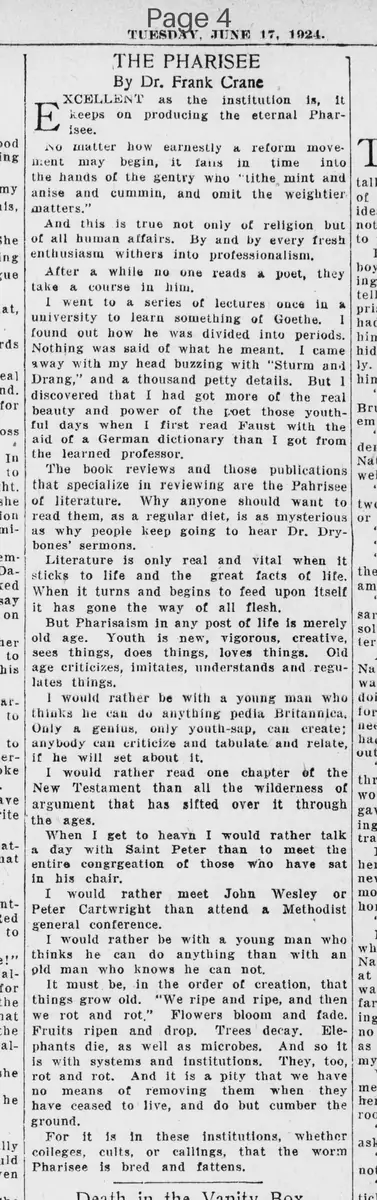
TUESDAY, JUNE 17, 1924.
THE PHARISEE
By Dr. Frank Crane
Excellent as the institution is, it keeps on producing the eternal Pharisee.
No matter how earnestly a reform movement may begin, it falls in time into the hands of the gentry who tithe mint and anise and cummin, and omit the weightier matters.
And this is true not only of religion but of all human affairs. By and by every fresh enthusiasm withers into professionalism.
After a while no one reads a poet, they take a course in him.
I went to a series of lectures once in a university to learn something of Goethe. I found out how he was divided into periods. Nothing was said of what he meant. I came away with my head buzzing with "Sturm und Drang," and a thousand petty details. But I discovered that I had got more of the real beauty and power of the poet those youthful days when I first read Faust with the aid of a German dictionary than I got from the learned professor.
The book reviews and those publications that specialize in reviewing are the Pharisees of literature. Why anyone should want to read them, as a regular diet, is as mysterious as why people keep going to hear Dr. Drybones' sermons.
Literature is only real and vital when it sticks to life and the great facts of life. When it turns and begins to feed upon itself it has gone the way of all flesh.
But Pharisaism in any post of life is merely old age. Youth is new, vigorous, creative, sees things, does things, loves things. Old age criticizes, imitates, understands and regulates things.
I would rather be with a young man who thinks he can do anything than with an old man who knows he can not.
Only a genius, only youth-sap, can create; anybody can criticize and tabulate and relate, if he will set about it.
I would rather read one chapter of the New Testament than all the wilderness of argument that has sifted over it through the ages.
When I get to heaven I would rather talk a day with Saint Peter than to meet the entire congregation of those who have sat in his chair.
I would rather meet John Wesley or Peter Cartwright than attend a Methodist general conference.
I would rather be with a young man who thinks he can do anything than with an old man who knows he can not.
It must be, in the order of creation, that things grow old. "We ripe and ripe, and then we rot and rot." Flowers bloom and fade. Fruits ripen and drop. Trees decay. Elephants die, as well as microbes. And so it is with systems and institutions. They, too, rot and rot. And it is a pity that we have no means of removing them when they have ceased to live, and do but cumber the ground.
For it is in these institutions, whether colleges, cults, or callings, that the worn-out Pharisee is bred and fattens.
THE PHARISEE
By Dr. Frank Crane
Excellent as the institution is, it keeps on producing the eternal Pharisee.
No matter how earnestly a reform movement may begin, it falls in time into the hands of the gentry who tithe mint and anise and cummin, and omit the weightier matters.
And this is true not only of religion but of all human affairs. By and by every fresh enthusiasm withers into professionalism.
After a while no one reads a poet, they take a course in him.
I went to a series of lectures once in a university to learn something of Goethe. I found out how he was divided into periods. Nothing was said of what he meant. I came away with my head buzzing with "Sturm und Drang," and a thousand petty details. But I discovered that I had got more of the real beauty and power of the poet those youthful days when I first read Faust with the aid of a German dictionary than I got from the learned professor.
The book reviews and those publications that specialize in reviewing are the Pharisees of literature. Why anyone should want to read them, as a regular diet, is as mysterious as why people keep going to hear Dr. Drybones' sermons.
Literature is only real and vital when it sticks to life and the great facts of life. When it turns and begins to feed upon itself it has gone the way of all flesh.
But Pharisaism in any post of life is merely old age. Youth is new, vigorous, creative, sees things, does things, loves things. Old age criticizes, imitates, understands and regulates things.
I would rather be with a young man who thinks he can do anything than with an old man who knows he can not.
Only a genius, only youth-sap, can create; anybody can criticize and tabulate and relate, if he will set about it.
I would rather read one chapter of the New Testament than all the wilderness of argument that has sifted over it through the ages.
When I get to heaven I would rather talk a day with Saint Peter than to meet the entire congregation of those who have sat in his chair.
I would rather meet John Wesley or Peter Cartwright than attend a Methodist general conference.
I would rather be with a young man who thinks he can do anything than with an old man who knows he can not.
It must be, in the order of creation, that things grow old. "We ripe and ripe, and then we rot and rot." Flowers bloom and fade. Fruits ripen and drop. Trees decay. Elephants die, as well as microbes. And so it is with systems and institutions. They, too, rot and rot. And it is a pity that we have no means of removing them when they have ceased to live, and do but cumber the ground.
For it is in these institutions, whether colleges, cults, or callings, that the worn-out Pharisee is bred and fattens.
What sub-type of article is it?
Moral Or Religious
Social Reform
What keywords are associated?
Pharisaism
Reform Movements
Professionalism
Youth Vs Old Age
Institutions
Creativity
Direct Experience
What entities or persons were involved?
Dr. Frank Crane
Goethe
Saint Peter
John Wesley
Peter Cartwright
Dr. Drybones
Editorial Details
Primary Topic
Critique Of Pharisaism In Institutions And Reform Movements
Stance / Tone
Critical Of Professionalism And Institutional Decay, Favoring Youth And Direct Experience
Key Figures
Dr. Frank Crane
Goethe
Saint Peter
John Wesley
Peter Cartwright
Dr. Drybones
Key Arguments
Institutions Produce Pharisees Who Focus On Minutiae Over Essentials
Reform Movements Start Earnestly But Become Professionalized
Direct Youthful Engagement With Literature And Religion Is Superior To Academic Analysis
Youth Creates While Old Age Criticizes
Institutions Inevitably Decay Like All Living Things