Thank you for visiting SNEWPapers!
Sign up free
The Silver Messenger
Challis, Custer County, Idaho
What is this article about?
Theodore Durrant is found guilty of first-degree murder in the killing of Blanche Lamont at Emmanuel Baptist Church after a four-month trial. The jury deliberates only 25 minutes, leading to immediate sentencing implications. The verdict creates intense courtroom drama involving Durrant's family and spectators.
Clipping
OCR Quality
Full Text
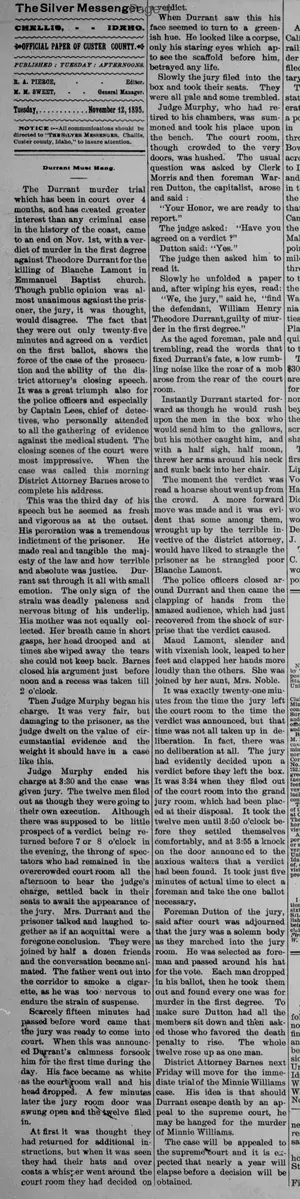
The Durrant murder trial which has been in court over 4 months, and has created greater interest than any criminal case in the history of the coast, came to an end on Nov. 1st, with a verdict of murder in the first degree against Theodore Durrant for the killing of Blanche Lamont in Emmanuel Baptist church.
Though public opinion was almost unanimous against the prisoner, the jury, it was thought, would disagree. The fact that they were out only twenty-five minutes and agreed on a verdict on the first ballot, shows the force of the case of the prosecution and the ability of the district attorney's closing speech.
It was a great triumph also for the police officers and especially by Captain Lees, chief of detectives, who personally attended to all the gathering of evidence against the medical student. The closing scenes of the court were most impressive. When the case was called this morning District Attorney Barnes arose to complete his address.
This was the third day of his speech but he seemed as fresh and vigorous as at the outset. His peroration was a tremendous indictment of the prisoner. He made real and tangible the majesty of the law and how terrible and absolute was justice. Durrant sat through it all with small emotion. The only sign of the strain was deadly paleness and nervous biting of his underlip.
His mother was not equally collected. Her breath came in short gasps, her head drooped and at times she wiped away the tears she could not keep back. Barnes closed his argument just before noon and a recess was taken till 2 o'clock.
Then Judge Murphy began his charge. It was very fair, but damaging to the prisoner, as the judge dwelt on the value of circumstantial evidence and the weight it should have in a case like this.
Judge Murphy ended his charge at 3:30 and the case was given jury. The twelve men filed out as though they were going to their own execution. Although there was supposed to be little prospect of a verdict being returned before 7 or 8 o'clock in the evening, the throng of spectators who had remained in the overcrowded court room all the afternoon to hear the judge's charge, settled back in their seats to await the appearance of the jury. Mrs. Durrant and the prisoner talked and laughed together as if an acquittal were a foregone conclusion. They were joined by half a dozen friends and the conversation became animated. The father went out into the corridor to smoke a cigarette, as he was too nervous to endure the strain of suspense.
Scarcely fifteen minutes had passed before word came that the jury was ready to come into court. When this was announced Durrant's calmness forsook him for the first time during the day. His face became as white as the courtroom wall and his head dropped. A few minutes later the jury room door was swung open and the twelve filed in.
At first it was thought they had returned for additional instructions, but when it was seen they had their hats and overcoats a whisper went around the court room they had decided on a verdict.
When Durrant saw this his face seemed to turn to a greenish hue. He looked like a corpse, only his staring eyes which appeared to see the scaffold before him, betrayed any life.
Slowly the jury filed into the box and took their seats. They were all pale and some trembled. Judge Murphy, who had retired to his chambers, was summoned and took his place upon the bench.
The court room, though crowded to the very doors, was hushed. The usual question was asked by Clerk Morris and then foreman Warren Dutton, the capitalist, arose and said: "Your Honor, we are ready to report."
The judge asked: "Have you agreed on a verdict?" Dutton said: "Yes." The judge then asked him to read it.
Slowly he unfolded a paper and, after wiping his eyes, read: "We, the jury," said he, "find the defendant, William Henry Theodore Durrant, guilty of murder in the first degree."
As the aged foreman, pale and trembling, read the words that fixed Durrant's fate, a low rumbling noise like the roar of a mob arose from the rear of the court room.
Instantly Durrant started forward as though he would rush upon the men in the box who would send him to the gallows, but his mother caught him, and with a half sigh, half moan, threw her arms around his neck and sunk back into her chair.
The moment the verdict was read a hoarse shout went up from the crowd. A more forward move was made and it was evident that some among them, wrought up by the terrible invective of the district attorney, would have liked to strangle the prisoner as he strangled poor Blanche Lamont.
The police officers closed around Durrant and then came the clapping of hands from the amazed audience, which had just recovered from the shock of surprise that the verdict caused. Maud Lamont, slender and with vixenish look, leaped to her feet and clapped her hands more loudly than the others. She was joined by her aunt, Mrs. Noble.
It was exactly twenty-one minutes from the time the jury left the court room to the time the verdict was announced, but that time was not all taken up in deliberation. In fact, there was no deliberation at all. The jury had evidently decided upon a verdict before they left the box.
It was 3:34 when they filed out of the court room into the grand jury room, which had been placed at their disposal. It took the twelve men until 3:50 o'clock before they settled themselves comfortably, and at 3:55 a knock on the door announced to the anxious waiters that a verdict had been found. It took just five minutes of actual time to elect a foreman and take the one ballot necessary.
Foreman Dutton of the jury, said after court was adjourned that the jury was a solemn body as they marched into the jury room. He was selected as foreman and passed around his hat for the vote. Each man dropped in his ballot, then he took them out and found every one was for murder in the first degree. To make sure Dutton had all the members sit down and then asked those who favored the death penalty to rise. The whole twelve rose up as one man.
District Attorney Barnes next Friday will move for the immediate trial of the Minnie Williams case. His idea is that should Durrant escape death by an appeal to the supreme court, he may be hanged for the murder of Minnie Williams.
The case will be appealed to the supreme court and it is expected that nearly a year will elapse before a decision will be obtained.
What sub-type of article is it?
What themes does it cover?
What keywords are associated?
What entities or persons were involved?
Where did it happen?
Story Details
Key Persons
Location
Emmanuel Baptist Church, Court Room
Event Date
Nov. 1st
Story Details
After a four-month trial, Theodore Durrant is convicted of first-degree murder for killing Blanche Lamont in Emmanuel Baptist Church. The jury returns a unanimous guilty verdict after minimal deliberation, amid dramatic courtroom scenes involving Durrant's family and spectators. Plans for appeal and another trial mentioned.