Thank you for visiting SNEWPapers!
Sign up free
The Daily Phoenix
Columbia, Richland County, South Carolina
What is this article about?
Testimonies before the Reconstruction Committee describe persistent bitter anti-Union sentiments in Florida post-Civil War, with witnesses J. A. Meeks, Wm. Marvin, and Rev. L. M. Hobbs noting deceitful locals, need for military protection, and increasing treasonous talk due to leniency.
Clipping
OCR Quality
Full Text
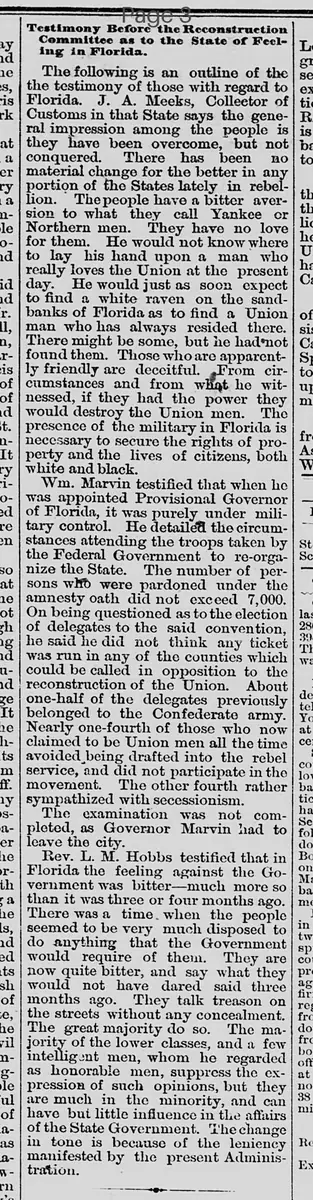
The following is an outline of the testimony of those with regard to Florida. J. A. Meeks, Collector of Customs in that State says the general impression among the people is they have been overcome, but not conquered. There has been no material change for the better in any portion of the States lately in rebellion. The people have a bitter aversion to what they call Yankee or Northern men. They have no love for them. He would not know where to lay his hand upon a man who really loves the Union at the present day. He would just as soon expect to find a white raven on the sandbanks of Florida as to find a Union man who has always resided there. There might be some, but he had not found them. Those who are apparently friendly are deceitful. From circumstances and from what he witnessed, if they had the power they would destroy the Union men. The presence of the military in Florida is necessary to secure the rights of property and the lives of citizens, both white and black.
Wm. Marvin testified that when he was appointed Provisional Governor of Florida, it was purely under military control. He detailed the circumstances attending the troops taken by the Federal Government to re-organize the State. The number of persons who were pardoned under the amnesty oath did not exceed 7,000.
On being questioned as to the election of delegates to the said convention, he said he did not think any ticket was run in any of the counties which could be called in opposition to the reconstruction of the Union. About one-half of the delegates previously belonged to the Confederate army. Nearly one-fourth of those who now claimed to be Union men all the time avoided being drafted into the rebel service, and did not participate in the movement. The other fourth rather sympathized with secessionism.
The examination was not completed, as Governor Marvin had to leave the city.
Rev. L. M. Hobbs testified that in Florida the feeling against the Government was bitter — much more so than it was three or four months ago. There was a time when the people seemed to be very much disposed to do anything that the Government would require of them. They are now quite bitter, and say what they would not have dared said three months ago. They talk treason on the streets without any concealment. The great majority do so. The majority of the lower classes, and a few intelligent men, whom he regarded as honorable men, suppress the expression of such opinions, but they are much in the minority, and can have but little influence in the affairs of the State Government. The change in tone is because of the leniency manifested by the present Administration.
What sub-type of article is it?
What keywords are associated?
What entities or persons were involved?
Where did it happen?
Domestic News Details
Primary Location
Florida
Key Persons
Outcome
no material change for the better; bitter aversion to union; military presence necessary for security; increasing bitterness and open treason talk due to leniency.
Event Details
Outlines of testimonies before the Reconstruction Committee: J. A. Meeks describes Floridians as overcome but not conquered, with deceitful anti-Union sentiments requiring military protection. Wm. Marvin details his provisional governorship under military control, amnesty pardons (under 7,000), and delegate elections with Confederate ties. Rev. L. M. Hobbs notes worsening bitterness against the government compared to three-four months ago, with majority expressing treason openly.