Thank you for visiting SNEWPapers!
Sign up free
The Enquirer
Richmond, Henrico County, Virginia
What is this article about?
An article in 'The Enquirer' introduces an ode to Georgiana, Duchess of Devonshire, praising her admiration for William Tell's chapel on Lake Lucerne, symbolizing Swiss liberty. It recounts Tell's legend of resisting Austrian tyranny in 1307, including shooting an apple off his son's head and assassinating Governor Gesler.
Merged-components note: Introductory prose on 'THE MUSE!!' and historical context merged with the following poem 'ODE TO GEORGIANA' as a single literary piece.
Clipping
OCR Quality
Full Text
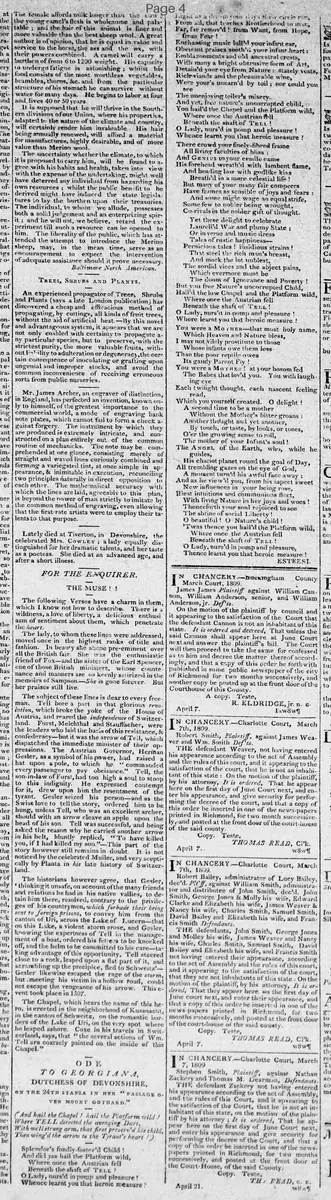
THE MUSE!!
The following Verses have a charm in them, which I know not how to describe. There is a wildness, a love of liberty, a delicious enthusiasm of sentiment about them, which penetrate the heart.
The lady, to whom these lines were addressed, moved once in the highest ranks of title and fashion. In beauty she shone pre-eminent over all the British fair. She was the enthusiastic friend of Fox—and the sister of the Earl Spencer, one of those British ministers, whose countenance and manners are so keenly satirized in the memoirs of Sampson.—She is gone forever. But her praises still live.
The subject of these lines is dear to every freeman. Tell bore a part in that glorious revolution, which broke the yoke of the House of Austria, and reared the independence of Switzerland. Furst, Melchthal and Stauffacher, were the leaders who laid the basis of this resistance, & confederacy—but it was the arrow of Tell, which dispatched the immediate minister of their oppressions. The Austrian Governor, Herman Gesler, as a symbol of his power, had raised a hat upon a pole, to which he commanded every passenger to pay obeisance. Tell, the son-in-law of Furst, had too high a soul to stoop to this indignity. He expressed contempt for it, drew upon him the resentment of the tyrant. Gesler seized his person—and as the Swiss love to tell the story, ordered him to be hung, unless Tell, who was an excellent archer, should with an arrow cleave an apple upon the head of his son. Tell was successful, and being asked the reason why he carried another arrow in his belt, bluntly replied, "To have killed you, if I had killed my son." This part of the story however still remains in doubt. It is not noticed by the celebrated Muller, and very sceptically by Planta in his late history of Switzerland.
The historians however agree, that Gesler, thinking it unsafe, on account of the many friends and relations he had in his native vallies, to detain him there, resolved, contrary to the privileges of his countrymen, which forbade their being sent to foreign prisons, to convey him from the canton of Uri, across the Lake of Lucern—that on this Lake, a violent storm arose, and Gesler, knowing the expertness of Tell in the management of a boat, ordered his fetters to be knocked off, and the helm to be committed to his care—taking advantage of this opportunity, Tell steered close to a rock, leaped upon a flat part of it, and scrambling up the precipice, fled to Schweiz'—Gesler likewise escaped the rage of the storm, but meeting his victim in a hollow road, could not escape the vengeance of his arrow. This event took place in 1307.
The Chapel, which bears the name of this hero, is erected in the neighborhood of Kussnacht, in the canton of Schweiz, on the romantic borders of the Lake of Uri, on the very spot where he leaped ashore. Coxe in his travels in Switzerland, says, that "the several actions of Wm. Tell are coarsely painted on the inside of this Chapel."
ODE
TO GEORGIANA,
DUTCHESS OF DEVONSHIRE.
ON THE 24TH STANZA IN HER "PASSAGE OVER MOUNT GOTHARD."
And hail the Chapel! hail the Platform wild!
Where TELL directed the avenging Dart.
With well strung arm, that first preserv'd his child.
Then wing'd the arrow to the Tyrant's heart!
Splendor's fondly-foster'd Child!
And did you hail the Platform wild.
Where once the Austrian fell
Beneath the shaft of TELL?
O Lady, nurs'd in pomp and pleasure!
Whence learnt you that heroic measure?
Light as a dream your days their circle ran.
From all, that teaches Brotherhood to man,
Far, far remov'd : from Want, from Hope, from Fear!
Enchanting music lull'd your infant ear,
Obeisant praises sooth'd your infant heart :
Emblazonments and old ancestral crests,
With many a bright obtrusive form of Art,
Detain'd your eye from Nature : stately vests,
Rich viands and the pleasurable wine,
Were your's unearn'd by toil : nor could you see
The unenjoying toiler's misery.
And yet, free nature's uncorrupted child.
You hail'd the Chapel and the Platform wild,
Where once the Austrian fell
Beneath the shaft of TELL!
O Lady, nurs'd in pomp and pleasure!
Whence learnt you that heroic measure?
There crowd your finely-fibred frame
All living faculties of bliss :
And Genius to your cradle came
His forehead wreath'd with lambent flame,
And bending low with godlike kiss
Breath'd in a mere celestial life!
But many of your many fair compeers
Have frames as sensible of joys and fears :
And some might wage an equal strife,
Some few to nobler being wrought,
Co-rivals in the nobler gift of thought.
Yet these delight to celebrate
Laurell'd War and plumy State
Or in verse and music dress
Tales of rustic happiness—
Pernicious tales! insidious strains!
That steel the rich man's breast,
And mock the lot unblest,
The sordid vices and the abject pains,
Which evermore must be
The doom of Ignorance and Poverty!
But you free Nature's uncorrupted Child,
Hail'd the low Chapel and the Platform wild,
Where once the Austrian fell
Beneath the shaft of TELL!
O Lady, nurs'd in pomp and pleasure!
Whence learnt you that heroic measure?
You were a Mother—that most holy name,
Which Heaven and Nature bless,
I may not vilely prostitute to those
Whose infants owe them less
Than the poor reptile owes
Its gaudy Parent Fly!
You were a Mother! at your bosom fed
The Babes that lov'd you. You with laughing eve
Each twilight thought, each nascent feeling read,
Which you yourself created. O delight!
A second time to be a mother
Without the Mother's bitter groans :
Another thought and yet another,
By touch, or taste, by looks, or tones,
O'er the growing sense to roll,
The mother of your Infant's soul!
The Angel of the Earth, who, while he guides,
His chariot planet round the goal of Day,
All trembling gazes on the eye of God,
A moment turn'd his awful face away;
And as he view'd you, from his aspect sweet
New influences in your being rose,
Blest intuitions and communions fleet,
With living Nature in her joys and woes!
Thenceforth your soul rejoiced to see
The shrine of social liberty!
O beautiful! O Nature's child!
Twas thence you hail'd the Platform wild,
Where once the Austrian fell
Beneath the shaft of TELL!
O Lady, nurs'd in pomp and pleasure
Thence learnt you that heroic measure!
What sub-type of article is it?
What themes does it cover?
What keywords are associated?
Literary Details
Title
Ode To Georgiana, Dutchess Of Devonshire. On The 24th Stanza In Her "Passage Over Mount Gothard."
Subject
On The 24th Stanza In Her "Passage Over Mount Gothard."
Key Lines