Thank you for visiting SNEWPapers!
Sign up free
Editorial
April 10, 1805
The National Intelligencer And Washington Advertiser
Washington, District Of Columbia
What is this article about?
Editorial from Washington City discusses restoring miscellaneous content to the paper after covering national proceedings. Emphasizes the need for public vigilance on political principles to preserve liberty, avoid government abuses, and promote internal improvements and education under the current administration.
Clipping
OCR Quality
95%
Excellent
Full Text
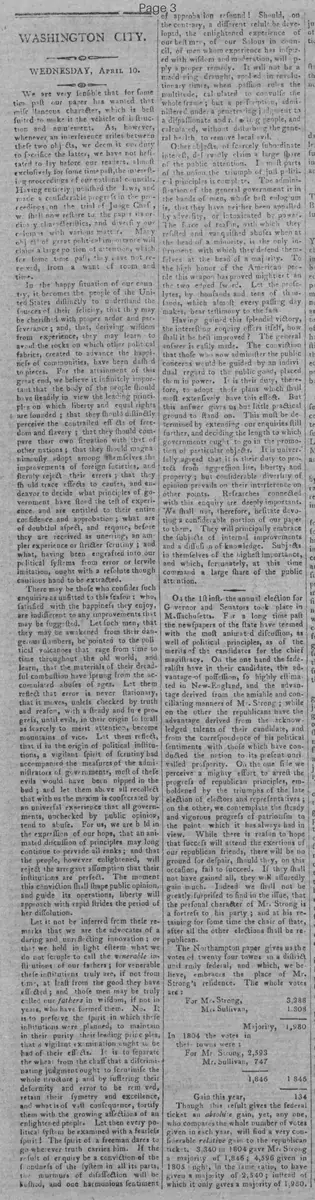
WASHINGTON CITY.
WEDNESDAY, APRIL 10.
We are very sensible that for some time past our paper has wanted that miscellaneous character, which is best fitted to make it the vehicle of instruction and amusement. As, however, whenever an interference arises between these two objects, we deem it our duty to sacrifice the latter, we have not hesitated to lay before our readers, almost exclusively for some time past, the interesting proceedings of our national councils. Having entirely published the laws, and made a considerable progress in the proceedings on the trial of Judge Chase, we shall now restore to the paper its ordinary characteristics, and diversify our columns with various matter. Many objects of great political importance will claim a large portion of attention, which for some time past, they have not received, from a want of room and time.
In the happy situation of our country, it becomes the people of the United States distinctly to understand the sources of their felicity, that they may be cherished with proper ardor and perseverance; and, that, deriving wisdom from experience, they may learn to avoid the rocks on which other political fabrics, created to advance the happiness of communities, have been dashed to pieces. For the attainment of this great end, we believe it infinitely important that the body of the people should have steadily in view the leading principles on which liberty and equal rights are founded; that they should distinctly perceive the contrasted effects of freedom and slavery: that they should compare their own situation with that of other nations; that they should magnanimously adopt among themselves the improvements of foreign societies, and sternly reject their errors; that they should trace effects to causes, and endeavor to decide what principles of government have stood the test of experience, and are entitled to their entire confidence and approbation; what are of doubtful aspect, and require, before they are received as unerring, an ampler experience or stricter scrutiny; and what, having been engrafted into our political systems from error or servile imitation, ought with a resolute though cautious hand to be extracted.
There may be those who consider such enquiries as unsuited to this season; who, satisfied with the happiness they enjoy, are indifferent to any improvements that may be suggested. Let such men, that they may be awakened from their dangerous slumbers, be pointed to the political volcanoes that rage from time to time throughout the old world, and learn, that the materials of their dreadful combustion have sprung from the accumulated abuses of ages. Let them reflect that error is never stationary, that it moves, unless checked by truth and reason, with a steady and sure progress, until evils, in their origin so small as scarcely to merit attention, become mountains of vice. Let them reflect, that if in the origin of political institutions, a vigilant spirit of scrutiny had accompanied the measures of the administrators of governments, most of these evils would have been nipped in the bud: and let them above all recollect that with us the maxim is consecrated by an universal experience that all governments, unchecked by public opinion, tend to abuse. For us, we are bold in the expression of our hope, that an animated discussion of principles may long continue to pervade all ranks; and that the people, however enlightened, will reject the arrogant assumption that their institutions are perfect. The moment this conviction shall shape public opinion, and guide its operations, liberty will approach with rapid strides the period of her dissolution.
Let it not be inferred from these remarks that we are the advocates of a daring and unreflecting innovation; or that we hold in light esteem what we do not scruple to call the venerable institutions of our fathers; for venerable these institutions truly are, if not from time, at least from the good they have effected; and those men may be truly called our fathers in wisdom, if not in years, who have formed them. No. It is to preserve the spirit in which these institutions were planned, to maintain in their purity their leading principles, that a vigilant examination ought to be had of their effects. It is to separate the wheat from the chaff that a discriminating judgment ought to scrutinize the whole structure; and by suffering their deformity and error to be removed, retain their symmetry and excellence, and what is of vast consequence, fortify them with the growing affections of an enlightened people. Let then every political system be examined with a fearless spirit! The spirit of a freeman dares to go wherever truth carries him. If the result of enquiry be a conviction of the soundness of the system in all its parts, the murmurs of disaffection will be hushed, and one harmonious sentiment of approbation resound! Should, on the contrary, a different result be developed, the enlightened experience of our best men, of our Solons in council, of men whom experience has inspired with wisdom and moderation, will apply a proper remedy. It will not be a maddening draught, applied in revolutionary times, when passion rules the multitude, calculated to convulse the whole frame; but a prescription, administered under a penetrating judgment to a dispassionate and religious people, and calculated, without disturbing the general health to remove local evil.
Other objects, of scarcely subordinate interest, deserve claim a large share of the public attention. In most parts of the union the triumph of just political principles is complete. The administration of the general government is in the hands of men, whose best eulogium is, that they have neither been appalled by adversity, or intoxicated by power. The force of reason, with which they resisted and vanquished abuses when at the head of a minority, is the only instrument with which they defend themselves at the head of a majority. To the high honor of the American people this weapon has proved mightier than the two edged sword. Let the proselytes, by thousands and tens of thousands, which almost every passing day makes, bear testimony to the fact. Having gained this splendid victory, the interesting enquiry offers itself, how shall it be best improved? The general answer is easily made. The conviction that those who now administer the public concerns would be guided by an individual regard to the public good, placed them in power. It is their duty, therefore, to adopt those plans which shall most extensively have this effect. But this answer gives us but little practical ground to stand on. This must be determined by extending our enquiries still further, and deciding the length to which governments ought to go in the promotion of particular objects. It is universally agreed that it is their duty to protect from aggression life, liberty, and property; but considerable diversity of opinion prevails on their interference on other points. Researches connected with this enquiry are deeply important. We shall not, therefore, hesitate devoting a considerable portion of our paper to them. They will principally embrace the subjects of internal improvements and a diffusion of knowledge. Subjects in themselves of the highest importance, and which, fortunately, at this time command a large share of the public attention.
WEDNESDAY, APRIL 10.
We are very sensible that for some time past our paper has wanted that miscellaneous character, which is best fitted to make it the vehicle of instruction and amusement. As, however, whenever an interference arises between these two objects, we deem it our duty to sacrifice the latter, we have not hesitated to lay before our readers, almost exclusively for some time past, the interesting proceedings of our national councils. Having entirely published the laws, and made a considerable progress in the proceedings on the trial of Judge Chase, we shall now restore to the paper its ordinary characteristics, and diversify our columns with various matter. Many objects of great political importance will claim a large portion of attention, which for some time past, they have not received, from a want of room and time.
In the happy situation of our country, it becomes the people of the United States distinctly to understand the sources of their felicity, that they may be cherished with proper ardor and perseverance; and, that, deriving wisdom from experience, they may learn to avoid the rocks on which other political fabrics, created to advance the happiness of communities, have been dashed to pieces. For the attainment of this great end, we believe it infinitely important that the body of the people should have steadily in view the leading principles on which liberty and equal rights are founded; that they should distinctly perceive the contrasted effects of freedom and slavery: that they should compare their own situation with that of other nations; that they should magnanimously adopt among themselves the improvements of foreign societies, and sternly reject their errors; that they should trace effects to causes, and endeavor to decide what principles of government have stood the test of experience, and are entitled to their entire confidence and approbation; what are of doubtful aspect, and require, before they are received as unerring, an ampler experience or stricter scrutiny; and what, having been engrafted into our political systems from error or servile imitation, ought with a resolute though cautious hand to be extracted.
There may be those who consider such enquiries as unsuited to this season; who, satisfied with the happiness they enjoy, are indifferent to any improvements that may be suggested. Let such men, that they may be awakened from their dangerous slumbers, be pointed to the political volcanoes that rage from time to time throughout the old world, and learn, that the materials of their dreadful combustion have sprung from the accumulated abuses of ages. Let them reflect that error is never stationary, that it moves, unless checked by truth and reason, with a steady and sure progress, until evils, in their origin so small as scarcely to merit attention, become mountains of vice. Let them reflect, that if in the origin of political institutions, a vigilant spirit of scrutiny had accompanied the measures of the administrators of governments, most of these evils would have been nipped in the bud: and let them above all recollect that with us the maxim is consecrated by an universal experience that all governments, unchecked by public opinion, tend to abuse. For us, we are bold in the expression of our hope, that an animated discussion of principles may long continue to pervade all ranks; and that the people, however enlightened, will reject the arrogant assumption that their institutions are perfect. The moment this conviction shall shape public opinion, and guide its operations, liberty will approach with rapid strides the period of her dissolution.
Let it not be inferred from these remarks that we are the advocates of a daring and unreflecting innovation; or that we hold in light esteem what we do not scruple to call the venerable institutions of our fathers; for venerable these institutions truly are, if not from time, at least from the good they have effected; and those men may be truly called our fathers in wisdom, if not in years, who have formed them. No. It is to preserve the spirit in which these institutions were planned, to maintain in their purity their leading principles, that a vigilant examination ought to be had of their effects. It is to separate the wheat from the chaff that a discriminating judgment ought to scrutinize the whole structure; and by suffering their deformity and error to be removed, retain their symmetry and excellence, and what is of vast consequence, fortify them with the growing affections of an enlightened people. Let then every political system be examined with a fearless spirit! The spirit of a freeman dares to go wherever truth carries him. If the result of enquiry be a conviction of the soundness of the system in all its parts, the murmurs of disaffection will be hushed, and one harmonious sentiment of approbation resound! Should, on the contrary, a different result be developed, the enlightened experience of our best men, of our Solons in council, of men whom experience has inspired with wisdom and moderation, will apply a proper remedy. It will not be a maddening draught, applied in revolutionary times, when passion rules the multitude, calculated to convulse the whole frame; but a prescription, administered under a penetrating judgment to a dispassionate and religious people, and calculated, without disturbing the general health to remove local evil.
Other objects, of scarcely subordinate interest, deserve claim a large share of the public attention. In most parts of the union the triumph of just political principles is complete. The administration of the general government is in the hands of men, whose best eulogium is, that they have neither been appalled by adversity, or intoxicated by power. The force of reason, with which they resisted and vanquished abuses when at the head of a minority, is the only instrument with which they defend themselves at the head of a majority. To the high honor of the American people this weapon has proved mightier than the two edged sword. Let the proselytes, by thousands and tens of thousands, which almost every passing day makes, bear testimony to the fact. Having gained this splendid victory, the interesting enquiry offers itself, how shall it be best improved? The general answer is easily made. The conviction that those who now administer the public concerns would be guided by an individual regard to the public good, placed them in power. It is their duty, therefore, to adopt those plans which shall most extensively have this effect. But this answer gives us but little practical ground to stand on. This must be determined by extending our enquiries still further, and deciding the length to which governments ought to go in the promotion of particular objects. It is universally agreed that it is their duty to protect from aggression life, liberty, and property; but considerable diversity of opinion prevails on their interference on other points. Researches connected with this enquiry are deeply important. We shall not, therefore, hesitate devoting a considerable portion of our paper to them. They will principally embrace the subjects of internal improvements and a diffusion of knowledge. Subjects in themselves of the highest importance, and which, fortunately, at this time command a large share of the public attention.
What sub-type of article is it?
Constitutional
Infrastructure
Education
What keywords are associated?
Political Principles
Government Scrutiny
Liberty Preservation
Internal Improvements
Diffusion Of Knowledge
Public Opinion
Constitutional Vigilance
What entities or persons were involved?
American People
Administrators Of Government
Solons In Council
Editorial Details
Primary Topic
Vigilant Scrutiny Of Political Institutions And Promotion Of Internal Improvements And Education
Stance / Tone
Advocacy For Ongoing Public Discourse And Cautious Reform
Key Figures
American People
Administrators Of Government
Solons In Council
Key Arguments
Public Must Understand Sources Of Felicity To Preserve Liberty
Vigilant Scrutiny Prevents Government Abuses
Compare Us Situation With Other Nations To Adopt Improvements And Reject Errors
Reject Assumption That Institutions Are Perfect To Avoid Liberty's Dissolution
Preserve Spirit Of Venerable Institutions Through Examination
Current Administration Guided By Reason And Public Good
Government Duty To Protect Life, Liberty, Property; Debate Further Interference
Devote Attention To Internal Improvements And Diffusion Of Knowledge