Thank you for visiting SNEWPapers!
Sign up free
Editorial
September 24, 1814
The Enquirer
Richmond, Henrico County, Virginia
What is this article about?
Editorial urges unity in the War of 1812, highlighting British attacks on Massachusetts towns like Eastport and Castine, criticizing past Federalist opposition, and calling for defense efforts and rejection of separatism. Quotes and comments on a Boston Gazette piece to promote national solidarity against invasion.
Clipping
OCR Quality
95%
Excellent
Full Text
Richmond, (Va.) Saturday, September 4, 1814.
OUR COUNTRY—NO. 2.
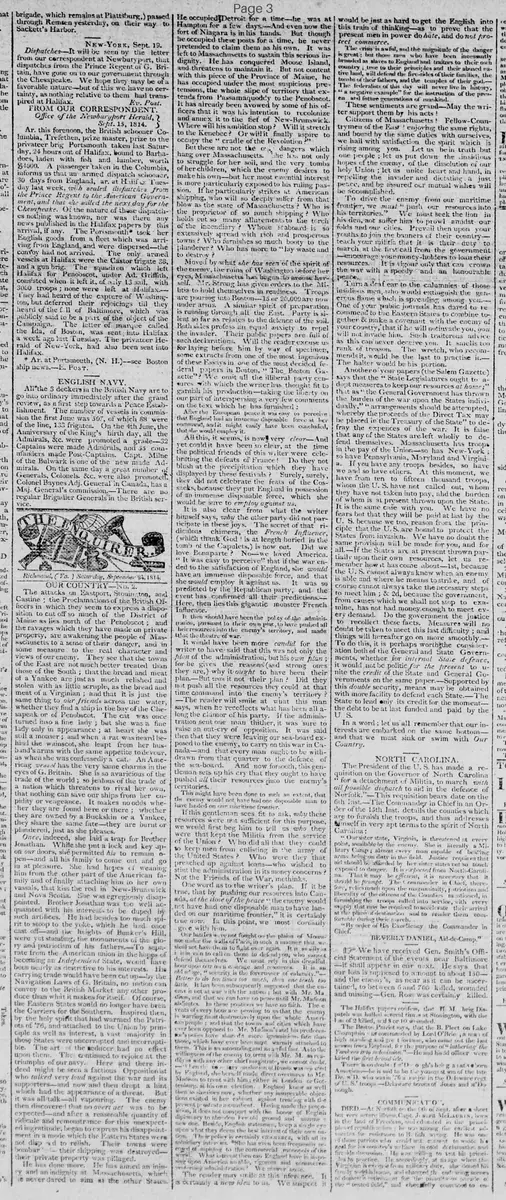
The attacks on Eastport, Stonington, and Castine; the Proclamations of the British Officers in which they seem to express a disposition to cut off so much of the District of Maine as lies north of the Penobscot; and the ravages which they have made on private property, are awakening the people of Massachusetts to a sense of their danger, and in some measure to the real character and views of our enemy. They see that the towns of the East are not much better treated than those of the South; that the bread and meat of a Yankee are just as much relished and stolen with as little scruple, as the bread and meat of a Virginian; and that it is just the same thing to our friends across the water, whether they find a ship in the bay of the Chesapeake or of Penobscot. The cat was once turned into a fine lady; but she was a fine lady only in appearance; at heart she was still a mouser: and when a rat was heard behind the wainscot, she leapt from her husband's arms with the same appetite to devour, as when she was confessedly a cat. An American vessel has the very same charms in the eyes of G. Britain. She is so avaricious of the trade of the world; so jealous of the trade of a nation which threatens to rival her own, that nothing can save our ships from her cupidity or vengeance. It makes no odds whether they are found here or there; whether they are owned by a Buckskin or a Yankee, they share the same fate—they are burnt or plundered, just as she pleases.
Once, indeed, she laid a trap for Brother Jonathan. While she put a lock and key upon our doors, she permitted his to remain open—and all his family to come out and go in at pleasure. She had hopes of weaning him from the other part of the American family and of finally attaching him to her own vassals, that kiss the rod in New-Brunswick and Nova Scotia. She was egregiously disappointed. Brother Jonathan was too well acquainted with his interests to be duped by such artifices. "He had besides too much spirit to stoop to the yoke, which he had once cast off—and the heights of Bunker's Hill, were yet standing, the monuments of the glory and patriotism of his fathers.—To separate from the American union in the hopes of becoming an Independent State, would have been nearly as destructive to his interests. His carrying trade would have been cut up—by the Navigation Laws of G. Britain, no nation can convey to the British Market any other produce than what it makes for itself.' Of course, the Eastern States would no longer have been the Carriers for the Southern. Inspired then, by the holy spirit that had warmed the Patriots of '76, and attached to the Union by principle as well as interest, a vast majority in those States were uncorrupted and incorruptible. The art of the seducer had no effect upon them. They continued to rejoice at the triumphs of our navy. Here and there indeed might be seen a factious Oppositionist who talked very loud against the war and its supporters—and now and then dropt a hint which had the appearance of a threat. But it was all talk—all vapouring. The enemy then discovered that no overt act was to be expected—and after a reasonable quantity of ridicule and remonstrance for this unexpected ingratitude, began to express his disappointment in a mode which the Eastern States were not disposed to relish. Their towns were bombarded—their shipping was destroyed—their private property was pillaged.
He has done more. He has aimed an injury and an indignity at Massachusetts, which he never dared to aim at the other States. He occupied Detroit for a time—he was at Hampton for a few days.—And even now the fort of Niagara is in his hands. But though he occupied these posts for a time, he never pretended to claim them as his own. It was left to Massachusetts to sustain this serious indignity. He has conquered Moose Island, and threatens to maintain it. But not content with this piece of the Province of Maine, he has occupied under the most suspicious pretensions, the whole stripe of territory that extends from Passamaquoddy to the Penobscot. It has already been avowed by some of his officers that it was his intention to recolonize and annex it to the fief of New-Brunswick. Where will his ambition stop? Will it stretch to the Kennebec? Or will it finally aspire to occupy the "cradle of the Revolution?"
But these are not the only dangers which hang over Massachusetts. She has not only to struggle for her soil, and the very tombs of her children, which the enemy desires to make his own—but her most essential interest is more particularly exposed to his ruling passion. If he particularly strikes at American shipping, who will so deeply suffer from that blow as the state of Massachusetts? Who is the proprietor of so much shipping? Who holds out so many allurements to the torch of the incendiary? Whose seaboard is so extensively spread with rich and prosperous towns? Who furnishes so much booty to the plunderer? Who has more to "lay waste and to destroy?"
Moved by what she has seen of the spirit of the enemy, the ruins of Washington before her eyes, Massachusetts has begun to arouse herself." Mr. Strong has given orders to the Militia to hold themselves in readiness. Troops are pouring into Boston—15 or 20,000 are now under arms. A similar spirit of preparation is running through all the East. Party is silent so far as relates to the defence of the soil. Both sides profess an equal anxiety to repel the invader. Their public papers are full of such declarations. Will the reader excuse us for laying before him by way of specimen, some extracts from one of the most ingenious of these Essays in one of the most decided federal papers in Boston, "The Boston Gazette"? We omit all the illiberal party censures with which the writer has thought fit to garnish his production—taking the liberty on our part of interspersing a very few comments on the text which he has furnished:
After the European peace it was easy to perceive that England had an immense disposable force at her command, and it might easily have been concluded, that she would employ it.
All this, it seems, is now "very clear"—And yet could it have been so clear, at the time the political friends of this writer were celebrating the defeats of France! Do they not blush at the precipitation which they have displayed by these festivals? Surely, surely, they did not celebrate the feats of the Cossacks, because they put England in possession of an immense disposable force, which she would be sure to employ against us.
It is also clear from what the writer himself says, why the other party did not participate in these joys. The secret of that ridiculous chimera, the French Influence, (which thank God! is at length buried in the tomb of the Capulets,) is now out. Did we love Bonaparte? No—we loved America.
"It was easy to perceive" that if the war ended to the satisfaction of England, she would have an immense disposable force, and that she would employ it against us. It was so predicted by the Republican party, and the event has confirmed all their predictions.—
Here, then lies this gigantic monster French Influence.
It then should have been the policy of the administration, pursuant to their own plan, to have pushed all their resources into the enemy's territory, and made that the theatre of war.
It would have been more candid for the writer to have said that this was not only the plan of the administration, but his own plan; for he gives the reasons (and strong ones they are,) why it ought to have been their plan.—But was it not their plan? Did they not push all the resources they could at that time command into the enemy's territory?
—The reader will smile at what this man says, when he recollects what has been all along the clamor of his party. If the administration sent one man thither, it was sure to raise an out-cry of opposition. It was said then that they were leaving our sea-board exposed to the enemy, to carry on this war in Canada—and that every man ought to be withdrawn from that quarter to the defence of the sea-board. And now forsooth, this gentleman sets up his cry that they ought to have pushed all their resources into the enemy's territories.
This might have been done to such an extent, that the enemy would not have had one disposable man to have landed on our maritime frontier.
If this gentleman sees fit to ask, why these resources were not sufficient for this purpose, we would first beg him to tell us who they were that kept the Militia from the service of the Union? Who did all that they could to keep men from enlisting in the army of the United States? Who were they that preached up against loans—who wished to stint the administration in its money concerns?
Not the Friends of the War. methinks.
One word as to the writer's plan. If it be true, that by pushing our resources into Canada, at the time of the peace "the enemy would not have had one disposable man to have landed on our maritime frontier," it is certainly true now. In this point, we most cordially agree with him.
Our battles were not fought on the plains of Moscow—nor under the walls of Paris, in such a manner that we shall not have them to fight over again. It is as silly as it is in vain to call on those to defend you, who cannot defend themselves. We must rely in this dreadful hour upon our own courage and resources. It is an old adage, "security is the forerunner of calamity."
Better to do ten times too much, than one tenth too little. It has been subsequently suggested that the enemy is not at war with the nation; but with Mr. Madison, and that we can have no peace until Mr. Madison abdicates. In these positions we have no faith. The events of every hour are proving to us that the enemy is warring most destructively upon the whole American people; and that the towns and cities which have ever been opposed to Mr. Madison's and his predecessor's policy have shared a more ignominious fate than those, which have ever been most warmly attached to them. This is an astounding and an awful fact. As to the willingness of the enemy to treat with Mr. M. as readily as with any other chief magistrate, we cannot doubt.
—Featherly overtures of negotiation passed with England, she herself. If made direct overtures to Mr. Madison to treat with him: either in London or Gottenburg, at his own election. England knew as well then as she does now, whether any insuperable objections existed in her cabinet against treating with the present prostrate incumbent. Having made the proposition, It does not comport with the honor of English diplomacy to abandon her old ground and assume a new one. Beside, English statesmen, keep a single eye upon what they deem the best interest of their own nation. Their policy is certainly commercial, with all its subsidiary interests. She has even been frequently accused of aspiring to the commercial monopoly of the world. What interest then can England have in imposing upon America an illiterate, rigorous and commerce-wrid-eing administration? We answer none.
The reader may smile at this inference. It is certainly a new idea to us. We suspect it would be just as hard to get the English into this train of thinking—as to prove that the present men in power do hate, and do not protect commerce.
The crisis is awful, and the magnitude of the danger is great: but those men who have been incessantly branded as slaves to England and traitors to their own country; true to their principles and their abused native land, will defend the fire-sides of their families, the tombs of their fathers, and the temples of their god.—
The federalists of this day will never live in history, "a negative example" for the instruction of the present and future generations of mankind.
These sentiments are grand—May the writer support them by his acts!
Citizens of Massachusetts! Fellow-Countrymen of the East! enjoying the same rights, and bound by the same duties with ourselves, we hail with satisfaction the spirit which is rising among you. Let us be in truth but one people; let us put down the insidious hopes of the enemy, of the dissolution of our holy Union; let us unite heart and hand, in repelling the invader and dictating a just peace, and be assured our mutual wishes will be accomplished.
To drive the enemy from our maritime frontier, we must "push our resources into his territories." We must seek the lion in his den, not suffer him to prowl amidst our folds and our cities. Prevail then upon your youths to join the banners of their country—
teach your militia that it is their duty to march at the first call from the government
—encourage your money-holders to loan their resources.
It is vigour only that can crown the war with a speedy and an honourable peace.
Turn a deaf ear to the calumnies of those insidious men, who would extinguish the generous flame which is spreading among you.—
One of your public journals has dared to recommend to the Eastern States to combine together & make a covenant with the enemy of your country, that if he will not invade you, you will not invade him. Such traitorous advice as this can never deceive you. It smells too rank of treason. The wretch, who recommends it, would be the last to practise it.—
The halter would be his portion.
Another of your papers (the Salem Gazette) says that the "State Legislatures ought to adopt measures to keep our resources at home;" that as "the General Government has thrown the burden of the war upon the States individually." "arrangements should be attempted, whereby the proceeds of the Direct Tax may be placed in the Treasury of the State" to defray the expences of the war. It is false that any of the States are left wholly to defend themselves. Massachusetts has troops in the pay of the Union—so has New-York: so have Pennsylvania, Maryland and Virginia. If you have any troops besides, so have we and so have others. At this moment, we have from ten to fifteen thousand troops, whom the U. S. have not called out, whom they have not taken into pay, and the burden of whom is at present thrown upon the State. It is the same case with you. We have no fears but that they will be paid at last by the U. S. because we too, reason from the principle that the U.S. are bound to protect the States from invasion. We have no doubt the same provision will be made for you, and for all. If the States are at present thrown partially upon their own resources, let us remember how it has come about—1st, because the U. S. cannot always know when an enemy is able and where he means to strike, and of course cannot always take the necessary steps to meet him; & 2d, because the government, from causes which we shall not stop to examine, has not had money enough to meet every demand. Do the government the justice to recollect these facts. Measures will no doubt be taken to meet this last difficulty; and things will hereafter go on more smoothly.—
To do this, it is perhaps worth the consideration both of the General and State Governments, whether for internal State defence, it would not be politic for the present to unite the credit of the State and General Governments on the same paper.—Supported by this double security, means may be obtained with more facility to defend each State.—The State to lend only its credit for the moment—
the debt to be at last funded and paid by the U. S.
In a word; let us all remember that our interests are embarked on the same bottom—and that we must sink or swim with Our Country.
OUR COUNTRY—NO. 2.
The attacks on Eastport, Stonington, and Castine; the Proclamations of the British Officers in which they seem to express a disposition to cut off so much of the District of Maine as lies north of the Penobscot; and the ravages which they have made on private property, are awakening the people of Massachusetts to a sense of their danger, and in some measure to the real character and views of our enemy. They see that the towns of the East are not much better treated than those of the South; that the bread and meat of a Yankee are just as much relished and stolen with as little scruple, as the bread and meat of a Virginian; and that it is just the same thing to our friends across the water, whether they find a ship in the bay of the Chesapeake or of Penobscot. The cat was once turned into a fine lady; but she was a fine lady only in appearance; at heart she was still a mouser: and when a rat was heard behind the wainscot, she leapt from her husband's arms with the same appetite to devour, as when she was confessedly a cat. An American vessel has the very same charms in the eyes of G. Britain. She is so avaricious of the trade of the world; so jealous of the trade of a nation which threatens to rival her own, that nothing can save our ships from her cupidity or vengeance. It makes no odds whether they are found here or there; whether they are owned by a Buckskin or a Yankee, they share the same fate—they are burnt or plundered, just as she pleases.
Once, indeed, she laid a trap for Brother Jonathan. While she put a lock and key upon our doors, she permitted his to remain open—and all his family to come out and go in at pleasure. She had hopes of weaning him from the other part of the American family and of finally attaching him to her own vassals, that kiss the rod in New-Brunswick and Nova Scotia. She was egregiously disappointed. Brother Jonathan was too well acquainted with his interests to be duped by such artifices. "He had besides too much spirit to stoop to the yoke, which he had once cast off—and the heights of Bunker's Hill, were yet standing, the monuments of the glory and patriotism of his fathers.—To separate from the American union in the hopes of becoming an Independent State, would have been nearly as destructive to his interests. His carrying trade would have been cut up—by the Navigation Laws of G. Britain, no nation can convey to the British Market any other produce than what it makes for itself.' Of course, the Eastern States would no longer have been the Carriers for the Southern. Inspired then, by the holy spirit that had warmed the Patriots of '76, and attached to the Union by principle as well as interest, a vast majority in those States were uncorrupted and incorruptible. The art of the seducer had no effect upon them. They continued to rejoice at the triumphs of our navy. Here and there indeed might be seen a factious Oppositionist who talked very loud against the war and its supporters—and now and then dropt a hint which had the appearance of a threat. But it was all talk—all vapouring. The enemy then discovered that no overt act was to be expected—and after a reasonable quantity of ridicule and remonstrance for this unexpected ingratitude, began to express his disappointment in a mode which the Eastern States were not disposed to relish. Their towns were bombarded—their shipping was destroyed—their private property was pillaged.
He has done more. He has aimed an injury and an indignity at Massachusetts, which he never dared to aim at the other States. He occupied Detroit for a time—he was at Hampton for a few days.—And even now the fort of Niagara is in his hands. But though he occupied these posts for a time, he never pretended to claim them as his own. It was left to Massachusetts to sustain this serious indignity. He has conquered Moose Island, and threatens to maintain it. But not content with this piece of the Province of Maine, he has occupied under the most suspicious pretensions, the whole stripe of territory that extends from Passamaquoddy to the Penobscot. It has already been avowed by some of his officers that it was his intention to recolonize and annex it to the fief of New-Brunswick. Where will his ambition stop? Will it stretch to the Kennebec? Or will it finally aspire to occupy the "cradle of the Revolution?"
But these are not the only dangers which hang over Massachusetts. She has not only to struggle for her soil, and the very tombs of her children, which the enemy desires to make his own—but her most essential interest is more particularly exposed to his ruling passion. If he particularly strikes at American shipping, who will so deeply suffer from that blow as the state of Massachusetts? Who is the proprietor of so much shipping? Who holds out so many allurements to the torch of the incendiary? Whose seaboard is so extensively spread with rich and prosperous towns? Who furnishes so much booty to the plunderer? Who has more to "lay waste and to destroy?"
Moved by what she has seen of the spirit of the enemy, the ruins of Washington before her eyes, Massachusetts has begun to arouse herself." Mr. Strong has given orders to the Militia to hold themselves in readiness. Troops are pouring into Boston—15 or 20,000 are now under arms. A similar spirit of preparation is running through all the East. Party is silent so far as relates to the defence of the soil. Both sides profess an equal anxiety to repel the invader. Their public papers are full of such declarations. Will the reader excuse us for laying before him by way of specimen, some extracts from one of the most ingenious of these Essays in one of the most decided federal papers in Boston, "The Boston Gazette"? We omit all the illiberal party censures with which the writer has thought fit to garnish his production—taking the liberty on our part of interspersing a very few comments on the text which he has furnished:
After the European peace it was easy to perceive that England had an immense disposable force at her command, and it might easily have been concluded, that she would employ it.
All this, it seems, is now "very clear"—And yet could it have been so clear, at the time the political friends of this writer were celebrating the defeats of France! Do they not blush at the precipitation which they have displayed by these festivals? Surely, surely, they did not celebrate the feats of the Cossacks, because they put England in possession of an immense disposable force, which she would be sure to employ against us.
It is also clear from what the writer himself says, why the other party did not participate in these joys. The secret of that ridiculous chimera, the French Influence, (which thank God! is at length buried in the tomb of the Capulets,) is now out. Did we love Bonaparte? No—we loved America.
"It was easy to perceive" that if the war ended to the satisfaction of England, she would have an immense disposable force, and that she would employ it against us. It was so predicted by the Republican party, and the event has confirmed all their predictions.—
Here, then lies this gigantic monster French Influence.
It then should have been the policy of the administration, pursuant to their own plan, to have pushed all their resources into the enemy's territory, and made that the theatre of war.
It would have been more candid for the writer to have said that this was not only the plan of the administration, but his own plan; for he gives the reasons (and strong ones they are,) why it ought to have been their plan.—But was it not their plan? Did they not push all the resources they could at that time command into the enemy's territory?
—The reader will smile at what this man says, when he recollects what has been all along the clamor of his party. If the administration sent one man thither, it was sure to raise an out-cry of opposition. It was said then that they were leaving our sea-board exposed to the enemy, to carry on this war in Canada—and that every man ought to be withdrawn from that quarter to the defence of the sea-board. And now forsooth, this gentleman sets up his cry that they ought to have pushed all their resources into the enemy's territories.
This might have been done to such an extent, that the enemy would not have had one disposable man to have landed on our maritime frontier.
If this gentleman sees fit to ask, why these resources were not sufficient for this purpose, we would first beg him to tell us who they were that kept the Militia from the service of the Union? Who did all that they could to keep men from enlisting in the army of the United States? Who were they that preached up against loans—who wished to stint the administration in its money concerns?
Not the Friends of the War. methinks.
One word as to the writer's plan. If it be true, that by pushing our resources into Canada, at the time of the peace "the enemy would not have had one disposable man to have landed on our maritime frontier," it is certainly true now. In this point, we most cordially agree with him.
Our battles were not fought on the plains of Moscow—nor under the walls of Paris, in such a manner that we shall not have them to fight over again. It is as silly as it is in vain to call on those to defend you, who cannot defend themselves. We must rely in this dreadful hour upon our own courage and resources. It is an old adage, "security is the forerunner of calamity."
Better to do ten times too much, than one tenth too little. It has been subsequently suggested that the enemy is not at war with the nation; but with Mr. Madison, and that we can have no peace until Mr. Madison abdicates. In these positions we have no faith. The events of every hour are proving to us that the enemy is warring most destructively upon the whole American people; and that the towns and cities which have ever been opposed to Mr. Madison's and his predecessor's policy have shared a more ignominious fate than those, which have ever been most warmly attached to them. This is an astounding and an awful fact. As to the willingness of the enemy to treat with Mr. M. as readily as with any other chief magistrate, we cannot doubt.
—Featherly overtures of negotiation passed with England, she herself. If made direct overtures to Mr. Madison to treat with him: either in London or Gottenburg, at his own election. England knew as well then as she does now, whether any insuperable objections existed in her cabinet against treating with the present prostrate incumbent. Having made the proposition, It does not comport with the honor of English diplomacy to abandon her old ground and assume a new one. Beside, English statesmen, keep a single eye upon what they deem the best interest of their own nation. Their policy is certainly commercial, with all its subsidiary interests. She has even been frequently accused of aspiring to the commercial monopoly of the world. What interest then can England have in imposing upon America an illiterate, rigorous and commerce-wrid-eing administration? We answer none.
The reader may smile at this inference. It is certainly a new idea to us. We suspect it would be just as hard to get the English into this train of thinking—as to prove that the present men in power do hate, and do not protect commerce.
The crisis is awful, and the magnitude of the danger is great: but those men who have been incessantly branded as slaves to England and traitors to their own country; true to their principles and their abused native land, will defend the fire-sides of their families, the tombs of their fathers, and the temples of their god.—
The federalists of this day will never live in history, "a negative example" for the instruction of the present and future generations of mankind.
These sentiments are grand—May the writer support them by his acts!
Citizens of Massachusetts! Fellow-Countrymen of the East! enjoying the same rights, and bound by the same duties with ourselves, we hail with satisfaction the spirit which is rising among you. Let us be in truth but one people; let us put down the insidious hopes of the enemy, of the dissolution of our holy Union; let us unite heart and hand, in repelling the invader and dictating a just peace, and be assured our mutual wishes will be accomplished.
To drive the enemy from our maritime frontier, we must "push our resources into his territories." We must seek the lion in his den, not suffer him to prowl amidst our folds and our cities. Prevail then upon your youths to join the banners of their country—
teach your militia that it is their duty to march at the first call from the government
—encourage your money-holders to loan their resources.
It is vigour only that can crown the war with a speedy and an honourable peace.
Turn a deaf ear to the calumnies of those insidious men, who would extinguish the generous flame which is spreading among you.—
One of your public journals has dared to recommend to the Eastern States to combine together & make a covenant with the enemy of your country, that if he will not invade you, you will not invade him. Such traitorous advice as this can never deceive you. It smells too rank of treason. The wretch, who recommends it, would be the last to practise it.—
The halter would be his portion.
Another of your papers (the Salem Gazette) says that the "State Legislatures ought to adopt measures to keep our resources at home;" that as "the General Government has thrown the burden of the war upon the States individually." "arrangements should be attempted, whereby the proceeds of the Direct Tax may be placed in the Treasury of the State" to defray the expences of the war. It is false that any of the States are left wholly to defend themselves. Massachusetts has troops in the pay of the Union—so has New-York: so have Pennsylvania, Maryland and Virginia. If you have any troops besides, so have we and so have others. At this moment, we have from ten to fifteen thousand troops, whom the U. S. have not called out, whom they have not taken into pay, and the burden of whom is at present thrown upon the State. It is the same case with you. We have no fears but that they will be paid at last by the U. S. because we too, reason from the principle that the U.S. are bound to protect the States from invasion. We have no doubt the same provision will be made for you, and for all. If the States are at present thrown partially upon their own resources, let us remember how it has come about—1st, because the U. S. cannot always know when an enemy is able and where he means to strike, and of course cannot always take the necessary steps to meet him; & 2d, because the government, from causes which we shall not stop to examine, has not had money enough to meet every demand. Do the government the justice to recollect these facts. Measures will no doubt be taken to meet this last difficulty; and things will hereafter go on more smoothly.—
To do this, it is perhaps worth the consideration both of the General and State Governments, whether for internal State defence, it would not be politic for the present to unite the credit of the State and General Governments on the same paper.—Supported by this double security, means may be obtained with more facility to defend each State.—The State to lend only its credit for the moment—
the debt to be at last funded and paid by the U. S.
In a word; let us all remember that our interests are embarked on the same bottom—and that we must sink or swim with Our Country.
What sub-type of article is it?
War Or Peace
Partisan Politics
Foreign Affairs
What keywords are associated?
War Of 1812
British Invasion
Massachusetts Defense
National Unity
Federalist Opposition
American Shipping
Penobscot Territory
What entities or persons were involved?
Britain
Massachusetts
Mr. Strong
Mr. Madison
Federalists
Republicans
Boston Gazette
Salem Gazette
Editorial Details
Primary Topic
Unity Against British Invasion In War Of 1812
Stance / Tone
Pro Union And Pro War, Urging Defense And Criticizing Opposition
Key Figures
Britain
Massachusetts
Mr. Strong
Mr. Madison
Federalists
Republicans
Boston Gazette
Salem Gazette
Key Arguments
British Attacks Reveal True Enemy Intentions Toward All Americans
Past Attempts To Divide East And South Failed Due To Shared Interests
Massachusetts Faces Unique Territorial Threats From Britain
Federalist Opposition Weakened War Efforts But Now Unity Is Needed
Push Resources Into Enemy Territory To Defend Coasts
Reject Separatism Or Covenants With Enemy As Treason
Federal Government Will Ultimately Support State Defenses