Thank you for visiting SNEWPapers!
Sign up free
Story
March 10, 1842
Lynchburg Virginian
Lynchburg, Virginia
What is this article about?
Praiseworthy account of U.S. Senator Henry Clay's voluntary resignation from public office, lauding his moral integrity, decades of faithful service, and enduring legacy as a patriot who prioritized principles over power and popularity. (187 characters)
Clipping
OCR Quality
98%
Excellent
Full Text
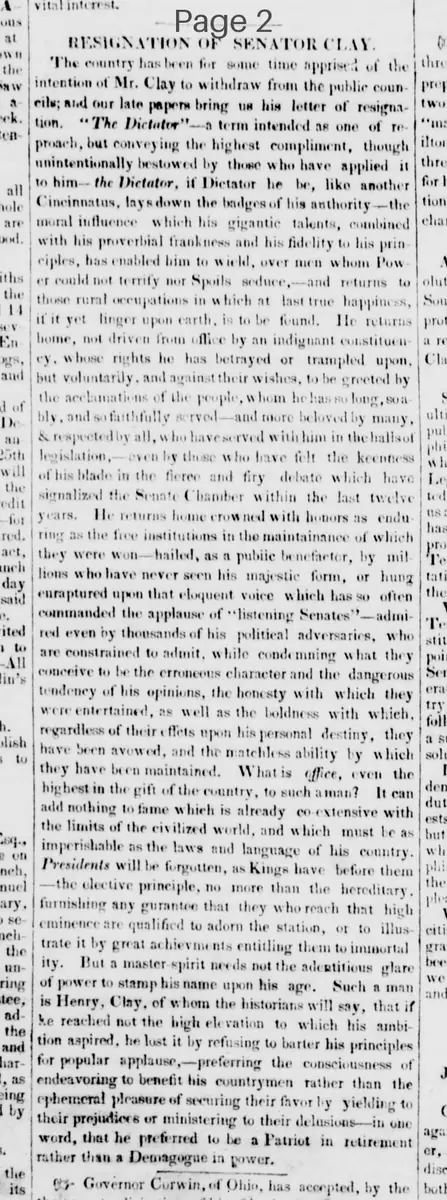
RESIGNATION OF SENATOR CLAY.
The country has been for some time apprised of the intention of Mr. Clay to withdraw from the public councils; and our late papers bring us his letter of resignation. "The Dictator"—a term intended as one of reproach, but conveying the highest compliment, though unintentionally bestowed by those who have applied it to him—the Dictator, if Dictator he be, like another Cincinnatus, lays down the badges of his authority—the moral influence which his gigantic talents, combined with his proverbial frankness and his fidelity to his principles, has enabled him to wield, over men whom Power could not terrify nor Spoils seduce,—and returns to those rural occupations in which at last true happiness, if it yet linger upon earth, is to be found. He returns home, not driven from office by an indignant constituency, whose rights he has betrayed or trampled upon, but voluntarily, and against their wishes, to be greeted by the acclamations of the people, whom he has so long, so ably, and so faithfully served—and more beloved by many, & respected by all, who have served with him in the halls of legislation,—even by those who have felt the keenness of his blade in the fierce and fiery debate which have signalized the Senate Chamber within the last twelve years. He returns home crowned with honors as enduring as the free institutions in the maintenance of which they were won—hailed, as a public benefactor, by millions who have never seen his majestic form, or hung enraptured upon that eloquent voice which has so often commanded the applause of "listening Senates"—admired even by thousands of his political adversaries, who are constrained to admit, while condemning what they conceive to be the erroneous character and the dangerous tendency of his opinions, the honesty with which they were entertained, as well as the boldness with which, regardless of their effects upon his personal destiny, they have been avowed, and the matchless ability by which they have been maintained. What is office, even the highest in the gift of the country, to such a man? It can add nothing to fame which is already co-extensive with the limits of the civilized world, and which must be as imperishable as the laws and language of his country. Presidents will be forgotten, as Kings have before them—the elective principle, no more than the hereditary, furnishing any guarantee that they who reach that high eminence are qualified to adorn the station, or to illustrate it by great achievements entitling them to immortality. But a master spirit needs not the adventitious glare of power to stamp his name upon his age. Such a man is Henry Clay, of whom the historians will say, that if he reached not the high elevation to which his ambition aspired, he lost it by refusing to barter his principles for popular applause,—preferring the consciousness of endeavoring to benefit his countrymen rather than the ephemeral pleasure of securing their favor by yielding to their prejudices or ministering to their delusions—in one word, that he preferred to be a Patriot in retirement rather than a Demagogue in power.
The country has been for some time apprised of the intention of Mr. Clay to withdraw from the public councils; and our late papers bring us his letter of resignation. "The Dictator"—a term intended as one of reproach, but conveying the highest compliment, though unintentionally bestowed by those who have applied it to him—the Dictator, if Dictator he be, like another Cincinnatus, lays down the badges of his authority—the moral influence which his gigantic talents, combined with his proverbial frankness and his fidelity to his principles, has enabled him to wield, over men whom Power could not terrify nor Spoils seduce,—and returns to those rural occupations in which at last true happiness, if it yet linger upon earth, is to be found. He returns home, not driven from office by an indignant constituency, whose rights he has betrayed or trampled upon, but voluntarily, and against their wishes, to be greeted by the acclamations of the people, whom he has so long, so ably, and so faithfully served—and more beloved by many, & respected by all, who have served with him in the halls of legislation,—even by those who have felt the keenness of his blade in the fierce and fiery debate which have signalized the Senate Chamber within the last twelve years. He returns home crowned with honors as enduring as the free institutions in the maintenance of which they were won—hailed, as a public benefactor, by millions who have never seen his majestic form, or hung enraptured upon that eloquent voice which has so often commanded the applause of "listening Senates"—admired even by thousands of his political adversaries, who are constrained to admit, while condemning what they conceive to be the erroneous character and the dangerous tendency of his opinions, the honesty with which they were entertained, as well as the boldness with which, regardless of their effects upon his personal destiny, they have been avowed, and the matchless ability by which they have been maintained. What is office, even the highest in the gift of the country, to such a man? It can add nothing to fame which is already co-extensive with the limits of the civilized world, and which must be as imperishable as the laws and language of his country. Presidents will be forgotten, as Kings have before them—the elective principle, no more than the hereditary, furnishing any guarantee that they who reach that high eminence are qualified to adorn the station, or to illustrate it by great achievements entitling them to immortality. But a master spirit needs not the adventitious glare of power to stamp his name upon his age. Such a man is Henry Clay, of whom the historians will say, that if he reached not the high elevation to which his ambition aspired, he lost it by refusing to barter his principles for popular applause,—preferring the consciousness of endeavoring to benefit his countrymen rather than the ephemeral pleasure of securing their favor by yielding to their prejudices or ministering to their delusions—in one word, that he preferred to be a Patriot in retirement rather than a Demagogue in power.
What sub-type of article is it?
Biography
Historical Event
Personal Triumph
What themes does it cover?
Moral Virtue
Triumph
Bravery Heroism
What keywords are associated?
Henry Clay
Resignation
Senator
Patriotism
Integrity
Public Service
What entities or persons were involved?
Henry Clay
Where did it happen?
United States Senate
Story Details
Key Persons
Henry Clay
Location
United States Senate
Story Details
Henry Clay resigns voluntarily from the Senate, praised for his integrity, faithful service, and preference for patriotism over power, returning to rural life amid public acclaim.